


For those who prefer the author has recorded an audio version
I. Emotional Damage
Last time, I told you that we would discuss what comes next.
But first - housekeeping.
I need to break some things to disabuse you of assumptions you may or may not be aware that you hold as part of being formed by the current Western institutions. Not flippantly, because what I’m breaking is the thing that keeps people in a cycle of repetition that I’ve seen across the country that ends up producing nothing.
To disclose a bit about myself, I was formed outside the public school system - never sat under the strongest installation vector for the mythology I’m about to demolish for more than six months. I’ve retained the naturally inquisitive nature that humans are born with, but in the way that gets you dis-invited from Thanksgiving dinner (thankfully, I’m the cook in my family). I’m an infantryman veteran - trained to close with and destroy the enemies of these United States (which is what I seek to do metaphysically). I’ve spent decades reading philosophy and history, the kind that requires that you hold your beliefs at arm’s length and examine without flinching.
These are advantages of mine, and though they come at cost, I still struggle due to what I’ve absorbed via cultural osmosis.
I held every one of these myths. Every single one. Even after all the research, reading, and years of pulling threads, poking at FOIA files that caused me to be physically unable to look at another word for days while everyone else was celebrating Christmas with their family (true story lol) there are mornings I sit with what I’ve found and check and double check and nothing changes about the assessment. So I keep writing.
If that’s where I am - with every formational advantage stacked in my favour - then I know what this is. You were likely taught these myths as history, as civics, as the way things are (you may even think that you have a Constitutional right to protest). The roots go deeper in you than they ever went in me.
But that’s the first step of standing on terra firma. That said, let’s jaunt.
II. The Myths
Here is the story we were told:
America is self-governance embodied if nothing else. The people are sovereign. Your voice matters equally to mine, to the billionaire’s, to the senator’s, to the President. When We the People stand up, justice prevails, We the People being a statement about how power actually moves through the Republic. The social contract is real: free citizens agreed to mutual governance, and that agreement binds. Merit earns ascent. Work hard, think clearly, build something excellent, and the system elevates you into its leadership class. Your vote is meaningful input into the machinery of governance. Elections hold the powerful accountable, and when they fail us, we remove them. And should all of that fail, the rugged individual - armed, provisioned, self-reliant - stands as the final backstop against tyranny, ready to water the Tree of Liberty.
Unfortunately, this is mythology.
I don’t mean mythology the way a campus postmodernist means it - “your truth is just a narrative, man.” I mean mythology in the way that it is a crafted narrative with an intended effect.
Let’s walk through it all.
**Self-governance.** We laid the foundation for this in the previous article. The American founding was an elite project executed through mass mobilization. Planters, merchants, lawyers, international financiers - they built the infrastructure, cultivated the alliances, and deployed the population as resource-weapons in an elite-versus-elite contest with the British crown. Masses didn’t rise up spontaneously and create America. Elites used masses to create America. I use the word “used” intentionally, because we (the lower and middle classes) aren’t on the same playing field as they (the upper class) and I’m trying to drive that point home. There are memes about with George Washington as the image and the text that says something to the effect of “me and my homies would have been stacking bodies by now” in response to some political injustice. That may be true, but the farmer down the road wouldn’t have had the same impact upon crossing the Delaware river on Christmas. This mythology reverses the arrow of causation because reversed arrows produce compliant resources (us). If you believe the order in which we operate was built by We the People, and if you believe that there were no breaks between the inception and today, then you will (incorrectly) assume that your opinion matters to its current operators.
https://news.stanford.edu/stories/2018/02/americans-dont-think-ear-elected-officials
**The social contract.** As Lysander Spooner observed - and I’m paraphrasing for the family-friendly crowd - he didn’t sign anything. And he was right. A contract binds signatories. A contract is renegotiable. A contract holds only as long as both parties find it useful. And whatever America was built on, it wasn’t a contract.
It was a covenant.
Read the language. Rights endowed by their Creator. Truths held self-evident - apprehended, not constructed. The appeal to the Supreme Judge of the world. The Mayflower Compact before it; the very same structure. This is the language of men standing under God and pledging themselves to an order they did not invent and cannot renegotiate. The covenant is vertical - God and men - with obligations that transcend the parties’ convenience, their moods, their changing circumstances. You don’t renegotiate a covenant. You keep it or you violate it.
Rousseau and Locke told us it was a social contract - horizontal, man-to-man, renegotiable by consensus. Your rights as an ever-changing terms of service. That substitution is the seed of everything that followed. If the foundation is covenant, then the rights are real, the obligations are permanent, the metaphysical architecture is load-bearing and cannot be edited without structural failure. If the foundation is contract, then everything is negotiable, nothing is permanent, and the governing class can amend the terms whenever the masses become less useful to them.
Look around you. Sure looks like they are renegotiating to me (Perot was correct).
Locke provided the crack - grounding natural rights in reason accessible without revelation. Compatible with the covenant, but no longer dependent on it. Later thinkers could keep the rights language, discard the Creator, and ground the whole edifice in human consensus (shadow metaphysics coming to light). The arch of unalienable rights lost its keystone. What you’re watching now, what you feel now - that ambient-turned-explicit wrongness (as made evident by recent file releases as key example) - is the arch completing its collapse. The keystone has been missing for generations. The structure may be exhausting whatever load-bearing capacity remained.
So as the masses become less useful - as automation replaces labour, financial arbitrage replaces production, and migrants replace voting blocks - the elite side of the bargain degrades further. The protection thins. The leadership reorients elsewhere. The metaphysical instantiation shifts toward frameworks amenable to the new useful population, whoever that turns out to be. We’re watching the covenant violated in real time, and they weren’t even polite enough to invite us to witness the violation. We were simply meant not to notice.
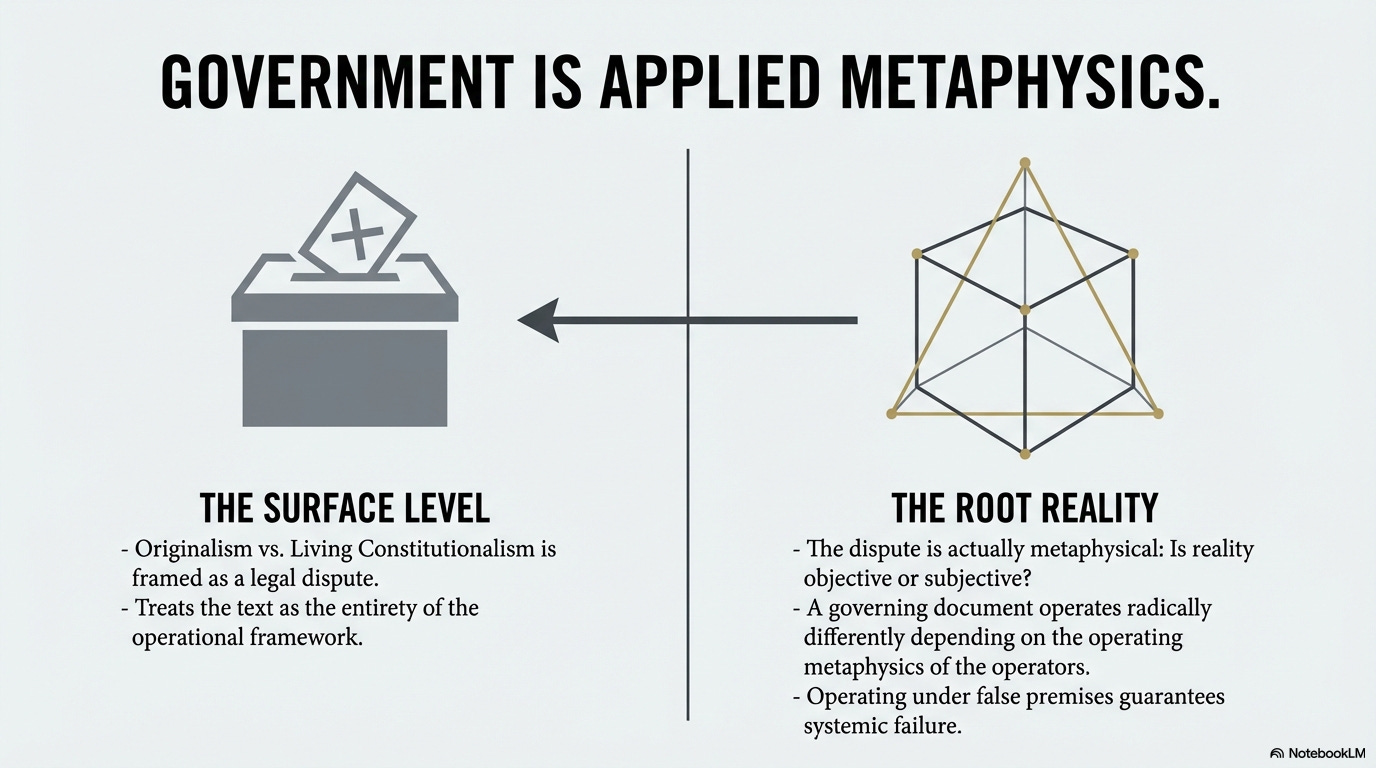
All of this is clarified by the following insight that I had a while ago: government is applied metaphysics. The Constitution doesn’t merely reflect metaphysical premises - the Constitution instantiates them into our daily life. Same document, same words, radically different operative government depending on which metaphysics the operators bring to the text. Originalism versus “living constitutionalism”? That’s a metaphysical dispute by another name. One says the text corresponds to a reality that preceded it. The other says the text means whatever the current consensus declares it to mean. Here’s a question to gnaw upon: what operating metaphysics does our current government hold? That reality is subjective (such as with gender) or objective? And no, you don’t get to choose “both.” A thing can’t be a thing and the opposite at the same time. Aristotle knew that.
**Meritocracy.** Merit exists. It matters. And it is necessary but nowhere near sufficient. You can build the most brilliant enterprise in your county, your state, your industry - and an elite who controls regulatory infrastructure, capital access, and media framing can erase it before lunch. Merit can get you to the table. Patronage pulls a chair out for you. Every self-made man in the American story, when you trace the actual genealogy, had a patron. Had access. Had a door held open by someone already inside. The myth of the purely self-made man serves the same function as the myth of self-governance: it makes you blame yourself when the system doesn’t deliver, instead of examining the system.
**The informed voter.** Informed about what? About the performed framework - the one presented for your consumption? In earlier articles, we discussed Declaration Reality and performed-versus-operative premises. Your vote is input into a system whose actual operation bears minimal resemblance to its advertised operation. You operate under two Constitutions and you only see one because the other is Unwritten. I shan’t discuss the nudging campaigns, but they exist to push you together or pull you apart.
**Accountability through elections.** The Tea Party was a case study of sorts from the previous article. It had massive grassroots mobilization. Historic electoral victories. The institutional machinery metabolized every victory and continued operating as before. The faces changed. The advisory structure didn’t. The policy outputs didn’t. You can replace every elected official in Washington and the permanent bureaucracy, the advisory networks, the donor infrastructure, the institutional momentum all continues. The operative machinery runs beneath, unelected, unaccountable, largely invisible and used to conduct operations that run for longer than a single election cycle. Carroll Quigley (Bill Clinton’s history professor) knew this and wrote about it.
**The rugged individual.** This is the one that costs the most to release, because it feels true in your bones, and the feeling is partly right. The impulse - self-reliance, preparation, strength, readiness - the impulse is American, through and through. But the application is catastrophically miscalibrated. More on this in a moment.
**The myth that you can opt out.** You cannot choose to serve no elite. You will be used. You are being used now. Your labour is taxed. Your attention is harvested. Your consumption patterns are monetized. Your political energy is channeled. The question has never been whether you serve an elite. The question is which. And whether you chose them, or they chose you while you weren’t looking. And you can’t opt out of the systems they will bring with them.
**The myth that all elites are equally predatory.** They aren’t. Some are better than others, but DTA (Stone Cold fans know). This is something you can build on.
**The myth that you’ll lead the revolution.** You won’t. I won’t. Neither will the guy with the podcast, the guy with the compound, or the guy with the mailing list. It’s not because of cowardice (the common refrain) but lack of backing. The revolution (if that word even applies to what’s coming) will be led by elites, backed by elites, financed by elites, and organized by elites. Like every revolution.
III. Guns, Ammo, and MREs
The reader who senses something is wrong (you) tends toward three responses. Three preparations. Three activities that feel like progress.
Guns. Militia. Prepping.
The impulse underneath all three is correct. Something IS wrong. Preparation IS rational. The instinct that drove you to arm yourself, to stockpile, to find others who see what you see - that instinct is solid, but encapsulates an incomplete understanding of the full spectrum of the battlespace in which we live.
In my professional life, I work with an IT framework called the Cloud Adoption Framework. (Yeah, yeah. Nerd shit. Bear with me. This matters.) The CAF teaches a four-phase sequence: Strategy, Plan, Ready, Adopt. Strategy first - what’s the objective? Plan - what resources and structures do we need? Ready - what conditions must exist before action? Adopt - then and only then, execute.
Every gun purchase, every militia meeting, every case of MREs - that’s Adopt. That’s the execution phase. Deployed without Strategy, without Plan, without Ready.
You’ve launched production workloads without a prepared cloud environment (IT people: you understand exactly what I mean. Everyone else: imagine building the seventh floor of a building before pouring the foundation.)
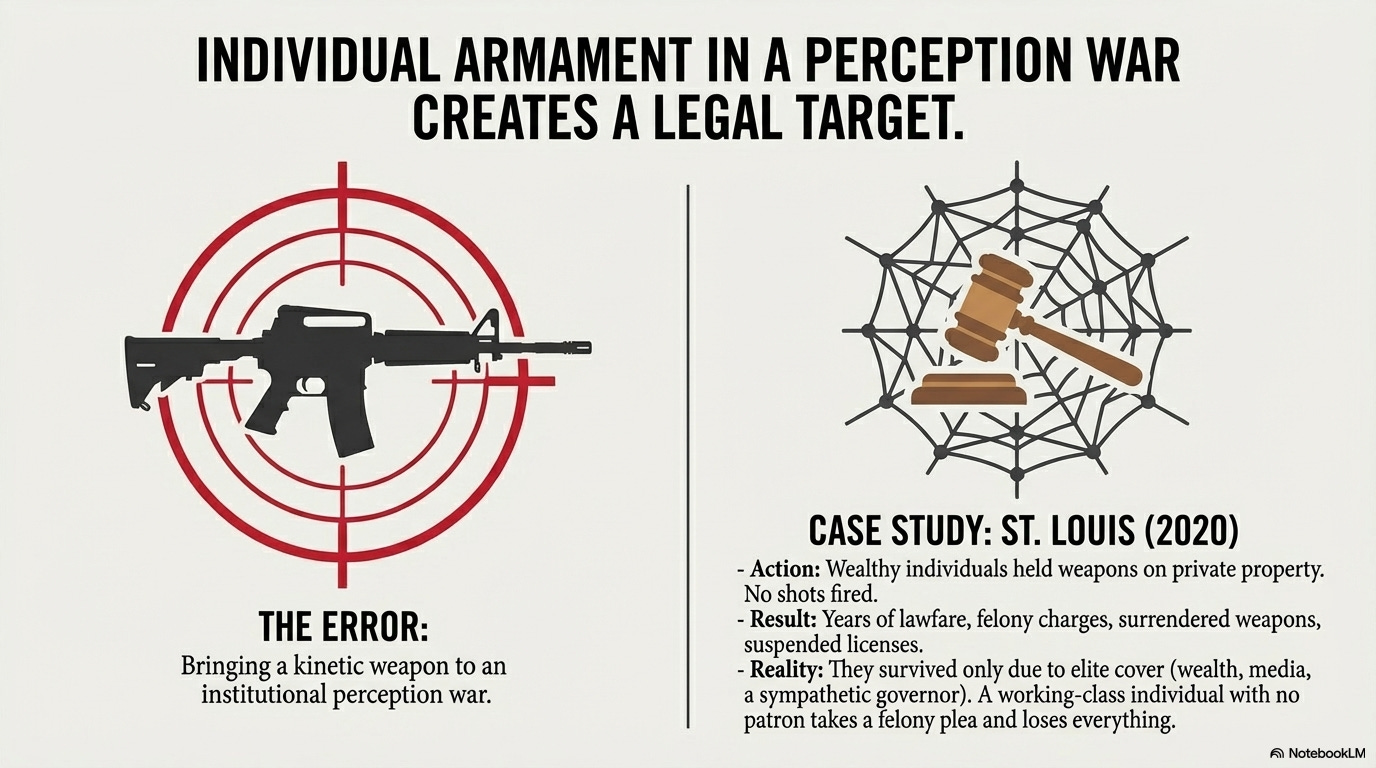
**Guns.** Individual armament assumes the fight is kinetic and individual-scale. In the previous article, we discussed the actual battlespace: institutional, metaphysical, operating through advisory capture, narrative control, framework installation (NATO is discussing Cognitive Warfare for a reason). You brought a rifle to a perception war. And here’s the biggest affront; every gun you own is a lawfare target. If the governing class decides to prosecute, each weapon becomes an exhibit (”he had an arsenal of three rifles and 500 rounds!”). For you non-gun people, that is a leisure day at the range, not an arsenal.
Let’s talk case study. Remember the couple in St. Louis? The McCloskey’s? Husband in a pink polo with an AR at low ready, wife stylish with Bryco 38? Wealthy attorneys, both of them - who stood on their own property with an AR-15 and a pistol when protesters entered their gated neighborhood in 2020 (allegedly). They didn’t fire. Nobody was hurt. They stood on their own lawn and held weapons.
The circuit attorney (a progressive prosecutor bankrolled into office by outside political money) charged them both with felonies. The prosecution was so transparently political that the judge disqualified the prosecutor for using the case in campaign fundraising emails. The couple pled guilty to misdemeanors: fourth-degree assault and harassment. Fined. Weapons surrendered. Law licenses temporarily suspended by the state Supreme Court.
They survived. They got the convictions expunged. They eventually got the AR-15 back and Bryco. It took lawsuits, two trips to the court of appeals, a gubernatorial pardon, and about 4 years.
And they survived because they were wealthy attorneys (not elite, but not too shabby) with national media coverage, institutional political support, and a sympathetic governor (there they are) willing to pardon them. They had elite cover and the lawfare still cost them five years and enormous expense. A working-class couple in the same situation, one with no connections, no media platform, no governor who knows their name, takes the felony plea. Guns are taken permanently. Job is gone. The lawfare machine processes them and moves on. They get nothing. They lose. Good day, sir.
The guns created a legal target. The elite patron provided a partial shield. Without the patron, the target is all that remains.
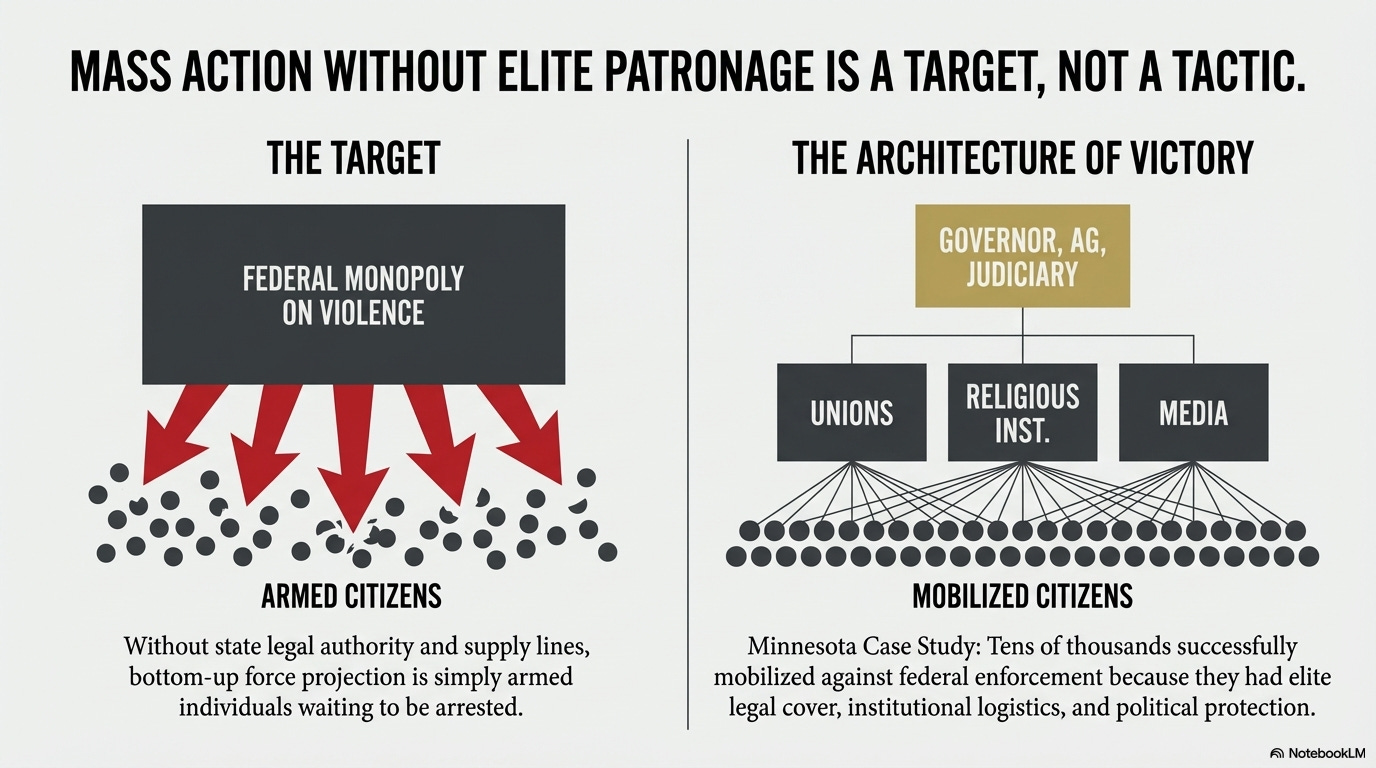
**Militia.** Bottom-up force projection without elite sponsorship. The founding correction demolishes this: the Revolution required elite leadership, French financing, Prussian training, international supply chains. A militia without elite patrons is a group of armed men waiting to be arrested.
And here’s the history that should haunt you: the constitutional militia had elite patronage. The state militias were state-sponsored formations - officers appointed by governors, funded through state budgets, operating under state legal authority. We the People were the militia (still are, a la 10 U.S.C. § 246 and State Defense Forces, a significantly weakened version of a militia), and the states were the institutional patron that gave the militia its legitimacy, its legal cover, its supply chain, its political protection. The Second Amendment presupposes this architecture. Armed citizens organized under sovereign state authority, serving as the military counterweight to federal overreach. The whole structure depended on state political sovereignty.
That sovereignty has been hollowed out. The federal consolidation - accelerating after 1865, cemented through the Progressive Era and the New Deal - subordinated the states to a federal authority that has no interest in sponsoring armed citizen formations that could challenge its dominance.
So now: the federal state holds monopoly on legitimate violence and the legal infrastructure to define any unauthorized challenge as criminal conspiracy. Without elite cover - lawyers, funding, political protection, supply lines - the militia is a target. Brave. Operational for about six minutes.
And if you want to see what a militia with elite patronage looks like in the current year, look at Minnesota. In January 2026, tens of thousands of citizens mobilized against federal immigration enforcement in subzero temperatures. Hundreds of businesses shut down. Workers walked off the job. Crowds confronted federal agents in the streets. Within six weeks, the federal government announced a drawdown.
That mobilization had every element the constitutional militia had: a governor providing political cover, an attorney general filing federal lawsuits, a judiciary issuing rulings against the federal operation, unions organizing and funding participation, religious institutions supplying moral authority and bodies for civil disobedience. Elite patronage. Legal infrastructure. Organizational structure. Political protection. Media support. Supply lines.
The political valence is irrelevant. It matters not whether you agree with the cause, but pray, brother, look at the architecture. The same population, with the same courage, without the governor, without the AG, without the judiciary, without the unions - every one of those protesters is individually arrested for obstruction of federal law enforcement. Lawfare picks them off one by one. The movement dies in arraignment courts.
The architecture is the architecture. Elite patronage makes mass action viable. Without it, mass action is a target. The left understands this. Whatever else you think of them, they have mastered the vertical integration of elite sponsorship with mass mobilization. The right has guns and a few boxes of ammo from Academy Sports.
**Prepping.** The individualist fantasy at its purest. Six months of food, water purification, medical supplies, a generator, maybe some solar panels. Admirable foresight. Useful in times of natural disaster. One problem: without rule of law (Joe Dolio), unless you hide these things, a larger organized force simply takes what you’ve stored. Your six months of provisions become a resupply depot for whoever has the organizational capacity to collect it. Prepping without community is hoarding. Prepping with community but without elite protection is a slightly larger, slightly more valuable target.
The common failure across all three: activity mistaken for progress. Deployment mistaken for transformation. The tangibility of the rifle, the cans, the bunker - it feels like readiness. That feeling is expensive anxiety management. You’re spending money to feel less afraid without changing your position in the actual conflict.
Here’s the CAF sequence translated to your situation:
**Strategy.** What is the actual objective? “Survive” is not a strategy. Survive what? For how long? To what end? What does the post-crisis landscape look like? What does victory mean at your level of the hierarchy?
**Plan.** What resources, alliances, organizational structures do you need? Who are the elites operating in your area? What are their operative frameworks - not what they say, what they do? Which are Lions? Which are Foxes performing Lion behavior?
**Ready.** What conditions must exist before action is effective? You need diagnostic capacity - the ability to see who’s who. You need community organized with vertical connections to elite patronage. Legal infrastructure. Supply relationships that scale beyond individual stockpiling.
**Adopt.** Then - and only then - act. In concert with elite direction, under elite protection, with organizational structure that can absorb and survive the inevitable counterpressure.
Strategy, Plan, Ready, Adopt. In that order. What you’ve been doing is Adopt, Adopt, Adopt, and Adopt; and losing ground in the process.
The good news: everything you’ve already done still has value. The guns aren’t wasted. The supplies aren’t wasted. The community you’ve built isn’t wasted. They’re assets waiting for a strategy.
Which brings us to the question that matters.
IV. Three Men, Three Lessons
I want to tell you about three men. Their stories are the complete taxonomy of what I’m trying to show you; every combination of the two things that matter, and what happens when you get the combination wrong.
**Napoleon Bonaparte** had authority. Emperor of France. Commander of the greatest military machine in Europe. Every institution answered to him. Resources, armies, territory, the full machinery of state. A Lion holding the world by the throat.
What Napoleon lacked was awareness.
Talleyrand, his chief diplomat (his Fox) managed the diplomatic channels, maintained the relationships, and sold Napoleon’s position to his enemies while smiling at his dinner table. Napoleon had the institution but couldn’t see which advisors served him and which served themselves through him. He conquered a continent and died on an island, because the man who held all the authority in the world couldn’t distinguish loyalty from performance.
Authority without awareness. Metabolized from within.
**William Wallace** had awareness. Formed through deliberate education beyond his station - Latin, law, political structure - under the tutelage of clerical relatives who ensured he grasped the institutional machinery he lived inside. Wallace could see. He understood what English occupation meant. He understood the architecture arrayed against Scotland. He had what I’ve been calling Condition Two; metaphysical awareness, the ability to perceive the operative framework beneath the performed one.
What Wallace lacked was authority. He was never elite. A Steward with a Lion’s temperament; willing to fight, willing to lead, willing to die. But a Steward.
And here’s the failure that cost him everything: he acted FIRST. Killed the English sheriff at Lanark before securing elite backing. Every negotiation with Scottish nobles afterward came from weakness costumed as strength. He won battles. He had popular support. He had moral authority. He had everything except the one thing that would have kept him alive: elite commitment of resources, logistics, legal protection, and diplomatic cover.
Robert the Bruce (the actual Lion, the man with elite position and resources) committed to the cause AFTER Wallace was dead. The elite moved when cost-benefit shifted. Wallace operated on personal time. Elites operate on institutional time. The clocks never synchronized.
**George Washington** had both.
Authority: wealthy Virginia planter, international connections, network of colonial elites, the social infrastructure of the planter class at his back. He was elite before the first shot fired.
Awareness: an autodidactically formed mind. The ability to see the operative framework of British colonial governance for what it was, and the ability to see which of his fellow elites were Lions and which were Foxes.
And then the thing that separated him from every brave, aware, well-positioned man who failed anyway: patience.
His men were trained before Concord. The militia companies that became the backbone of the Revolution were already drilling, already organized, already equipped under colonial institutional authority. The minutemen weren’t spontaneous - they were the product of existing institutional infrastructure, the same state-as-patron architecture the Second Amendment would later presuppose. The colonial militia was the constitutional militia before the Constitution existed.
The Declaration of Independence came AFTER the Continental Congress was organized. AFTER French support was being cultivated. AFTER institutional infrastructure was in place. AFTER the strategy existed, the plan was formed, the readiness conditions were met. Washington didn’t act first. Washington readied first. Strategy, Plan, Ready - then Adopt.
He died in his bed. At Mount Vernon. An old man, in his own home, with his boots off.
The taxonomy is complete. Authority without awareness: eaten alive by your own advisors. Awareness without authority: destroyed by the system you can see but can’t fight. Both together, with patience: Mount Vernon.
Now - which one are you?
If you’re honest, we’re Wallace. Aware. Brave. Resourceful. And utterly without the institutional position to change anything alone.
So the question changes, doesn’t it? The question is no longer “how do I lead the revolution?” The question is: how do I find my Washington (if there is one to find)?
V. The Hunting Party
Here’s your mission. Here’s the thing you can actually do, starting tomorrow, that changes your position in the real conflict.
Hunt.
Not for a fight. Not for a bunker. Not for a candidate who says the right words on a stage - you already know what performed frameworks look like, and you know the gap between performed and operative. Hunt for a Lion.
A Lion worth his salt that you can throw your weight behind. All you need is the answer to one question; everything else is nth order effects that emanate from the response.
**”What would this person have to believe for their behavior to make sense?”**
Don’t listen to what they say. Watch what they do. Study them. Then ask: what would someone have to believe for those actions to be rational?
The school board member who says she’s fighting for parental rights but consistently votes to expand administrative authority - what would she have to believe for that behavior to make sense? She’d have to believe parents can’t actually be trusted, that expertise supersedes consent, that the administrative state is the appropriate locus of decision-making. Her performed framework says “parental empowerment.” Her operative framework says “institutional management.” The gap is the signal.
The pastor who preaches community and builds a personal brand - what would he have to believe? He’d have to believe the institution exists to serve him rather than the other way around. His performed framework says “shepherd.” His operative framework says “platform.” The gap is the signal.
The political figure who channels your outrage and produces no structural change - what would he have to believe? He’d have to believe your energy is a resource to be harvested, your attention a commodity to be monetized, your loyalty a renewable fuel source. His performed framework says “champion of the people” yet his operative framework says “farmer of the tax cattle.” The gap. The gap. Always the gap.
Now flip it. The leader whose private behavior matches his public commitments - small gap. The patron who builds institutions that outlast his tenure - small gap. The elite who absorbs personal cost to protect the people and structures beneath him - small gap. That’s your Lion.
A word of caution: Lion describes a governance style (direct, authority-bearing, willing to exercise power) and nothing more. History is full of Lions who were tyrants (looking at you, Oliver Cromwell). The question and the Fork are what separate a Lion worth serving from a Lion worth fleeing.
And here’s the connection to the Fork that we addressed in the previous article. Identifying a Lion requires understanding what a Lion stands on. The elite who operates from correspondence - whose words match reality, whose actions track truth, whose institutions are built on what is rather than what’s declared - that’s the elite worth serving. The elite who operates from declaration - whose words manufacture reality, whose actions serve the performance, whose institutions exist to manage perception? That’s Fox territory.
And here’s the performed-versus-operative test in its simplest form: Does what he does match what he says? Small gap: potential Lion. Large gap: Fox. That’s it. That’s the whole tool. You can carry it out of this article in a single sentence and use it before dinner.
VI. Your Role
So you’ve found a Lion candidate. Now what?
Here’s where the last myth falls - the myth that finding the right leader means you passively follow. The Steward role is not passive. The Steward role is the most critical role in the entire structure, because the Steward solves the problem that killed Napoleon.
Napoleon died because he couldn’t see which advisors were loyal and which were Talleyrand. He had authority. He lacked awareness. And nobody in his orbit had both the diagnostic capacity to see the Foxes AND the loyalty to tell him.
That’s you. That’s the role. The man who can see - because I’ve been handing you diagnostic instruments for six articles - and who offers that sight to a Lion who has the authority to act on it.
The fire team analogy: the soldier serves the Captain. Both are essential. Neither is diminished by the relationship. And the soldier who serves the right Captain comes home alive.
The advisor who walks into a Lion’s office and says, “I can show you which of your people are loyal and which are performing loyalty” - that advisor fills the gap that has destroyed every Lion in recorded history. That’s the gap Napoleon couldn’t fill. That’s the awareness Wallace had but couldn’t pair with authority. That’s what you bring to the table.
If you’re a Ghost (someone who’s been unwittingly possessed by the thoughts of dead men) your first task is to define your metaphysic. Start to grapple with what you think reality is - objective or subjective (hint: it’s objective). Move from vibes to specifics by building the capacity to see and articulate your thoughts and find out who came up with the ideas you hold true, because I guarantee it isn’t you.
If you’re a Steward (already metaphysically aware of where your ideas came from) your task is the hunt. Find the Lion and act as the advisor Talleyrand should have been and wasn’t.
VII. Here Comes The Sun (Rammstein, not Beatles)
Here is where we stand.
We can see Declaration Reality - the infrastructure of manufactured correspondence between what institutions say and what they do. We can see the Fork - the split between those who operate from objective reality and those who operate from declared reality. We know Lions and Foxes. We know performed-versus-operative. We know elite theory.
What we have yet to establish is doctrine that takes a Lion (or perhaps you in an institutional role? A school board, perhaps? Hmmmm?) with authority and awareness and patience and gives him a system for building power that Foxes cannot capture.
Ruthless Sunshine and Shadow Metaphysics.
Then we will continue building upon the concepts that you may find to be useful in the less-than-immediate for the sake of fleshing out the realms of war, so to speak.
Brutus is the founder of the American Epistemology Institute (AEI), an educational nonprofit dedicated to restoring the metaphysical foundations of American life. He is the creator of Metadiagnostics — a diagnostic theory that identifies how metaphysical premises shape institutional behavior and civilizational trajectories. Twenty years of autodidactic philosophical study. A professional background in systems design. A conviction that the real crisis is upstream of politics. He is the lead author of AEI's white papers and the author of this publication. Read more at
.
Interesting and impressive article. You left me with several things to ponder! I agree the metaphysical is the thing worth pondering for many. Gonna go back and read you earlier work.