New legislative changes have come to Canada, and the broad response has been underwhelming. This is notably the case with the general public, and with institutions which might have asserted themselves more strongly in times past, like the media, academia, unions, NGOs, and professional bodies such as the Canadian Bar Association. This comes to no surprise to many of us, who note the compound effect of digital pacification upon a culture that prides itself on avoiding conflict. But are those who have amassed the cojones necessary to voice some concern portraying the issue correctly?
With the recent passing of Bill C-9 and, likely to follow, Bill C-22, some are stunned by the speed at which federal law is changing, and some are attempting to share their opinion before it might be more commonplace to be criminally punished for doing so. These changes are coming courtesy of a variety of bills, with some of the most significant being Bill C-9 (Combatting Hate Act), Bill C-22 (Lawful Access Act), and Bill C-34 (Digital Safety Act). This article intends to discuss the ideas of these bills, the sociopolitical direction they lead us down, and the ways we’re likely to be thinking about them. Why? Because if we’re serious about wanting to move away from these trends, we need to discover ways of breaking out of our motivations for chasing them, which embrace negative sentiments, and cause society to become increasingly intolerant of humankind and human mind.
It’s one thing to realize the nature of these pieces of legislation and consider that society is transforming in precisely the ways many of our universally celebrated intellectual heroes had warned about. This is especially striking given that the legislation doesn’t even need to be given a far-fetched interpretation. But it’s bitter, off-putting, and cringey to see any actually in support of these changes, and particularly those who explicitly advocate for them to the end of presenting those who disagree with the legislation as already being guilty of what this legislation criminalizes:
“Bill C-9 is the combating hate act and this is absolutely a good thing unless you are a part of the problem and hate on vulnerable and marginalized communities. We should be accepting all persons. Bring back equality and equity. Bring back humanity. Less hate; more love.”[1]
“So you want to be able to post a swastika and be a terrorist but remain anonymous”[2]
Indeed, the agitators are out in full force, and whether they are intentional or not, their modus operandi is to draw you into a web of doubt and confusion. This has been explicated as the “aufheben der Kultur”, among other things, and, in that way, thought it’s not necessary to engage in “Jiu-Jitsu” with bad-faith interlocutors, there will come moments in some of our lives where we’re faced with a critical junction where we’re able to effect change. As such, it’s necessary to understand the ideas, not to benefit wraith-like cult initiates, but for impactful situations where the logic of policy is challenged, or a reasonable denizen of political-influence lends their ear.
2 Why People Are Concerned
The changes are focused around 3 areas:
1. New definitions for criminality
2. Erosion of privacy
3. Assurance of “safety”
As the erosion of safety occurs through the promise of safety, we can examine them together.
2.1 Criminality
These legislative changes add new offences to the criminal code:
• Intimidation and Obstruction: illegal to provoke a state of fear to impede access to a “protected place”. Exception for those seeking to obtain or communicate information.
• Hate Crime Offence: if one is deemed to be motivated by hate while committing any offence, one will be charged with an additional “hate crime offence”.
• Hate Propaganda Offence: illegal to promote hatred using a symbol:
– Terror-associated symbols
– Nazi symbols
– A noose
– Others symbols that can be confused with the above
Of course, the entire notion that one’s bias of hate can be detected through forensic and evidentiary methods only seems coherent because of a presumption of humans having “identities” and that one’s identity, or one’s most meaningful “identity”, comes through these dimensions: colour, race, religion, national or ethnic origin, age, sex, sexual orientation, gender identity or expression, or mental or physical disability.
With these dimensions referenced in law, the state recognizes disparate types of citizens. That people are enumerated in this way is only relevant on the basis of the relations between the different types, with the details of those relations constituting the means by which the crime of hate is interpreted.
More specifically, since hate is defined through the ambiguous combination of the emotion one is experiencing as they express themselves, and the speculation of whether a reasonable person would view their expression as exposing an identifiable group to hatred, the entire determination is ultimately unfalsifiable. In fact, beyond directly making it forbidden to utter, write, inscribe, or otherwise record specific words or phrases, any hate speech legislation needs to be unfalsifiable, as it is always the forbidding of emotion, or otherwise expressing something which could invite condemnation. Any other more egregious example of what one would refer to as “hate speech” could otherwise be called incitement, with the one gray area possibly the repetition of slurs, but even that is impossible to fully understand. (Tourette Syndrome? Culture shock? Naive enunciation absent comprehension?)
As far as dimensions of identity upon which hate is theoretically predicated, if there weren’t a theory of the historical effect of group relations being applied, we wouldn’t have many of these dimensions for the state to contemplate. And though some might remain, like sex, age, religion, sexual orientation, or disability, at least they would be grounded in factors that are logically deducible. Most still know what a woman is. Age can be tracked. People of faith can declare it openly, as they can their sexual orientation. Disabilities can be diagnosed.
2.1.1 The Difference
“What’s the difference?”, some will say. “We still have group categories upon which to evaluate hate!”.
The difference is we shouldn’t be giving the state the power to assert it can read the minds or emotions of anyone. Worse than that, the moment we do grant that power to the state, we throw away the best epistemological toolset that can be used to protect people from undue harm and oppression: the opportunity for universally-applicable logic and reason. The only means by which rights and dignity can be fought for on even ground.
2.2 Privacy (Safety)
For many of us, it was always assumed that privacy is never something that can be guaranteed, just as one cannot operate in the world without having a body and face that are observable (notwithstanding the pathological effects of masking in public, be it as a criminal or as a good Covid cult initiate). When it came to the use of networked digital devices, one always wonders the degree to which law enforcement and security services operate neatly to the letter of the law, or whether there’s a difference between what information is monitored, and what information is legally acted upon. Techniques and technologies to violate privacy have existed since the advent of networked computers and digital telecommunication, and very few individuals utilize a perfectly rigorous process to maximize the care with which they use their devices.
That being said, there is a difference between operating under the expectation that the state and its agencies are prepared to use malicious practices to endow themselves with an enhanced ability to conduct surveillance on citizens, and the announcement of what is essentially an open-ended intent to do so.
With that intent declared, and acted upon, we should emphasize the need for attention to the fact that the state has taken it upon themselves to determine the definitions and methods to fulfill the requirements indicated by the new acts. Even if such details were to be formulated and presented through new legislation requiring the same level of scrutiny as the preceding initiating bills themselves, the fact of the original intent having been validated as appropriate generates some concern that it may be a foregone conclusion that future articulations will be acquiesced to obediently. But hopefully a threshold of unprecedented interest will be placed upon the revelation of those details, which will be the Governor in Council (the cabinet, which can be observed here for a reliable rictus buffet: https://www.pm.gc.ca/en/cabinet), the incoming Digital Safety Commission of Canada, and an assortment of meetings with legal representatives and private consultants to whitewash the gravy train of perpetual tyranny which has the potential to ensue.
Do humans really want to feel private? Aren’t we ultimately led, inspired, and tormented by our relationships with other people? Aren’t we perpetually chasing the amendment of those relations, our amendment through them?
What are some motivations that might exist for anything to be private at all?
• Irrelevance: Something not worth sharing for there would not be a sufficient purpose in doing so.
• Unfinished thoughts: A thought was formed, but isn’t yet fully understood, or not yet fleshed out.
• Inappropriate: “Do you have any Grey Poupon?”
• Offensive: Things better left unsaid, lest someone soil themselves.
• Security: Things that, if shared, could provide a common enemy with a tactical advantage.
Those advocating for the state’s prying eyes will claim that the prying only happens to those who deserve it, and might suggest that things don’t really need to be kept private anyway, except those things which you never share with others.
And when such things get uttered, one has to wonder whether there might be some level of projection. We see it all the time: people having to have their delusional self-image confirmed by those around them. They can’t but help themselves, and there’s no shortage of examples in anyone’s life—from ourselves, from those we hold dear, and from those playing the role of foe. Our experiences as children also serve to remind us just how and why, at least at an emotional level, we give our minds consent to run through these patterns.
2.2.1 Who Wants Privacy
“More fear porn bullshit propaganda from a brainwashed simp. How have these bills affected you?”[3]
Who has an expectation of privacy? Forget the prospectively targeted dissidents, or the awkwardly-intentioned stumbling normies, and let’s consider the activists, agitators, and the more enthusiastic of totalitarian apologists, of whom some might suggest they don’t have anything to hide, or anything to keep private beyond the details of their own loved ones. Would they claim to share everything else?
If we are to take such agitations at face value, because surely there are those who might think this way (and certainly such things would be thought by those who want to push these bills through), we need to consider human perception in the context of assuming one’s compliance to ever-encroaching tyranny, or Perceiving Imminent Collectivist Authoritarianism (PICA). It’s not enough to simply think “these people are tyrants who hate us, so obviously they want more tyranny”, and it’s also not enough to think “these people are sheep, and pushovers at the suggestion of increasing state control”, because some are not taking a passive stance at all, but either offer an enthusiastic hand to participate in empowering the state, or are at least active in their desire to agitate those whom they see as their other.
So in returning to our question of whether members of “team tyranny” are in favour of there being no privacy we ask:
“Are there things you are not sharing?”
If the logic is that anything expressed in communication between humans (and for now we’ll say, digital communication) should pre-emptively be made accessible to the prying eyes of the state, then it stands to reason that any communication that would have otherwise taken place privately should have been compliant with the objectives of our political society as understood by the state. And if that is the case, then what is the ultimate goal of this initiative? Is it not to reveal those who are not congruent to the objectives?
If unsafe expression of thoughts and ideas is harming members of our society, and the state has taken it upon itself to prevent that from occurring, would it not be ruinous to the effort for the bad actors to become more scrupulous in their malicious dissemination?
Assuming that is indeed the case, the supposed successful effect of the undertaking would either be to capture the ill-formed thoughts, or to prevent them from occurring, thus it becomes more reasonable to demand that all thoughts be shared.
2.2.2 Thought Harvesting
It’s difficult to predict whether technology and our understanding of neurobiology will ever get to the point of having instruments able to losslessly read thoughts, but it doesn’t matter, as the instruments of today are already, to varying degrees, attempting this. Be it through reading user preferences, or leveraging machine learning to continuously score a system’s prediction performance regarding online user behaviour, each time we allow for the state to be made increasingly in charge of ensuring the safety of the expressions able to be received, we tacitly legitimize the question of whether the state should ensure the safety of the expressions able to be conceived. And though we could let our imaginations go wild on how an implementation of such a capability might one day be developed, we can at least understand that, for now, a simple means of detecting when a biometric shift occurs in an observed subject could suffice in indicating that a thought has formed without it yet having been publicly expressed.
2.2.3 Stunted Growth
Good ideas might seem to come from thin air, but that’s seldom the case. A good idea becomes lucid in the mind of the thinker because of the thoughts and experiences preceding it.
A big part of the process of developing good thoughts comes in the form of presenting their seeds, or premature approximations of those things that could elevate human experience, in one’s exchanges with their peers, foes, and other participants. Should we impede our capacity to engage in that process, we relegate ourselves to old ideas and a system of force which becomes ever-increasingly rigid in its blind adherence to them. Indeed, many believe they can disburden themselves of creative work by employing a tool of approximating language, the aesthetic of which presents an ever-refined accuracy in its orchestration of terms (namely LLMs), and hope that this somehow permits humans to have its new evolution of existence, but we’ll be left sucking on our own dust if we expect the fundamental source of an idea to come from anything other than human thinking (little green men and entities occupying the manifolds of psychoactively-observed hyperspace notwithstanding).
3 Who Is Speaking Up
Though some higher profile institutions and organizations normally concerned with liberty, like unions, academia, NGOs, the Bar Association, and academia, have voiced some concern regarding new legislation, most of it provides consent to it in the same breath. That is to say, they validate the undertaking while claiming that there could be some unintended consequences. Of course, those unintended consequences are rarely described as affecting people universally as individuals attempting to state what they believe as true, but as negative effects on “marginalized” or “minoritized communities”. This is no surprise, and is one of the motivations for my writing about this subject.
The logic of these bills is that humans express and are presented with information which has been assured to fit within a range of specification over which the state assumes the role of best understanding. Whatever undermines that configuration will, over a long enough period, come to be a counterproductive and damaging element to be responded to accordingly, as opposed to an exceptional case worth of nuance consideration.
With that in mind, let us consider some disparate sources of criticism for the legislation which are doing a better job of describing the threat, who could be organized into buckets of Old-school Leftists and “Conservatives”.
3.1 Old-school Eco Warrior
As far as “Old-school Leftist” is concerned, a lot of people reacted positively to seeing Elizabeth May of the Green Party of Canada demonstrating concern for Bill C-22. Indeed, earlier this year May had shown some apprehension to the bill, particularly concerning the language used from which a threshold for procuring a warrant would be affected, but ultimately still supported the purpose of the bill and simply wanted it amended.[4]
Ultimately, she abandoned support of the bill, and said that it should be scrapped altogether. Juno News[5]
Though it’s great she finally refused to get behind the bill, it’s likely that this isn’t because a change in her worldview that would have otherwise caused her to cease empowering the state with additional surveillance capability. Her gripe was on the distinction of reasonable grounds to suspect to reasonable grounds to believe and, though that’s a worthy distinction, it’s ultimately on the basis of whether ANY offense from ANY Act “has been” or “will be” committed. Given the set of Acts entailed includes ones covering “hate crime” and identity-related offenses, we really don’t need to celebrate Elizabeth May finally having good sense about applying limits to government.
This is an operational consequence of approaching political society with a collectivist worldview. There is no way to avoid having to erect a tyrannical means of governance, regardless of how aesthetically pleasant and unimposing one hopes for it to be. But, she does show some distrust of government from time to time, as demonstrated with her pushback of Bills C-9, C-22, and back in 2015 when she opposed the Conservatives’ Bill C-51. Elizabeth May[6]
So how is it that someone employing a collectivist worldview, which desires a socialist perspective on environmental issues, supports social justice—including Critical Social Justice and Decolonization—and supposes goals of equity which fundamentally conflict with aspects of civil libertarianism she exhibits from time to time, can still demonstrate resistance to the types of government overreach which would be necessary for meeting those goals?
Anyone ensconced in a collectivist worldview is engaged in a historical mission of completing the collectivist mission, which invariably must be some representation of a frictionless collective. It isn’t a matter of having the principles in place, even if they appear to be championing those principles in the meantime. The friction, tension, and contradictions of engaging political society are the evidence that they are engaged with their historical mission, and that they sport some form of proletarian consciousness.
In the case of the climate justice warrior, they will portray a mythology of the earth-loving steward concerned for all its inhabitants, and their oppression by a hegemonically-possessed machine of greed and lust for power. Ultimately, it must be them or their delegates who hold the levers of power—levers which must be wielded in order to meet their objectives. And, sure, it might seem that she’s only willing to empower tyranny when it’s aesthetically modest, but note that her excuse is not a principle of human freedom, but that of legal precedent. This hints us back to a rule by law vs. rule of law distinction, which is further placed in perspective when considering May’s support of Decolonization.
3.2 Trad-Con
Those who identify or otherwise perceive themselves as “conservatives”, or those who believe they can be associated as the type of citizen who embodies stereotypical traits broadly associated with the “traditional” inhabitant of the land, will feel explicitly targeted by the new legislation (particularly Bill C-9). They might believe they are witnessing a play by adversaries to codify in law the means to evoke a political advantage. This isn’t necessarily an incorrect perspective, but it only scratches the surface and, in doing so, causes many to miss an opportunity to catch a glimpse the serious issues these pieces of legislation introduce, and how to consider one’s principles in the face of that.
The truth is that many self-professed conservatives are amenable to having the state remove harmful threats from society, with some removals making more sense than others. Sure, in one regard the concept of borders is a fundamental component to a functioning society, and a pre-requisite to prosperity, and, thus, removing those things which should otherwise be kept out through a properly functioning border, like dangerous people who are in the country illegally, makes it appear that the state is indeed in charge of removing bad elements from our lives. But other examples are a bit more slippery, and even break the facade of an adherence to principles of liberty, with some well-known examples being the Parents Music Resource Center (PMRC) and the push for warning labels on music in the 1980s, the application of obscenity laws and pressure campaigns by conservative public figures to remove offensive albums from record stores, and demands for strict radio broadcasting regulations. Many of those were criticized by the “mainstream left” of the day and, at that time, may very well have been doing so for reasons that are not so heavily biased by partisanship as has become the norm today. Ironically, for those who have taken to a more leftist partisan bent, the critics of those bills may be quite supportive of empowering the state to curate our digital experiences and assign us identity labels today, with the conservatives of the 1980s possibly being part of an older generation which haven’t the clarity of understanding necessary to form an informed and principled position on digital safety.
A good example of how conservatives of today have the right general concern, but are primed to be susceptible to suggestions that are at odds with liberty, is on the issue of digital devices and children. Certainly, giving children screen time is detrimental to their development, and though many public school advocates claim that the screens help children develop the “21st century skills” necessary for success in modern society (stupid, lazy, and misguided, at best), children don’t in fact need screen time, and most people with a modicum of good sense who spend a moment thinking about it come to the same conclusion. Unfortunately, when many of these people come across Jonathan Haidt, they suddenly agree that the state should invoke the force of law to ban social media for children, believing this will mitigate exposure to harmful content, restore wasted time otherwise spent staring into the abyss, and even help with discipline by not leaving them vulnerable to as many addictive activities. Jonathan Haidt[7]
Whatever Haidt’s motives for taking this position, it affirms that the role of the state is to know what content is being looked at by which citizen, making a determination about what content the citizen is and is not to consume, and making it their business to limit, incentivize, and punish the consumption of particular information. It also affirms that the state is responsible for guiding, limiting, and directing a child to information in a capacity otherwise undertaken by its parents.
They’ll argue that corporations target children, and that they have a business incentive for doing so. And, no surprise, as this is perfectly in line with why anyone should be suspicious of public-private partnerships and the like. No one is waiting for a corporation whose axioms are centered around a child’s wellbeing, even if they’ve ostensibly made that their product. The fact remains that parents should be making decisions and setting boundaries for their children, just as they’ve always had to.
That will be countered by with the assertion that parents can’t be trusted to execute to a high-enough degree of success, and that too many children will still succumb to the depression, indoctrination, adoption of destructive habits, and formation of an erroneous worldview that social media sites threaten to burden us with. But the natural baseline of a society is that, whatever alleged polities it might entail, its fundamental components always break down to the familial and the individual. There is no fundamental unit of society described as a set of humans raised by the state, and anything resembling as such has always been rife with problems, such as a government-operated orphanage—or, say, a residential school.
But forget about comparing to see which approach offers the best performance: choosing the best performance is the wrong way to be thinking about it. We aren’t trying compare two baseline behaviours. One intervenes and disrupts the distribution of roles as occurs in nature, and so the case must be made for the intervention, not both “approaches”. And how is this case to be made? Not on the basis of whether the intervention produces an outcome that is good enough to justify the means, but on the fundamental basis for governance itself, and whether it is ethical to even apply such a measure to any human, much less all of them. No one has the right to vote away another human’s ability to procreate or ability to raise a child. Even if one human could give consent and demand to have the state take over their own child-rearing duties, that wouldn’t justify the state applying that consent to all other families it wishes to concern itself with.
4 The State’s Digital Destination
4.1 Muh Dark Web
I always found it laughable to hear people refer to the “Dark Web”, as though there is some location in a cyber-universe of alternate dimensions which is physically demarcated. The internet is simply a term to acknowledge our capacity to digitally transmit data, and it is nothing more cryptic than that. These same people are liable to suggest that the government can regulate some portions of the internet, and not others, similar to walking around a plaza and placing police tape on one brick-and-mortar store, and not the next. But what is being policed here is the capacity for data to be transmitted and received, and that we might stylize this in terms of social media platforms through which much of that data flows, the state’s mandate does not revolve around a set of corporations, but the capacity for information it deems illegitimate or inappropriate to be received by certain parties.
In a recent Access to Information disclosure by Blacklock’s Reporter, it was shown that the government would consider legal action against persons it finds to be impeding its efforts to “uphold the integrity of and public trust in government information”. Such language better demonstrates fluid and movable limits to the application of force that the state would be prepared to utilize to maximize the supreme presentation of itself.[8]
4.2 A Living Implementation
As was said before, the interpretation for some of this legislation and the standards by which they will be applied is still to be determined, and this will play out at the “pleasure” of the current administration and a new Digital Safety Commission, which is all the more reason to think about these legal shifts in terms of the ideas they’re based on, and the direction they move us in, rather than the semantics by which they’re expected to be constrained.
With these Acts, the state is acknowledged as being tasked with assuring the public (and itself) that the information being transmitted electronically is sanitized, and that there is oversight to understand who it is being received by. It is ambiguous enough to measure things against the term social media, given that all digital transmission intended for human eyes is arguably a form of social media—it is sent and received as a social act, pertaining to one’s social relations and socialization in society, and it is to be decoded as media that is legible and intelligible to human eyes—but the wording of the Act has made it into an even stickier and broader wildcard, by measuring it against the term Electronic Service Provider.
In a sense, there’s almost no activity we engage in anymore which does not involve an electronic device, and nearly every electronic device is capable of transceiving data, making it liable to be construed as an endpoint in digital communication or somehow pertaining to the provisioning of an “electronic service”. Any sort of modernized professional or recreational service comes with an elaborate interface comparable to what one expects when using a well-known social media platform. Emails from services might be interpreted as social media, even if they don’t display comments from other people (which they often do). And though we might assume that the devices themselves are not to be included in the list of items that are somehow indicated by these new Acts, the precedent is set, the state’s satisfaction as to whether it has succeeded in its efforts is likely insatiable, and if the completed standards or future interpretations of the legislation don’t bleed over into surveillance through hardware, future Acts which build upon these precedents can surely do that, especially as technology continues to improve.
4.3 Hardware Surveillance
“What do you mean by”Hardware Surveillance?” Doesn’t surveillance need to be implemented through services accessible through the internet?”
Well, what is the internet? It is not a place. It’s just an understanding of the ability to transmit data broadly across many systems by virtue of the fact that computers are able to transmit data to one another whatsoever. Our carriergrade telephony is leveraged via infrastructure designed to facilitate this, and our protocols are designed to attempt connections through whatever networks are available until the route is realized. But do we even need for that perfect route to be setup before surveillance data can be sent to one of the state’s systems specifically tasked for this purpose?
Not necessarily. All microcontrollers and CPUs have firmware—memory on the hardware itself—and future development could give greater consideration to the potential for surveillance by having firmware which runs software alongside the operating system presented to the user of the system containing those chips. The firmware work in conjunction with UEFI to launch software outside the OS, before the OS launches, or such as to automatically cause installation of specific commands and services once the user’s operating system is installed. The firmware can also be the operating system, as is the case with many embedded/IoT products, whether running RTOSes (Real Time Operating Systems), or even more minimal systems.
Would surveillance technology being placed on hardware have to use your internet in order to transmit data to the state? No, it wouldn’t. Though, it could certainly try to do that first, and that would be the most effective way to get that surveillance data to its intended destination. But, barring that, other means could be utilized, such as custom radio modules and Low Power Wide Area Network (LPWAN) solutions. If this initiative were sought long term, the state could see it fit to ensure that a rich pool of radio-capable devices were ubiquitously available to ensure surveillance data is always able to make its way to the destination, regardless of a citizen’s connectivity to the internet.
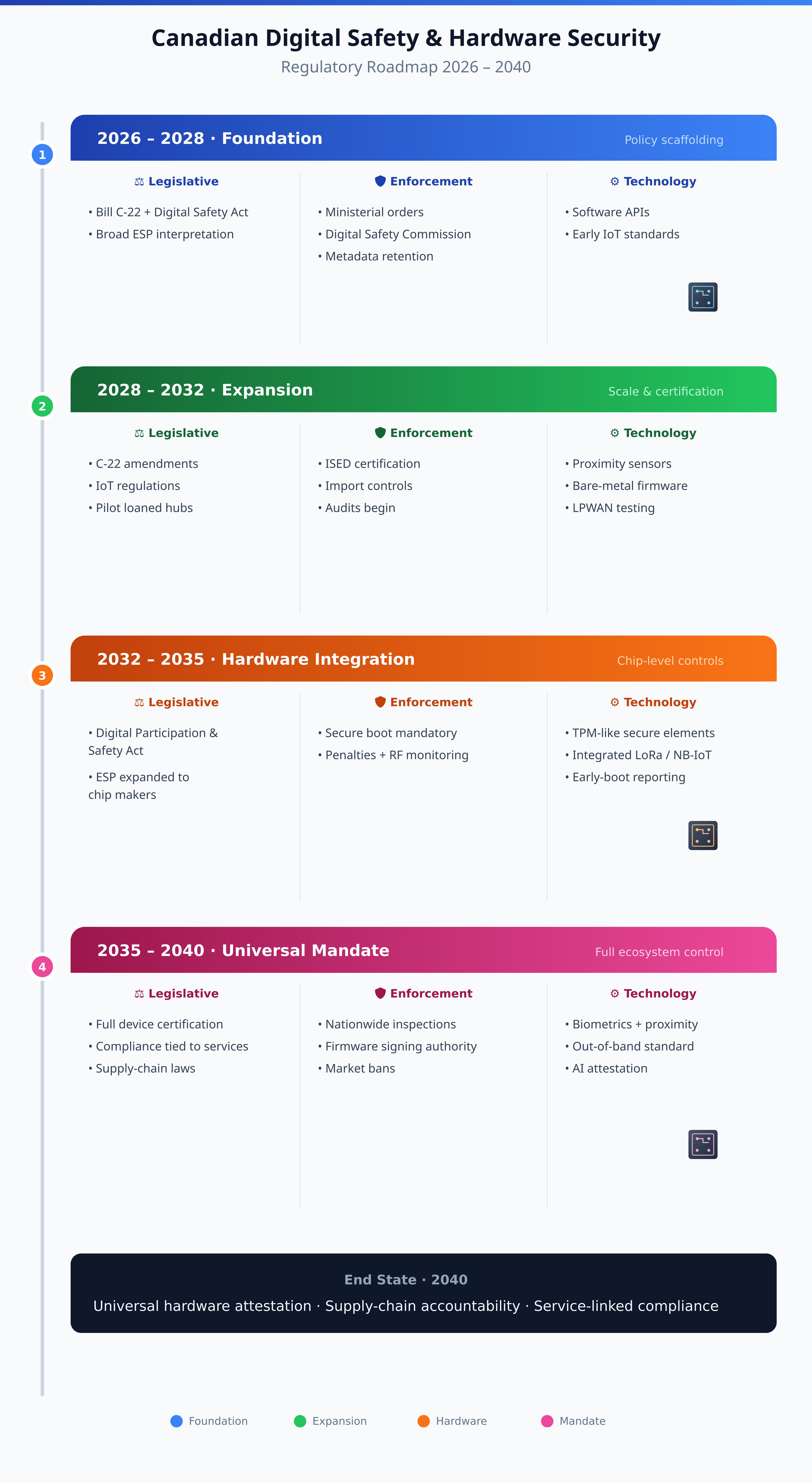
Here’s how Grok presented a hypothetical legislative path to digital surveillance at the hardware level:
What begins as an open-ended initiative with safety legislation, a new mechanism for enforcement, and a demand for corporate alignment with state policy is made all the more ridiculous in that the standards and interpretations are left open for the state to form and curate as it sees fit. Though it promises to do this with consultation should not assuage anyone’s concerns and should, in fact, do the opposite, given the federal government’s track record for awarding bloated contracts to companies and organizations with whom it has conflicts of interest. In time, reinterpretation, amendments, and publicly-funded pilot programs will lead to state standards for trust certificates at the hardware level, the assurance of “safe booting”, and digital safety standards for IoT, embedded security, and module safety centered not around encryption and permission to enforce operational privacy for an individual user, but “safety” regarding what information may theoretically be presented to a human. Indeed, as we’ve become accustomed to, and so the dialectic progresses, with a dialectic of digital safety.
Where this concludes is wherever the limits of technology happen to be, but which can thus far be imagined to include firmware signing, state safety standards for the reading and transmitting of sensor data, and safety for capture and storage of biometric data. A system of governance measures its success in the degree of control it has over the outcome of its initiatives, and so to grant it the semblance of legitimacy to assure the safety of our minds is to project a demand for the state to assert control over them.
Figure 1: Hardware Surveillance
5 What We Can Do
There’s little doubt that many are feeling helplessly left without a voice as it seems that the partisan structure of our system of governance is well-suited to passing in whatever legislation it targets, with the only pushback coming in the form of demands for amendments which imply the goal of the legislation is sound. For those who consider what future constraints are logically demanded by such legislation, they may feel at a loss to explain why Canadians are so warm to authoritarianism. The truth is that there is likely little to no support for an authoritarian system, freakish outliers notwithstanding, but that most are supportive of the logic to erect one so long as it is proposed under the veneer of what is socially acceptable. What this means is that hope is not lost, and that so long as there is room to move and a capacity to discuss, we can find opportunities to help people consider that they may be overlooking points about the issue that are not simply of a nature that opposes their values, but are actually ones for which their interest should ignite precisely because of those values.
5.1 Totalitarian
It’s easy to avoid imagining how a long term initiative might develop when the immediate rationale is based on “the children”. For this reason, it’s always necessary to bring people back to a base of understanding about incentives for power and professional advancement. There’s no doubt that anyone who is swayed by the argument “the corporate executives are willing to sacrifice your kids for extra bucks” can be led into agreeing that this extends to any position of sociopolitical import which, in addition to being remunerated, yields political and economic influence. Once we bring people into that view about those who draft, compose, vote on, and consult for these pieces of legislation, they’re more able to imagine that both the target of the initiative may not be perfectly identifiable, and that the operational scope is not limited to be perfectly discrete.
If you can get that far with people, then the next step is putting forward the question of what right a human being has to its own thoughts, and whether your interlocutor believes they would have a better life by relinquishing control of their mind to a governing entity—assuming, of course, that this entity has greater wisdom and is better able to orient them toward their correct destiny
(lest the interlocutor be a complete nihilist, in which case it’s time to move on).
Using the content of this article, you can then take it upon yourself to illustrate the path toward an increasingly totalizing system, both ideologically (the ideas) and mechanistically (the tech).
5.2 Identity
“The state’s enumeration of identity is precisely its policy to not allow you to be who you are.”
Any political system which seeks to extinguish the capacity for individuals to exert influence must either use immediate brutal force, or a rationale to dismiss those individuals. This means that if we have any hope of amending our system to be fair, support liberty, and potentiate human flourishing, we will need to completely and utterly obliterate any mention of identity from our laws. The only possible exception might be a national identity, but it is my opinion that such a thing is unnecessary so long as the laws apply equally to the citizens of the country, without exception.
Identity, in every case, is the reference to a theoretical model of a human mind, and once one’s association to that model is indicated, the observer can imagine the content of mind that may come to fruition as per the characteristics of that model, and cognize that model as an understanding of you. This, in essence, is a perpetual rationale to supplant any human, so long as the prospect of doing so is perceived to be beneficial.
There is no equal application of justice through laws that recognize a plurality of identities. For those identities to have any relevance whatsoever, such as to have prompted their addition, is for the state to reveal an intention for asymmetrical application of force to disparate classifications of citizen.
To move toward a just configuration of governance, we’ll be well-served by helping people understand that their perception of themselves as unique becomes meaningless in the face of a state that refers to them through group identity.
Gerritsen, Ryan. “Elizabeth May Making It Known That She Along with Every Opposition Party Opposed Bill c-22 Due to Privacy & Constitutional Concerns.” June 18, 2026.
Haidt, Jonathan. The Anxious Generation: How the Great Rewiring of Childhood Is Causing an Epidemic of Mental Illness. Penguin Press, 2024. @HungryTrucker. More Fear Porn Bullshit Propaganda from a Brainwashed Simp. How Have These Bills Affected You? X post, 2026.
[1] Finding Serenity (@mmysticbloom), Bill c-9 Is the Combating Hate Act and This Is Absolutely a Good Thing Unless You Are a Part of the Problem and Hate on Vulnerable and Marginalized Communities. We Should Be Accepting All Persons. Bring Back Equality and Equity. Bring Back Humanity. Less Hate; More Love., X (formerly Twitter), 2026,
[6] “Elizabeth May Speech on Bill c-51,” 2015, https://elizabethmaymp.ca/elizabeth-mayspeech-on-bill-c-51/.
[7]The Anxious Generation: How the Great Rewiring of Childhood Is Causing an Epidemic of Mental Illness (Penguin Press, 2024).
[8] Blacklock’s Reporter, “Would Sue over Social Posts,” Blacklock’s Reporter, July 3, 2026, https://www.blacklocks.ca/would-sue-over-social-posts/.
Emmanuel Rajinder Buckshi a telecom engineer in Canada who is optimistic about the prospect of solving many difficult problems through technology. I scrutinize defenses of collectivism and look shrewdly upon the risk of runaway authoritarianism inherent in administering systems of governance.
He is long time musician and former guitar teacher, and believes an appreciation for music as a demonstration of the logical brilliance in nature provides a good starting point for people that are ready to work out differences of opinion in good faith.
He is the author of the new book Tyranny of We: The Selfishness of Collectivism. He posts on X https://x.com/RBuckshi. His book can be purchased







Thanks so much for publishing my article!