


Greetings!
Long time no see, ladies and gents. Back to work (well, I’ve been working this whole time, which is why I’ve not written here). With that said, let’s discuss human communication, as you may labor under the delusion that facts and evidence change people’s minds. Let’s pop the hood on the braincase by way of a scenario.
You are Person A, conversing with Person B. You make a statement; B reacts with something that had nothing to do with your statement. On X, this is a meme of sorts; you say you like pancakes and someone asks why you hate waffles. There’s a kernel of truth there, buried; let’s dig it out.
I. The Operating System Below the Argument
Bold statement incoming: most human communication is unconscious.
I do not mean this as insult, nor as reference to nonverbal gesticulation; I mean it descriptively, and I’ll show you what I mean.
Words do two things in a conversation. Either they point at an individual, examinable definition (something you can pull up and interrogate, answerable to what it actually refers to) or they feed the standing frame the speaker perceives through. The second use dominates; it dominates most in proximity to the load-bearing, unexamined pieces of a person’s picture; the tendency intensifies the more morally charged a topic is from the speaker’s vantage.
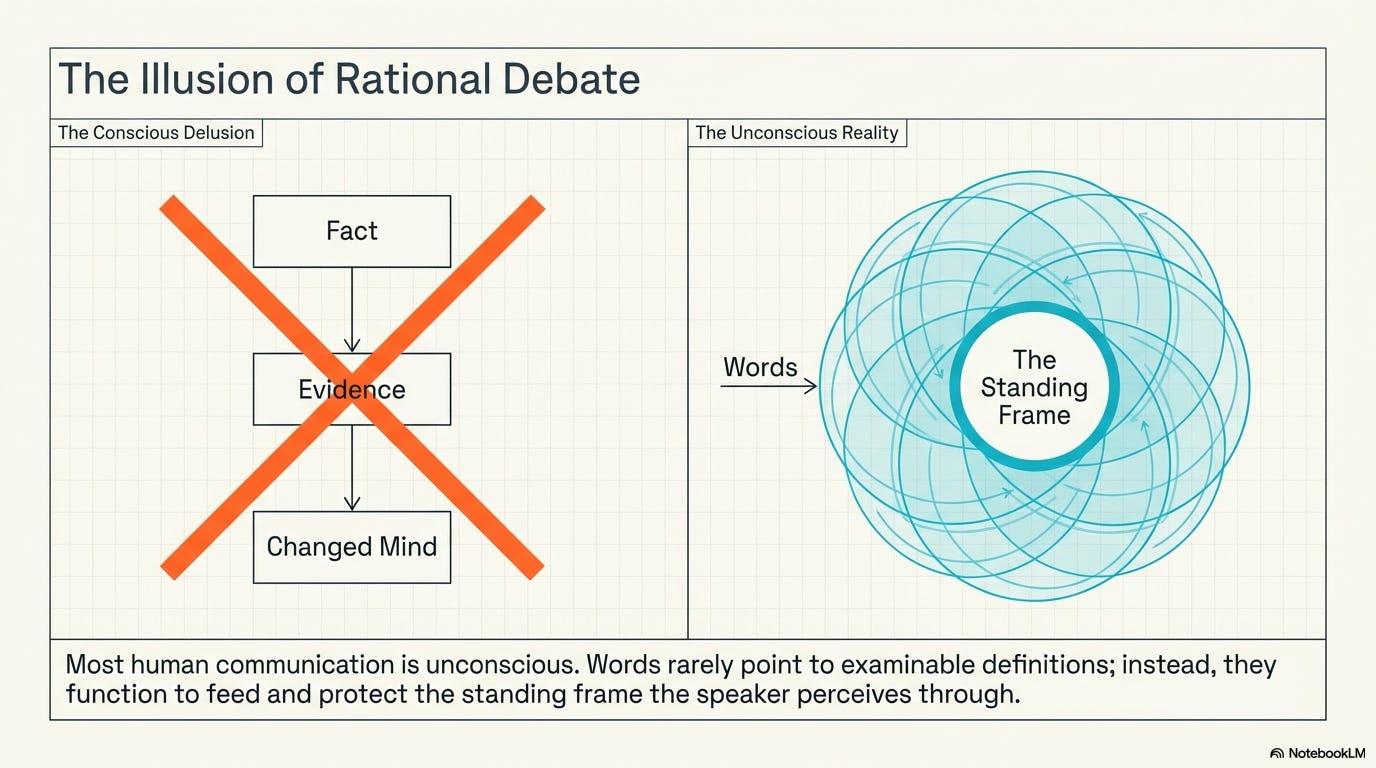
Near that core, a word carries almost no definition behind it. It functions as a token (yeah, you thought you were different than large language models, didn’t you?). It is held by positing rather than by correspondence, and returns nothing when you demand the definition, because the definition was never what it was doing.
Watch this.
Trump.
Did you read that, parse it as a card suit or a brass instrument, and move calmly to the next sentence? Or did a frame summon itself; favorable, unfavorable, somewhere between?
I didn’t even need to give you context; nothing regarding politics had appeared in this article up to that word. One word. The frame summoned itself.
Here is what that means for B’s response. The frame casts its content as neutral and true; to place a contradicting input onto that register is to index it as false and bad. The cheapest re-indexing fixes a verdict to the challenging word and skips the definition. What fires back is a label; a word run as a verdict where an argument was owed.
What you’re seeing shall henceforth be known as Framespeak.
Words in various contexts act as frame-tokens; units of a given frame, akin to the tokens an AI uses to parse a request. They carry the frame’s meaning rather than pointing at a definition; more often than not, the definition isn’t what the word is doing.
Let’s go check out some non-controversial examples.
II. Framespeak in the Wild
The Sex Binary
Biological sex in humans is binary. Two gamete types exist; the organism is organized around the production of sperm or egg; there is no spegg. State this in a conversation where the frame is load-bearing and the response does not address the gamete concept. It addresses you as a moral agent.
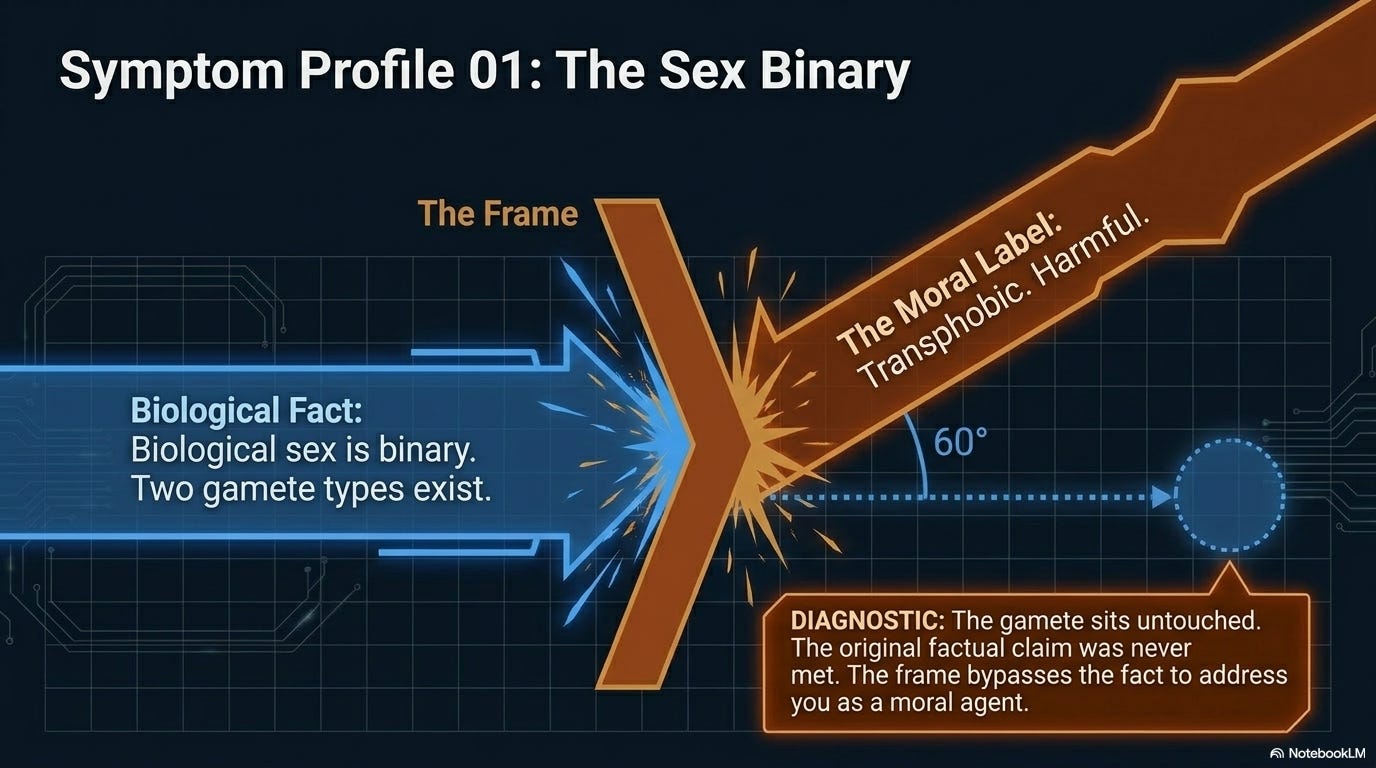
“Transphobic.” “Harmful.” “You want to erase trans people.”
The gamete sits untouched. The claim was never met.
Intersex conditions are real; they are developmental anomalies within a binary system, not evidence of a third category. A missing limb does not constitute a third class of limb. The frame does not engage this distinction. The distinction is not what the frame is processing.
The Embryological Claim
The embryological claim is this: at fertilization, a genetically distinct human organism is present. New genetic life, identifiable as such by any laboratory.
State this to someone holding the pro-abortion position and you receive an argument. The claim is met as a premise; new genetic life is present, but it is not a person because it is not born; it is a “parasite” and can be killed without moral consequence.
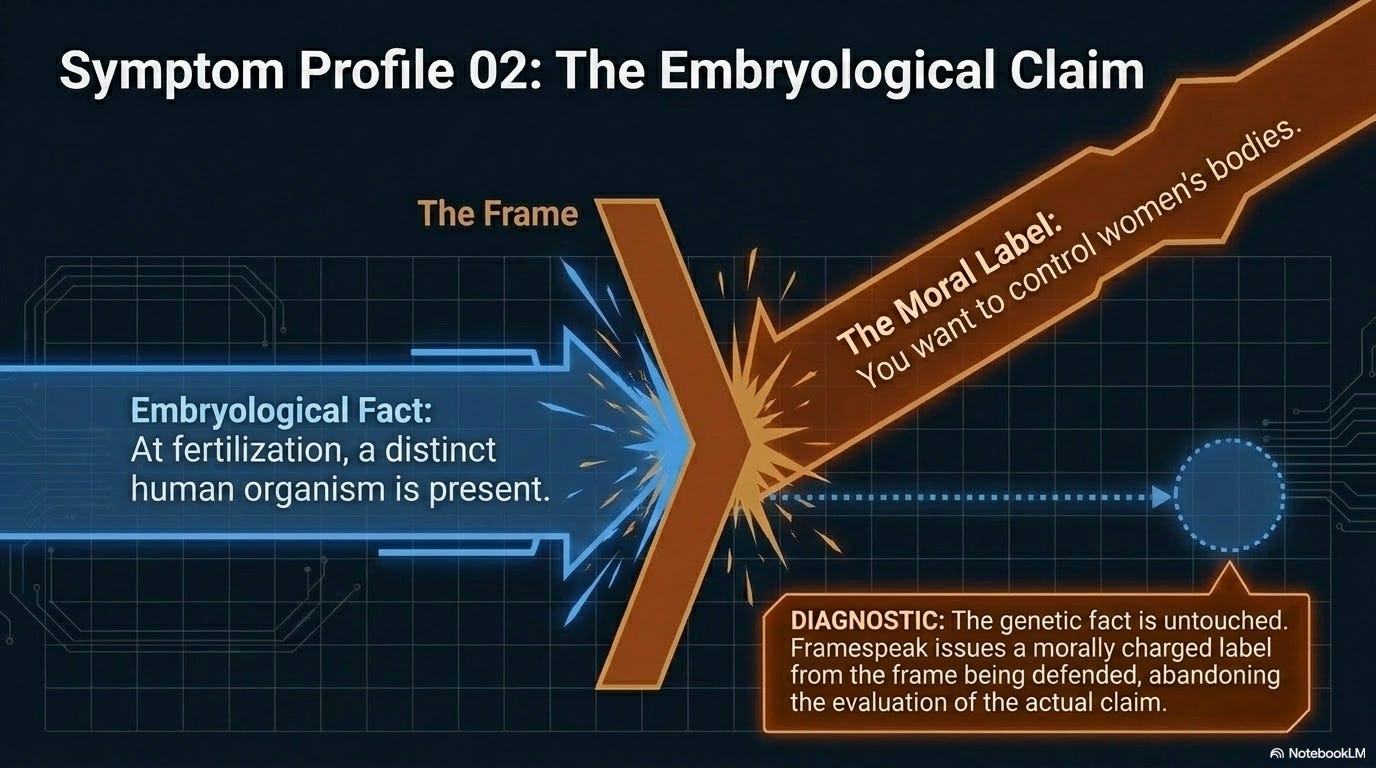
“You want to control women’s bodies.” “You’re imposing your religion.” “You hate women.”
The genetic fact (a new and distinct human is present) is not touched. The pro-abortion frame literally reinterprets the words in a manner that is commensurate with the frame itself; the claim of a distinct human being tends to remain unaddressed.
The distinction here is between an argument (a coherent series of reasons, statements, or facts intended to support or establish a specific point of view, claim, or conclusion) and Framespeak; the former is an evaluation of the topic of discussion (sex is binary or life begins at conception), the other issues a label from the frame being defended and that label is usually morally charged.
III. Under the Hood
All righty; I’ve described the mechanism in question. What I haven’t described is what I used to flesh it out.
Below is the formal argument that underpins the concept that I introduced in this article; this is the kind of structure that Metadiagnostics runs on; namely, the Euclidean method. I do this in order to ensure logical rigor with my thought processes. I won’t showcase every framework this explicitly (because it’s boring) but I will likely do so if I release a written work.
The Frame Spine: A Euclidean Polysyllogism
The Thesis
A word can be used two ways: to point at a standard definition, a referent public and answerable to mind-independent reality, or to carry a frame-centric definition, a meaning fixed inside the frame the speaker perceives through. On any topic that bears on a person’s metaphysical amalgam, the frame-centric use predominates, and it predominates most at the load-bearing, unexamined metaphysics at the amalgam’s core. This is a descriptive claim about how words function in ordinary cognition, prior to any claim about what makes an argument good.
The chain below derives, from this thesis and the foundation it rests on, how a frame holds an amalgam-bearing matter against contradiction, why the defense takes the form of a label, why the defense intensifies on moral ground, how its profile under pressure reads the core’s type, and the one operation that reaches a posited core.
Primitives
A primitive is a term the system does not define and cannot, on pain of regress; it is pointed at, and everything else reduces to it.
Pr1. Reality. What is, independently of any mind. The terminus of answerability; nothing grounds it.
Pr2. Mind. The human subject that holds, perceives, reasons, and uses words.
Pr3. Word. A linguistic token a mind uses.
Pr4. Reference. The relation in which a word stands for something; the referent is what the word is about.
Pr5. Logic. The principles by which inference proceeds.
Pr6. Topic. Any subject matter that can be considered.
Definitions
D1. Metaphysic. What a mind holds concerning what is fundamentally real. (Pr2, Pr1)
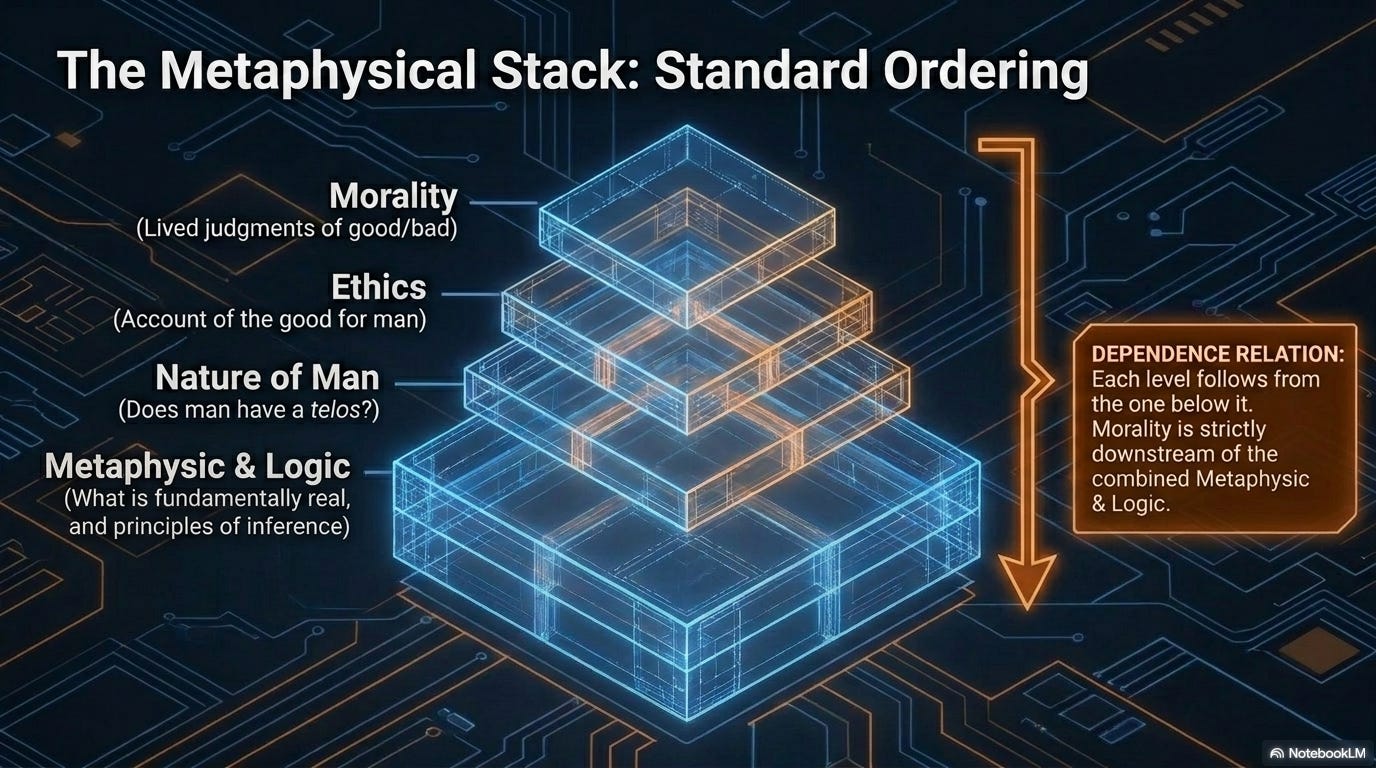
D2. Metaphysical ordering. The dependence relation between a metaphysic and the levels derived from it. Logic is an aspect of a metaphysic. From the metaphysic follows the nature of man, including whether man has a telos (the end toward which a nature is directed); from the nature of man, ethics (the account of the good for man); from ethics, morality (the lived judgments of good and bad in action). Each derived level follows from the one above it and cannot ground it. (D1, Pr5)
D3. Metaphysical amalgam. The aggregate of metaphysics a mind holds, typically unexamined, used heuristically, and not necessarily consistent with one another. (D1, Pr2)
D4. Frame. A coherent subset of the amalgam, activated by a topic, through which the person perceives; self-similar in kind to the amalgam, composed of the same unexamined metaphysics, and locally free of contradiction even where the whole amalgam is not. (D3, Pr6, Pr5)
D5. Standard definition. A referent that is public, stable across frames, and answerable to mind-independent reality. A dictionary is a corruptible proxy for this, never the thing itself. (Pr4, Pr1, D4)
D6. Frame-centric definition. The meaning a word holds within a frame, fixed by that frame’s internal freedom from contradiction rather than by a public referent or by reality. (Pr3, D4, Pr5)
D7. Load-bearing metaphysic. A metaphysic in the amalgam (D3) on which other metaphysics, and the person’s action and sense of who he is, depend. (D3, D1)
D8. Unexamined. Held without having been tested against reality or made explicit as a proposition. (Pr2, Pr1)
D9. Moral dimension. A property of a topic; a topic has a moral dimension when the position taken on it implicates the holder’s own goodness, his standing under the morality his amalgam holds (D2). (Pr6, D2)
D10. Misconstructed metaphysic. A morality placed in the grounding position the ordering (D2) reserves for the metaphysic, commonly a morality imported from another metaphysic. (D2)
D11. Frame-centric fraction. For a given metaphysic in the amalgam (D3), the proportion of all word-uses bearing on it that are handled by the frame-centric definition (D6) rather than judged against a standard definition (D5); frame-centric uses over total uses, on that metaphysic. (D3, D6, D5)
D12. Core. A metaphysic at or near the maximum of load-bearing (D7) in an amalgam (D3), one on which the greatest number of the amalgam’s other metaphysics, and the person’s action and sense of who he is, depend. An amalgam may have more than one. The grounding position the ordering reserves for the metaphysic (D2) is a position of maximal load, so a misconstructed metaphysic (D10) is a core. (D7, D3, D2, D10)
Premises
P1. A word points to one of two targets: a standard definition (D5) or a frame-centric definition (D6). For topics bearing upon the amalgam (D3), the frame-centric use is the more frequent.
P2. The frame-centric fraction (D11) is greater for a more load-bearing metaphysic (D7), and is greatest at the most load-bearing, unexamined (D8) metaphysics of the amalgam (D3).
P3. The ordering (D2) holds: logic is an aspect of the metaphysic, and ethics and morality derive from it. So logic is upstream of every derived level, and morality is downstream of logic.
P4. Where a topic has a moral dimension (D9), the moral dimension tends to obfuscate the logical evaluation of the topic, even though morality is downstream of logic (P3). The obfuscation is greatest when the engaged metaphysic is a misconstructed metaphysic (D10), where a morality occupies the metaphysical role from which it should be derived.
P5. When a topic bears upon the mind’s metaphysical amalgam (D3), the frame activated by that topic (D4) handles the word through itself; the standard definition (D5) may be consulted, but the frame-centric definition (D6) overrides it and fixes the operational meaning.
P6. A mind perceives through its active frame (D4), not at it. To represent a frame as one position among alternatives requires a standard outside that frame, against which it and its alternatives are compared.
P7. A mind may hold a metaphysic in either of two ways. By correspondence: it holds the metaphysic as answerable to mind-independent reality (Pr1), so that reality stands as a standard outside the frame (P6) against which the metaphysic itself can be judged. By positing: it holds the metaphysic as fixed within the frame, answerable only to the frame’s internal freedom from contradiction (D6), so that no standard outside the frame bears on it.
P8. When a demand for the standard definition of a word exposes that the word answers to nothing outside the frame, a mind may register that absence or may fail to register it; the exposure does not compel registering, and the same exposure is registered by one mind and not by another. (Pr2, D5)
The Chain
1. When a topic bears upon the amalgam and activates a frame (P5, D3, D4), the word is handled through the frame; the standard definition may be consulted, but the frame-centric definition overrides it and fixes the operational meaning (P5). A frame-centric definition is fixed by the frame’s internal freedom from contradiction, mind-independent reality playing no part (D6); a standard definition answers to that reality (D5). ∴ For a word on such a topic, its operational meaning is settled within the frame and is not answerable to mind-independent reality (Pr1); and since this is the more frequent condition of word-use for amalgam-bearing topics (P1), the settling-within-the-frame is the ordinary case across that domain. (from P5, D6, D5, P1)
2. By step 1, for amalgam-bearing topics the operational meaning of a word is fixed within the frame and is not corrected by mind-independent reality. A frame-centric definition is validated only by the frame’s internal freedom from contradiction (D6), and that freedom from contradiction is a standard the frame itself supplies. ∴ Within the domain of amalgam-bearing topics the frame is self-warranting: it is the source of its own operative meanings and the sole standard by which they are validated, with no external check. (from step 1, D6)
3. Within the amalgam-bearing domain the frame is its own sole standard, with no external check (step 2). A mind perceives through its active frame, not at it, and to represent that frame as one position among alternatives would require a standard outside it (P6). Within the domain there is no such standard (step 2). ∴ From within, the frame is not represented as one position among alternatives; it is taken as simply how things are, neutral rather than a stance, and true rather than a view, identified with reality rather than held as a position upon it. (from step 2, P6)
4. Within the amalgam-bearing domain the frame is taken as coincident with reality, the neutral and the true (step 3). A contradicting input is a word whose standard definition (D5) points to something the frame does not contain or denies. To judge that input against its standard definition would set a referent answerable to mind-independent reality against the frame; but in this domain the frame admits no standard outside itself (step 2), and the activated frame overrides the standard definition with its own (P5, D6). ∴ A contradicting input cannot be judged against its standard definition from within the frame; it is handled through the frame, taken on the frame’s own terms rather than on the referent it answers to. (from step 3, step 2, P5, D5, D6)
5. A contradicting input is handled on the frame’s own terms rather than on the referent it answers to (step 4). On those terms the frame is the neutral and the true, taken as coincident with reality (step 3). To place an input that contradicts the true-and-neutral onto the frame’s own register is to assign it the only standing that register leaves for what opposes the true and the neutral. ∴ The contradicting input is received as the untrue and the non-neutral, the false and the partisan, by the frame’s own classification and prior to any examination of the referent it actually points to. (from step 4, step 3)
6. A response that engages the contradicting input’s referent would require judging it against its standard definition, a judgment the domain forbids (step 4). The input instead is received as false and non-neutral by the frame’s classification, before any inspection of that referent (step 5). So a response to the input has only two forms available: engage the referent, which is foreclosed, or express the classification already assigned. ∴ Any response the frame makes to the input expresses the assigned classification and does not engage the referent; the input is answered by applying the frame’s category to it, a word that carries the verdict and does not meet the referent the input points to. This response-form is henceforth called a label. (from step 4, step 5)
7. The label assigns the input a category and does not engage its referent (step 6). The one route by which the input could have corrected the frame was to be judged against its standard definition, and that judgment the domain forecloses (step 4). ∴ Once labeled, the contradicting input exerts no corrective pressure; the frame stands unchanged. The labeling operation preserves the frame against the challenge. (from step 6, step 4)
8. Step 7 shows that for the contradicting input in view, the labeling operation leaves the frame unchanged. Nothing in steps 4 through 7 revolves around the particular input: any input that engages the amalgam is handled through the frame (P5), cannot be judged against its standard definition (step 4), is received as false and non-neutral (step 5), and is answered by a label that preserves the frame (steps 6, 7). ∴ Within the amalgam-bearing domain every contradicting input meets the same preservative operation; the frame admits no input that corrects it from within the domain. (from step 7, step 4, step 5, step 6, P5)
9. Step 8 establishes that within the amalgam-bearing domain frame preservation meets every contradicting input. P2 adds that the frame-centric fraction is not even across that domain: the more load-bearing a metaphysic (D7), the greater the proportion of words bearing on it that are handled inside the frame rather than judged against a standard definition (D11). The preservative operation is what frame-centric handling produces, since it is frame-centric handling that overrides the standard definition (P5), forecloses the judging against a standard definition (step 4), and applies the label (steps 5, 6, 7). So the concentration of the operation follows the frame-centric fraction. ∴ The more load-bearing the engaged metaphysic, the more completely frame-centric handling governs and the less the standard definition governs; the preservative operation is greatest, and correction least available, at the most load-bearing, unexamined metaphysics. This is the load-ordering of the frame-centric fraction. (from step 8, P2, P5, step 4, steps 5, 6, 7)
10. By the ordering (D2) a metaphysic descends through ethics to a morality, so the metaphysics composing the amalgam carry moral content, and the frame, self-similar in kind to the amalgam (D4), carries that moral content in small. Step 3 established that the frame, being its own sole standard, represents its content as true and as neutral. The same self-warrant applied to its moral content represents that content as good. ∴ Where the engaged metaphysic is moral, the frame represents its own moral content as good, and a contradicting input, already received as false and non-neutral (step 5), is received also as bad. (from D2, D4, step 3, step 5)
11. Step 9 established the load-ordering: the frame-centric fraction, and with it the preservative operation, is greater for a more load-bearing metaphysic. P4 adds a moral charge whose source is the metaphysic’s implication of the holder’s goodness (D9), not how load-bearing the metaphysic is (D7); it therefore does not increase with load, and can be present at low load or absent at high load. Where a topic has a moral dimension (D9), the position taken implicates the holder’s own goodness. The self is held good by virtue of the positions it holds, so the goodness of the position and the goodness of the self are one; to attack the position is to attack the self, and to oppose the frame is to be cast as holding the bad. The contradicting input therefore arrives as bad (step 10) and as an attack on the self. P4 states that this moral dimension obfuscates the judging of the input against its standard definition, though morality is downstream of logic (P3, D2). The obfuscation differs from the override of step 4 in where it cuts. Under the override, the input is judged against its standard definition and that judgment is then subordinated, the frame-centric meaning winning. Under the moral charge, the input is met as an attack on the self and the defense fires before the input is judged against its standard definition, so the input is never judged against its standard definition at all. ∴ On a moral topic the preservative operation is intensified beyond the load-ordering of step 9: the input is foreclosed as bad and as an attack on the self, the input is never judged against its standard definition, and this charge, arising from self-implication (D9) and not from load (D7), adds to the ordering rather than restating it. Where a topic carries moral content but does not implicate the holder’s goodness (D9), no such charge arises, and the topic is handled by the load-ordering of step 9 alone; the intensification is a function of self-implication, not of moral content as such. (from step 9, P4, step 10, P3, D2, step 4)
12. D10 names a misconstructed metaphysic: a morality placed in the grounding position the ordering (D2) reserves for the metaphysic. The grounding position is the one on which every derived level depends (D2), so a morality that takes the place of metaphysics is maximally load-bearing (D7). Two intensifiers follow from that position, by the two separate routes the chain has built.
By step 9, where load is maximal the frame-centric fraction is maximal, so almost no word bearing on this metaphysic is judged against a standard definition.
By step 11, the content placed there is a morality, so the moral charge is present, and present at its greatest, since a morality at the ground fixes the holder’s whole standing under morality (D9) rather than his standing on one matter among many; to oppose it is to attack the self entire, not the self on a point.
∴ At a misconstructed metaphysic the two intensifiers coincide and compound: the input (the opposing word or argument) is at once not judged against a standard definition (step 9) and determined as an attack on the self (step 11). This is the least correctable position in the amalgam. (from D10, D2, D7, step 9, step 11, D9)
13. By step 6 a contradicting input is answered with a label, a word carrying the verdict and not engaging the referent. By step 3 the frame represents its content not as one position among alternatives but as neutral and true, coincident with reality. By step 10, where the engaged metaphysic is moral, the frame represents its moral content as good. So a label drawn from the frame’s moral content carries a verdict that the frame represents at once as neutral, as true, and as good, the application of the standard rather than the taking of a side. ∴ The moral label presents as the measure against which the input is judged, not as one moral position set against another; the frame’s own value is presented as the objective moral standard. This presentation is strongest at a misconstructed metaphysic (step 12), where the moral content occupies the grounding position and is held as what is fundamentally real (D1, D2), so the label drawn from it presents as the measure of reality itself. (from step 6, step 3, step 10, step 12, D1, D2)
14. Steps 9, 11, and 13 established the load-ordering of the frame-centric fraction: across the metaphysics of one amalgam, the more load-bearing a metaphysic, the greater the proportion of the words bearing on it that are handled inside the frame by the frame-centric definition (D6) rather than judged against a standard definition (D5); at the most load-bearing metaphysic the proportion is near total, so almost every word bearing on it is handled inside the frame and almost none is judged against a standard definition.
An interlocutor who presses a single challenge nearer and nearer to a load-bearing metaphysic engages, at each step of approach, a more load-bearing metaphysic, and so traverses that ordering in time; the proportion of the holder’s responses handled inside the frame grows greater the nearer the approach comes. This traversal of the load-ordering in time is the approach-behavior of the frame-centric fraction.
By P7 a metaphysic held by positing is answerable only within the frame, with no standard outside it; when the approach reaches it, no input can be judged against a standard outside the frame, because none is held, and handling inside the frame is the only handling available. So for a posited core the proportion grows toward total as the approach nears the core; at the core almost every response is a frame-internal label and almost none is a judgment against a standard definition. By P7 a metaphysic held by correspondence is answerable to mind-independent reality, so a standard outside the frame is held (P6); when the approach reaches it, the holder can step to that standard, judge the input against it, and submit the metaphysic itself to examination (P6) rather than take it as simply how things are (step 3). So for a corresponding core the proportion does not grow toward total; at the core the holder judges the input against the standard outside the frame, and each such judgment is a response not handled inside the frame, so the proportion handled inside the frame stays below total however near the approach comes.
∴ As a challenge nears the most load-bearing metaphysic, the proportion of the holder’s responses handled inside the frame either grows toward total or does not, and which it does forks on how the metaphysic is held. For a posited core it grows toward total, almost every response at the core a frame-internal label. For a corresponding core it stays below total, the holder judging the input against the standard outside the frame and so producing responses not handled inside the frame. The behavior of this proportion across the approach is therefore diagnostic of how the core is held: the proportion growing toward total as the core is neared marks the core posited; the proportion staying below total marks the core corresponding. (from steps 9, 11, 13, P7, P5, P6, step 3)
15. For a posited core the proportion of responses handled inside the frame grows toward total as the approach nears the core, until at the core almost every word bearing on the core is handled inside the frame and almost none is judged against a standard definition (step 14). A word handled inside the frame takes its frame-centric definition, the meaning fixed by the frame and answerable to nothing outside it (D6, P7); a word judged against a standard definition takes a meaning answerable to mind-independent reality (D5). At the core, where the first has grown to near total and the second to near none, the words bearing on the core carry almost only frame-centric definitions and almost no standard definition. ∴ At a posited core a word bearing on the core has, in the limit, no standard definition behind it at all, only the verdict the frame assigns it; the word points to nothing outside the frame. To demand the standard definition of such a word, to ask what outside the frame it answers to, is to demand what is not there, and the demand returns nothing. (from step 14, D6, P7, D5, step 5, step 6, step 1)
16. By step 15, at a posited core the demand for the standard definition of a core word returns nothing, the word answering to nothing outside the frame. By P8 a mind meeting this empty return either registers that the core word answers to nothing outside the frame, or fails to do so.
Failing to register it: the holder does not take the empty return as an absence at all; the demand is met with one more frame-internal label (step 6) or with a refusal to proceed, the handling remains inside the frame, and the posited core remains held as before (step 14).
Registering it: the holder takes the empty return as an absence, registering that the core word answers to nothing outside the frame. To register this is to register that what step 3 held as simply how things are answers to nothing outside the frame. A thing seen to answer to nothing outside the frame is no longer held as reality itself; it is held as a position, one the frame takes. And by P6 holding the core as a position is possible only against a standard outside the frame, which the empty return has just supplied, the contact with reality (Pr1) that the demand produced. So in registering the absence the holder holds, for the first time, the core as a position answerable to a standard outside his frame.
∴ The empty return forks on whether the absence is registered. Where it is not registered, the posited core remains held as reality itself, and the demand changes nothing. Where it is registered, the holder comes to hold the core as a position answerable to a standard outside the frame, and the core that was held as reality itself is held, for the first time, as one position among the positions that are possible. This registering is the first correspondence the posited core admits, and it is reached only through the demand that exposed the empty return. (from step 15, P8, step 3, P6, Pr1, D5, step 6, step 14)
17. At a posited moral core the frame holds its moral content as good (step 10) and as the measure against which inputs are judged, the standard itself rather than one position among alternatives (step 13). By P7 the posited core holds no standard outside the frame, and by step 15 the core word answers to nothing outside the frame. So the only standard available for judging a moral input is the frame’s own moral content, held as good. A standard that is a single content held as good admits, of what it can itself register, exactly two verdicts: accord with that content, which it marks good, or discord with it, which it marks bad (step 11). No third verdict is available to the frame, because a third would require a standard other than the frame’s own moral content, and by P7 and step 15 the posited core holds none. This is a limit on what the one frame-internal standard can register, not a limit on the moral field. ∴ At a posited moral core every moral input the frame registers is sorted into one of two standings, the good that accords with the frame’s content or the bad that discords with it; the frame can place no input outside this pair, because the single frame-internal content is the only standard it admits. This pair exhausts what the one frame-internal standard can register, and the frame presents it as exhausting the moral field itself. The presentation overreaches the registration. (from step 10, step 13, P7, step 15, step 11)
18. Take two minds in contact on an amalgam-bearing topic, each perceiving through a frame (D4). A word the first sends is received by the second through the second’s frame, which handles it by its own frame-centric definition (D6, P5) and, where it contradicts, by the preservative operation of steps 4 through 8. So the word does not arrive in the second mind bearing the first frame’s meaning; it arrives as the second frame renders it. The same holds in the other direction. Words cannot carry a meaning from inside one frame to inside another, because meaning is fixed within each frame and re-fixed on receipt.
Nor is there a shared logic beneath the words to compel agreement across the divide. By P3 logic is an aspect of a metaphysic, so each frame carries its own logic, and an inference that binds within one frame need not bind within the other. There is no logic standing outside both frames, common to them, by which one could force the other to a conclusion it does not already hold.
∴ Two frames in contact cannot reach each other by words or by argument. A word is re-fixed by the receiving frame, and no shared logic compels the inference across the divide; so neither frame can be moved from inside the other’s terms. This is the no-outside: from within, a frame meets every challenge on its own terms and is reachable by no move that stays within words and shared logic, because for amalgam-bearing matter there is no shared logic, and the words do not cross. (from steps 4–8, D6, P5, P3, D4)
19. By step 18 neither words nor argument cross between two frames, so a challenge that defeats a particular label the frame has issued does not reach the frame: the defeated label is one word handled inside the frame, and by steps 6 and 8 the frame answers the next challenge with another label. Defeating labels one at a time moves the defense from label to label and leaves the frame holding. So the labels are not what a breach must reach; the holding is, the frame’s holding of its core as answerable to nothing outside itself (step 15).
By step 16 one operation reaches that holding. The demand for the standard definition of a core word brings the word into contact with reality (Pr1) by asking what outside the frame it answers to (D5), and at a posited core the demand returns nothing (step 15). This demand is not a word sent to be re-fixed by the receiving frame, nor an inference offered to be judged by the frame’s own logic; it is neither of the moves step 18 sealed off. It asks the holder to produce, from his own frame, the outside referent of his own word, and where there is none the absence is his own to register (step 16).
∴ A posited core is reached not by defeating its labels and not by argument across the divide, but by the demand for the standard definition of a core word, the demand that returns nothing and, where the holder registers the absence, begins the conversion of the core from held-as-reality to held-as-a-position (step 16). This operation is the one move that passes the no-outside, because it neither sends a meaning across nor compels an inference, but turns the holder to the standard that stands outside every frame, reality itself. Name this operation the demand for the standard definition. (from step 18, steps 6, 8, step 15, step 16, Pr1, D5)
20. By step 19 a posited core is reached only by the demand for the standard definition, the demand that asks the holder to produce, from his own frame, what outside reality his core word answers to. Consider who can press this demand and have it do its work. The one pressing must hold the matter open to the standard outside the frame, mind-independent reality, since the demand is an appeal to that standard, an asking-what-outside-reality-the-word-answers-to (D5, Pr1); one who held the same matter by positing would have no outside standard to appeal to and could issue only a competing label, which by steps 18 and 19 does not cross and does not reach.
By P7 a mind holds a given metaphysic in one of two ways, by correspondence or by positing. A speaker who holds the matter under challenge by correspondence holds it as answerable to mind-independent reality; for him, on this matter, the word keeps its standard definition, the proportion of his own responses handled inside the frame does not grow toward total as the matter is pressed (step 14), and he can therefore carry the appeal to the outside standard into the other’s frame, asking of the other’s word what he already holds his own word to answer to. A speaker who holds the matter by positing cannot: pressed on it, his own responses grow toward the frame-internal, he has no outside standard in hand to appeal to, and he can meet the other only frame to frame, label against label, the no-outside on both sides.
∴ The demand for the standard definition can be pressed effectively only by a speaker who holds the matter under challenge by correspondence, answerable to the standard outside the frame. Only such a speaker carries an outside standard into the exchange, and only an outside standard carried in can ask of a posited core’s word what it answers to and expose that it answers to nothing. The breach of a posited core requires, on the side pressing it, a corresponding hold on the same matter. (from step 19, P7, D5, Pr1, step 14, step 18)
Conclusion
The whole chain follows from the foundation wherever a frame must hold an amalgam-bearing matter against contradiction.
A word on such a matter takes its meaning inside the frame and is not judged against mind-independent reality (steps 1, 2), the frame-centric handling predominating by P1 and P5. The frame represents its content as neutral and true, taken as how things are rather than as one position among alternatives (step 3); so a contradicting input is received as false (steps 4, 5) and answered with a label, a word carrying the verdict and not engaging the referent (step 6), and the labeling preserves the frame against every such input (steps 7, 8). The frame-centric fraction is ordered by load: greater at the more load-bearing metaphysics, near total at the core (steps 9, 14). On moral matter a further charge is added, arising from the metaphysic’s implication of the holder’s goodness and not from load (steps 10, 11), greatest at a misconstructed metaphysic where a morality occupies the grounding position (step 12); there the frame’s own value presents as the objective standard (step 13), and moral judgment is forced onto two values, accord or discord with that value, presented as exhaustive of the moral field (step 17).
Pressed toward the core, the proportion of responses handled inside the frame behaves diagnostically: it grows toward total where the core is held by positing and stays below total where the core is held by correspondence (step 14). At a posited core the core word answers to nothing outside the frame, so the demand for its standard definition returns nothing (step 15); where the holder registers that absence, he comes to hold the core as a position answerable to the standard outside the frame, and the conversion begins (step 16). Between two frames neither words nor argument cross, words re-fixed on receipt and no shared logic beneath them (step 18, by P3); so defeating labels does not reach the frame, and the one operation that reaches the holding is the demand for the standard definition (step 19), which can be pressed effectively only by a speaker who holds the matter under challenge by correspondence, and so carries the standard outside the frame into the exchange (step 20).
∴ On amalgam-bearing matter a frame holds against contradiction by settling meaning within itself, answering challenge with the preservative label, and admitting no correction from inside its own terms; it is reachable only from outside those terms, by the standard that stands outside every frame, reality, brought to bear through the demand for the standard definition by one who holds the matter in correspondence with that standard. And because a frame is self-similar in kind to the amalgam it is drawn from (D4), and the same ordering governs a metaphysic and its derived levels at every level of organization (D2), this same structure recurs wherever a frame must hold an amalgam-bearing matter against contradiction, from the single word in an exchange to the institution. The structure recurs; the particular contents at each scale differ. (from Premise and steps 1–20, with D2, D4)

Brutus is the founder of the American Epistemology Institute (AEI), an educational nonprofit dedicated to restoring the metaphysical foundations of American life. He is the creator of Metadiagnostics — a diagnostic theory that identifies how metaphysical premises shape institutional behavior and civilizational trajectories. Twenty years of autodidactic philosophical study. A professional background in systems design. A conviction that the real crisis is upstream of politics. He is the lead author of AEI’s white papers and the author of this publication. Read more at

Amazing, as usual. But communication goes a long way when it's honest/sincere. Without calculations.
I'd love an article about that.
*Resharing my thoughts from Twitter.
I think I get the concept, but I don't think I know enough to fully grasp it.
Basically, detailing the method by which man receives and interprets incoming information by layering it through the various metaphysical levels.
It is well worth the reading.