


For those who prefer, the author has recorded an audio version
I want to talk about narratives and how they’re made and why they need to be preserved in the west, but especially in Canada. I am interested in talking about this because Canada really only has narratives left. That’s all we have, agree or disagree. To understand Canada’s position on the world stage, consider our global irrelevance. South of us, we have the Americans, and they’re bagging Tropico 6 dictators and traveling around the world to try to deal with issues and possibly take Greenland, who knows? But they’re doing things and they’re making moves, big moves. Canada’s response has been, well, we don’t really have a response. Government officials have made some safe statements, but that’s all they’ve done. Because we don’t have any strength, we don’t have any power, we don’t have any moral clarity on the world stage. We’re a bit of a joke. So even though we occupy the northern border of the United States, all we can really do is comment and take potshots from the side because we don’t have any actual authority to make any decisions.
We can’t really call anyone out. We don’t have the military backing to call out the United States. We don’t have the moral clarity to be the moralizers for any situation given our own corruption. We’ve really run out of rope, so to speak, when it comes to having any ability to influence or even really comment on world events at this point. Canada has largely become irrelevant. So while the adults are at the adults table making decisions, we are playing with paint, with our elbows up at the kids table, because we’re not really that serious. As a country, we have built a set of assumptions and a set of narratives, and we’ve done it for a long time but probably for the past 10 years especially. This has been a very long game of propaganda for Canada.
We are a deeply subverted country. In order to keep people from rebelling, really taking a stance or noticing, we have to operate as a country on a set of narratives. This reliance on stories shapes our national discourse and limits meaningful action.
Introduction to Manufacturing Consent
To best talk about narratives, lets talk about something called Manufacturing Consent. Noam Chomsky wrote the book Manufacturing Consent really to attack neocons allying up with intelligence agencies and news agencies to do clandestine operations to basically bring smaller countries into the fold. To make it work they had to get the American people on board. Manufacturing consent is not just something that neocons do, we’ve seen it become a foundational structure for left wing order.
Manufacturing consent is something that we’re seeing heavily in Canada. I want to give a few examples here and build on it in the following paragraphs. In quick review of Manufacturing Consent, one of the key areas of it is the propaganda model. Mass media in democratic societies filter the news out to serve the interests of some type of elite; whether it’s politicians, corporations or a mix. They basically take the public consent and they mold it rather than just informing objectively. I do want to note that the advertising filter will not be discussed in here as most of Canada’s media is Government or subsidized. Relying on tax dollars rather then advertisers, which has troubling implications as well.
Examining a specific instance reveals how manufacturing consent operates in Canada. It’s one you can easily look up and it’s a very damning example. It barely registered as a flicker on most people’s radars. Jody Wilson Raybould was the Attorney General for Canada, and she was tasked with dealing with a company called SNC-Lavalin. This is not the first time this company has been near a Liberal scandal. Jody Wilson Raybould became embroiled in a web of attempts to influence her position towards a deferred prosecution and she recorded her conversations.
When she gave her testimony to the justice committee, she made a very interesting comment and for some reason it really just slipped by the media, maybe purposefully. It was about her chief of staff that had heard from a senior member of the Prime Minister’s office. This is what she said. “She was like, if Jody is nervous, we would of course line up all kinds of people to write op eds saying that what she’s doing is proper.”
That, my friends, is manufacturing consent. You see when something might not be popular or possibly legal, the ruling party can find some useless media eaters that will line up and deliver the op eds to mold the opinions of Canadians. That is media and government colluding to ensure that there is a narrative preservation through manufacturing consent. How do they get away with being able to do these things and why was this not the front page quote for every newspaper in Canada? Well, we have to understand another part of manufacturing consent. It’s media ownership.
In Manufacturing Consent it is explained that media corporations are owned by wealthy people, elites, conglomerates, or in the case of Canada the government. They prioritize profit and aligning content with business interests. In the Government sector, tax paying money is spent to hire people to mold the opinions of Canada. Most mainstream media in Canada receives subsidies from the government or they’re directly government funded themselves. I’m going to give you another example here from a Liberal MP towards a journalist.
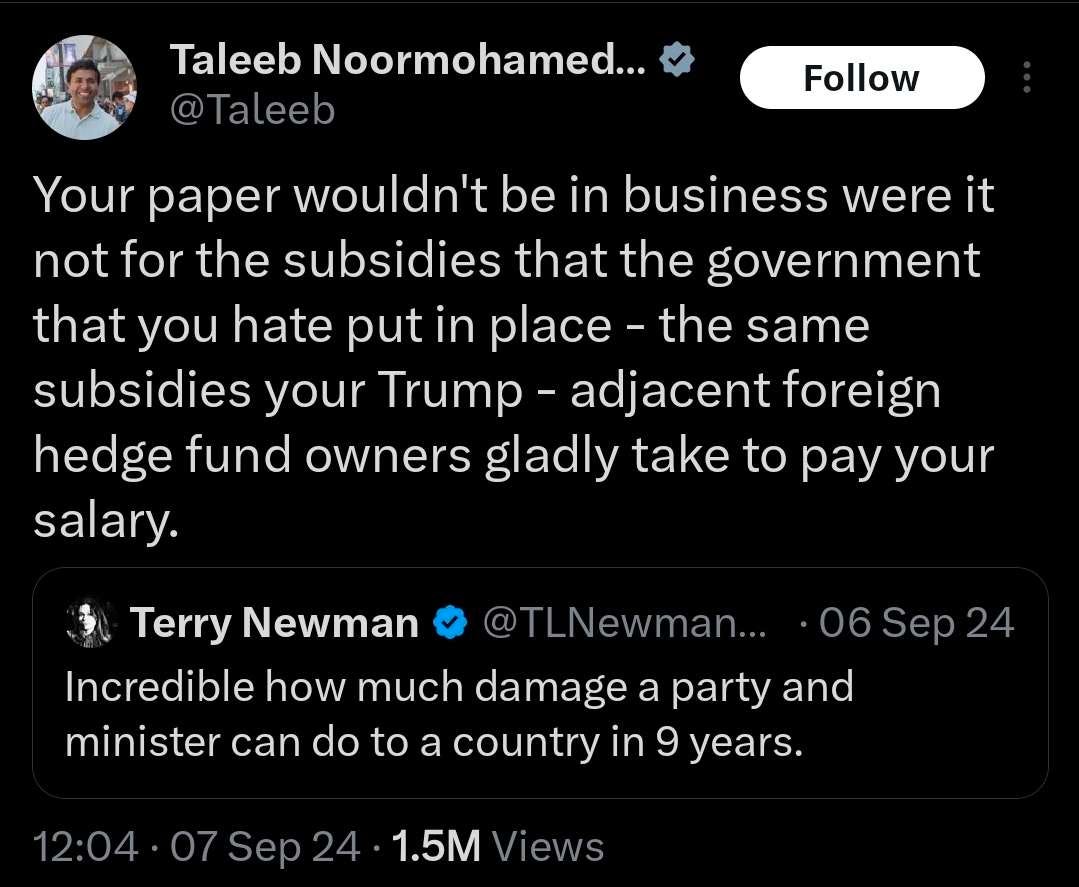
This Liberal MP is openly commenting about their funding and commenting about where their funding comes from which is the government. Now that’s not just a comment. You have to understand that’s more than just a comment. That’s a reminder. It’s a reminder to know your place. It’s Flak.
The Government believes that it is the media’s responsibility to prop up the propaganda machine. It’s actually the job of the media to manufacture the consent that they want to. So one must understand, although the newspapers did run stories about Jody Wilson Raybould’s testimony and some of them even mentioned the troubling implications... this was not widely shared across the news. The silence itself is deafening. The silence says that opinion writers can be bought and that they will tow the government line, that they will preserve the narratives. This ties into how sources are selected and experts are used to reinforce these narratives.
Former Liberal Member of Parliament Catherine McKenna discusses lying in Parliament.
Sourcing and Appeal to Experts
Delving into the role of information sources shows how they shape public perception. This is called the Sourcing filter. Journalists have to depend on official sources like government officials, University professors, researchers, corporations, think tanks and the public for information. It’s interesting because Noam Chomsky, when he wrote Manufacturing Consent, was talking about conservatives and social elites. We look at it in the modern political or cultural context and we see that more of our sourcing now in Canada is sourcing of people that are there to uphold a narrative. I think it’s key to focus on the appeal to experts.
As the trend of Criminal activity continues to rise in Canada I think an apt example is criminal behavior in this appeal to experts. When discussing crime increases in specific urban areas instead of interviewing victims, witnesses, the 711 employees, the midnight security guards, beat cops/EMT’s, Etc... what the media does is find a criminologist that works at a University that has tenure or wants to be quoted in things because it’s going to help their profile and they will interview them. This criminologist wants to uphold a narrative because it is advantageous to themselves and possible recognition or favor they can curry with their School. They may even become a regular and turn it into an additional paid gig. Whatever the personal reasoning is, what matters is the narrative. They will come out and they’ll say, whoa, whoa, guys, crime’s never been lower, it’s been dropping rapidly since the 80’s, you’ve never been safer out there. They’ll re-enforce that your concerns are part of a mass hysteria, usually blaming right wing fear mongers. Multiple videos of petty and serious crime concentrated in one area will requires a re-frame. They’ll move away from the rate of crime to focus on that we need more after school programs, more mental health resources, more compassion and kindness to deal with the crime. It separates the misery that crime causes from the act itself.

Of course they’re not directly affected by crime because they don’t live in high crime areas. They live in safe suburbs and go to work where there is security or University Police. They shop at different stores than you and I would. We go to the decrepit urban mall, they shop at boutiques the bus route doesn’t stop at. You have to understand they don’t experience reality the same way that you and I would because they live in a different reality. They understand that their part is to preserve a narrative and to get the public to consent overall to that narrative for personal gain or funding or to avoid the flak filter, more on that later.
Another important context is the appeal to experts in the media themselves. I think about Saskatchewan for this example. What is the most popular news agency in Saskatchewan? Is it CBC? No. Is it CTV? No. The most popular news agency in Saskatchewan is a waste disposal company called Just Bins. Why are they the most successful media company? They get stuff submitted to them all the time. Videos of the nastiest, dirtiest stuff and they just post it in raw format. They usually do it with something like a sarcastic title or catchphrase attached to it. They’re literally a waste disposal company posting content sent to them yet they’re more trusted to report news in Saskatchewan then most media outlets. It’s because they are more objective. They simply post the evidence and you decide what to think about it. This brutal reality is dangerous to the narrative preservers. Just Bins has had to weather the Flak Filter because when the narrative collapses, it’s time to damage control. For a Narrative piece attempting to put flak on Just Bins see this article by Government Media.
Flak and Enforcement of Narratives
The Flak Filter is the direct confrontation that the people behind narrative enforcement use to keep opposition at bay. Any time there is attempts to manufacture consent, there will be those who push back against it. It’s when powerful groups, the government, the corporation, the news, the advocacy group, etc...produce something to attack someone without defending or addressing the narrative itself. Common behaviors include criticism directed at the opposition personally, lawsuits, online bot farms repeating insults, hit pieces, lawfare, having content removed by platforms, sabotage, hacking, physical violence, use of professional regulatory bodies, deplatforming...the list goes on. This can also be from pressure to discipline media outlets that stray from acceptable narratives.
A recent example I would like to highlight is the former Interim Parliament Budget Officer. He sounded the alarm on fiscal spending, the hit pieces came, the questions came, then he was out of the job and they are now looking for a permanent replacement who will tow the line.
The Interim Parliament Budget Officer refuses to promote a Government narrative.
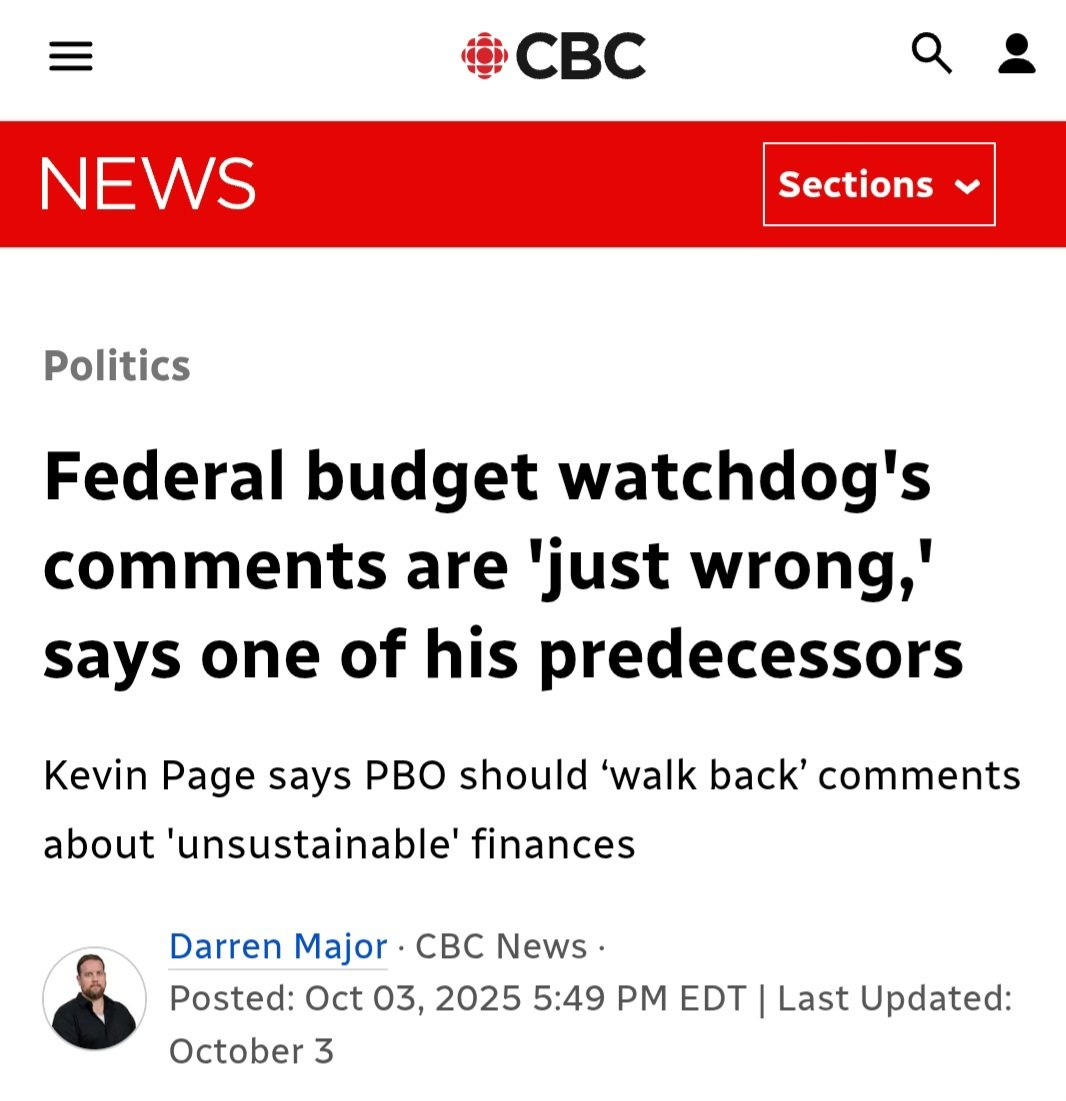
Regime media releases flak on the PBO for not following the narrative.
Regime does an interview to direct towards narrative preservation.
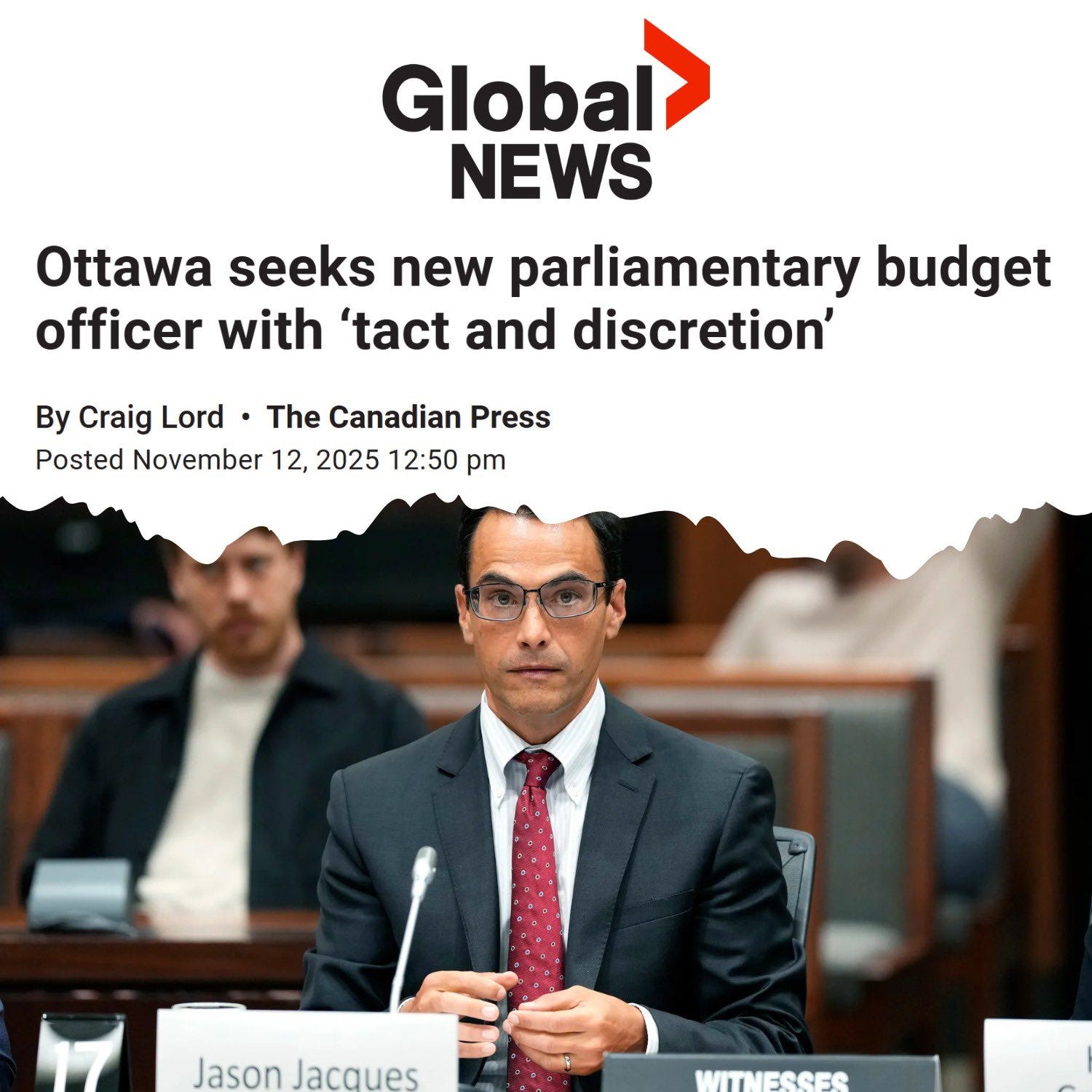
Regime media positions interim PBO for flak. Note the headline and picture used.
You have to understand that there are avenues, personal, legal and even illegal used to preserve the narratives of the dominant culture in Canada which is heavily influenced by foreign powers, Non-profits, lobbyists and our own Government’s personal interest. Those who challenge narratives are put on notice. The narrative creators understand more then you may think, the fickle behavior of the public. They don’t appeal to moderates. They appeal to a fanatical base who then perpetuate the narrative and blatantly ignore any contradictions. Bad behavior, lies, slip ups and immoral or unethical behavior is simply ignored and the narrative doctrines are enforced. Behavioral science is used to manipulate public perception and public opinion.
Rosie Barton a host for CBC, questions Prime Minister Mark Carney who scolded her publicly for questioning the narrative. An example of a narrative maker giving a narrative preserver flak publicly.
Worthy and Unworthy Victims
In manufacturing consent, the treatment of victims highlights narratives of selective outrage. Media coverage will amplify actions by perceived enemies, while downplaying those by allies. We see this all the time in Canadian politics. Despite Conservatives not being in power since 2015 there has been disproportionate coverage of negative media towards Conservatives.
While Conservatives are targeted despite having no institutional power, Liberals who have the power and create/enforce the narratives are given soft questions and pro-regime propaganda in opinion columns.
Here are some examples from CBC:
Unworthy
Coverage of Pierre Poilievre’s Rhetoric on Conspiracy Theories (2023): A CBC article titled “Poilievre’s Conservative Party embracing language of mainstream conspiracy theories” accused Conservative Leader Pierre Poilievre of ramping up rhetoric around debunked World Economic Forum claims during summer speeches. Critics, including Conservative commentators, called this a smear linking him to far-right elements without equal scrutiny of Liberal policies. cbc.ca However, CBC defended it as factual reporting on public statements.
Disproportionate Coverage During 2020 Conservative Leadership Race: CBC gave significantly more headlines (500% more) to U.S. Democrat Kamala Harris than to Canadian Conservative candidate Leslyn Lewis, the first Black woman to run for party leadership. This was seen as downplaying Conservative diversity while amplifying left-leaning figures. tnc.news. Supporters argue CBC’s U.S. focus was due to global relevance, not bias.
Framing of Poilievre’s Media Relations (2024): In “What, if anything, should voters make of Pierre Poilievre’s attitude toward journalists?”, CBC highlighted Poilievre’s mockery of reporters and fundraising emails accusing media of bias, portraying him as evasive. This was labeled a hit piece for ignoring similar Liberal tactics. cbc.ca CBC’s editor-in-chief has pushed back, stating their commitment is to impartiality despite accusations from all sides.
Alleged Over-Fact-Checking of Conservatives: Reports note CBC fact-checks Conservative commentators more aggressively than others on shows like Power & Politics, with examples including scrutiny of Poilievre’s economic claims while giving Liberal policies lighter treatment. A Liberal-appointed senator even pressed CBC on this in 2025, accusing some staff of targeting Conservatives. nationalnewswatch.com CBC maintains fact-checking is applied evenly.
Worthy
SNC-Lavalin Affair (2019): Critics, including a True North compilation of CBC biases, accused the CBC of underreporting the scandal’s severity, where PM Justin Trudeau allegedly pressured Attorney General Jody Wilson-Raybould to interfere in SNC-Lavalin’s prosecution. Coverage was described as “soft,” focusing more on Conservative calls for investigations than on ethics violations, with limited follow-up after initial reports. Former CBC producer Tara Henley highlighted this as part of a broader “groupthink” favoring Liberals. tnc.news thehub.ca CBC defended its extensive reporting, including breaking stories, as balanced.
WE Charity Scandal (2020): The CBC was criticized for minimal prime-time emphasis on Trudeau’s family ties to WE Charity, which received a $912 million sole-sourced contract amid ethics probes. A Medium analysis noted CBC downplayed Trudeau’s conflicts of interest while amplifying his apologies, contrasting with harsher scrutiny of Conservative figures. medium.com Reports from The Hub and Substack articles framed this as evidence of left-leaning bias, with CBC allegedly treating it as a “passing controversy” rather than systemic corruption. therealstory.substack.com thehub.ca CBC countered that it led coverage with investigative pieces.
Chinese Election Interference (2023–2025): Amid CSIS leaks alleging Liberal ties to Chinese agents influencing elections, critics like ex-CBC host Travis Dhanraj (via Toronto Sun) claimed CBC underreported the scandal’s implications for national security, focusing instead on “debunking” leaks or opposition “overreactions.” A CRTC-linked report noted low Conservative trust in CBC due to such perceived minimizations. torontosun.com commissioningerenceetrangere.ca CBC’s David Johnston coverage disputed bias claims, emphasizing fact-checking. cbc.ca
ArriveCan App Scandal (2022–2024): The $54 million app’s cost overruns and contracting irregularities were allegedly given weak CBC coverage, with brief articles downplaying fraud allegations against Liberal appointees. Conservative MP Arnold Viersen’s social media and a YouTube panel blasted CBC for “systemic bias” in ignoring waste, contrasting with detailed Conservative policy critiques. facebook.com youtube.com CBC maintained it reported facts without sensationalism.
As you can see the media plays a distinct role in preserving narratives and part of that is to clearly identify worthy vs unworthy victims.
Undermining Democracy
Ultimately, manufacturing consent weakens the foundations of democracy. Citizens become spectators in democracy rather than participants. Narratives take precedence over objective reporting. As we become spectators we engage less in the system, not only because we trust it less but the cost of engaging the narratives the wrong way rises. Say the wrong thing and be prepared to eat more flak, even if you’re not a social media influencer or commentator. Be prepared to lose your job, your home, your reputation, your professional licenses or designations. Be prepared that in order to make money you will have to take the fight on that narrative as your new full time responsibility. It isn’t fair but that’s the cost of refusing to consent.
It’s not supposed to be the job of the government to make or participate in narratives and to manufacture our consent towards those narratives, especially when those narratives promote subversion. As long as we remain spectators, nothing really will change. We have so much more power than I think people realize. We’re busy, people work multiple jobs, people have to take care of kids and try to have hobbies and down time. So we just contract out democracy to our City Councilor and to their MPP and their MP. We disengage from the processes. We hope that someone else will stand up to the narratives so that we don’t have to take on any risk. Democracy is not supposed to be a spectator sport.

Recommendation to Read Manufacturing Consent
For a fuller grasp of these concepts, I recommend reading Manufacturing Consent. There’s some old documentaries on Youtube from Noam Chomsky himself talking about the concept if you would rather watch content discussing this. It is important that we use discernment. We need to see the world as clearly as possible and as objectively as possible.
Try to seek out and understand the truth. If you feel like you are closer to the truth than a narrative, you’ll see that the barbs will come at you. What I found again and again is that usually when people start receiving significant flak, when they challenge a narrative, they’re usually over target.

Russell is a Canadian Conservative and Catholic. He believes in volunteerism as a key means to building community and social cohesion. He believes that citizens should be active members in the life of their Country and that rejecting that responsibility has resulted in physical and moral decay in Canada. Find him on X @thecanadiancon
This is the best explanation of manufacturing consent I’ve read. You’ve described Denver’s media environment to a T, including a wicked Flak Filter on our version of the waste management company, @dobettrdnvr over the summer. Search Denver Post and Do Better Denver for a recent example.
Excellent article.
Well done.