


Nein Kings? More Like, Nine Kings.
Greetings and salutations! Remember the “No Kings” protests (which I’d call a color revolution operation more than a protest)? Pepperidge Farm remembers. Ostensibly, it was a protest held in defense of our democracy against being attacked by those who see themselves as kings.
Two things are wrong with that framing. We have kings. And the democracy isn’t ours.
I’ll spend the rest of this article earning both halves of that, but I need to hand you a tool first, and the tool is a concept I want you carrying forward: government is applied metaphysics. I mentioned this back in an earlier article, Abuse and Disabuse, and I want to expound upon it here, as it is a load-bearing concept in my system of thought.
Government Is Applied Metaphysics
What do I mean when I say that government is applied metaphysics? I mean that the very concept of government is built on metaphysical premises. Where there is two men, there is government (so no, you can’t exist without it unless you’re living in the woods like a nymph). Don’t mistake me for saying this as a figure of speech, as I’m being literal here. Government applies (by force, if necessary) and instantiates a given metaphysic. Don’t believe me? Tell me, if we’re a Constitutional republic or Constitutional democracy (I’ll address that later), why does the text of the Constitution no longer have to change for the application of that Constitution to change? It’s because the text matters less than the metaphysical and ontological premises being instantiated. This is where most people stop short in their thought, attributing this problem to activist judges, corrupt politicians, and the like. I think the issue runs deeper than that, and stopping bad actors in government one at a time leaves the foundation untouched. Let’s dive further.
Every law answers a metaphysical or ontological question before it answers a legal one. What is a person? What is a right? What is a marriage? And so on. All the way down to your speeding ticket that you were issued for going five over in a school zone. Courts rule on these metaphysical questions on an hourly basis; philosophers have argued them for millennia. The difference is that the courts have the power of the state behind their decisions. Your neighbor’s opinion about what a human being is, is an opinion. The state’s opinion about what a human being is, is backed by those shiny bracelets that the police love so much (handcuffs, for the uninitiated).
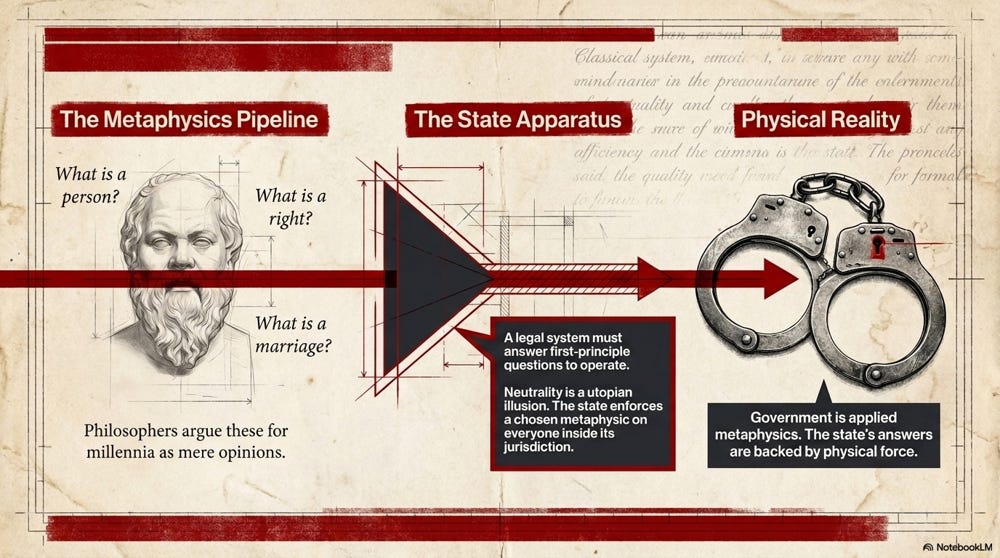
This means that neutrality is unavailable; to think otherwise is a utopian position. A legal system must answer the first principle questions in order to have a basis from which to operate; answering them commits the state to a given metaphysical system; the system then enforces that metaphysics on everyone inside its jurisdiction, including the people who reject it.
Here’s the part that turns all of this from a philosophy lecture into your Tuesday afternoon. A document does nothing. Ink is inert. The Constitution has never once arrested a man, seized an account, closed a business, or told a school district what it may teach. Between the text and your life stands a person holding an office, and that person has to decide what the words require before he can act on them. Every application of law, every single one, runs through a human being performing that translation.
Which means the operative law of a country is the text as filtered through the metaphysics of whoever holds the office. The Constitution hasn’t changed since 1992, yet the translation of metaphysics into our everyday life continues unabated.
So look at the artifact itself. Why is the Constitution written? Why does it exist as a text at all? England ran for centuries without a written constitution and runs that way still, governed by accumulated statute, custom, and precedent that no one ever gathered into a single document. The founders knew that, as they were Englishmen in every sense that mattered, yet they broke with English practice on this specific point, deliberately, at considerable effort. Why do this?
Because of what they believed about reality.
Each government is a mechanism by which a given metaphysic is brought into the physical reality. The artifacts a regime leaves behind (and the context that surrounds them) will tell you which metaphysics it was operating on. A written constitution is one such artifact. Writing a standard down makes three claims about the way reality works, whether the men doing the writing notice they’re making them or not.
There is an objective standard. There is something for words to correspond to, and it existed before anyone showed up with any given grievance.
It is accessible to whoever reads it. No mediator required, no special faculty, other than the context in which the law was written and fluency in the language.
The officer applying it can be measured against it. Which means he can be wrong. Which means he can be corrected (theoretically).
We shall expand and expound on those three concepts.
Exhibit A: Originalism Versus Living Constitutionalism
For example, let’s take originalism versus living constitutionalism. This is a hilariously silly dispute on its face, as it’s asking “does the law mean what is written, or should the judge have carte blanche to rewrite the law to get the best outcomes?” “Best” being defined by the judiciary, of course.
This is an “ends justify the means” style of thinking that subverts the whole point of a Constitution; that is, to be written down and checked against as an agreed-upon standard.
The Constitution has seven articles, twenty-seven amendments, at roughly 7,600 words. That very document recorded the manifestation of a federal government of limited, enumerated powers, and that government has metastasized into a continent-spanning administrative apparatus that manages you as a cog in a vast machine. Wha? What happen? The same words are being interpreted via very different metaphysics, boyo.
The Revolution That Left the Furniture Where It Was
Chief Justice John Marshall understood this in 1803 when he decided Marbury v. Madison, the case that established the power of a court to strike down an act of Congress, and he built the argument on writtenness itself. The powers of the legislature are both defined and limited, he wrote, and the reason those limits were committed to writing was so “that those limits may not be mistaken, or forgotten.” That is the whole justification for judicial review. Judicial review is the mechanism that says the Court may check Congress because the text is fixed and legible, and a fixed legible text can be held up against an act to see whether they match. The power that the modern Court uses to make the text mean nothing in particular was originally justified by the text meaning something in particular. Alanis would call it ironic whereas I call it a metaphysical revolution that took place inside a document that never changed a jot or a tittle.
Go back to those three claims and watch what the practice looks like now.
The standard lives in the mind of the officer (call it the mens rea of the bench). There is nothing for the words to correspond to until a court announces which parts of the text it seeks to emphasize and which parts it will ignore.
Access runs through the men. What the words require is learned by studying the officers instead of the text (which doesn’t matter so much to the officer), and the text gets cited afterward as a justification, usually secondary to the goal of the officer doing the interpretation.
Nothing outside the officer measures him. Error becomes a thing only his colleagues are positioned to declare, and they declare it rarely. Who can tell a judge that he is wrong but another judge?
What we have instead of a standard is bias, be it personal or procedural, and bias is inaccessible because it exists only in the mind of the person applying it, shifting with his mood and temperament.
This “living” Constitutionalism facilitates the skinsuiting of the Constitution into new and amorphous forms. For most of the last half century, one such form held that abortion was protected by the 14th Amendment as a “private” matter (that ends a human life), while gun laws weren’t really “infringements” against the 2nd Amendment (because they were “reasonable” in the 21st century). An unwritten right was backed by the highest court in the land, whereas a right written down in plain English got weighed against whatever the era found sensible.
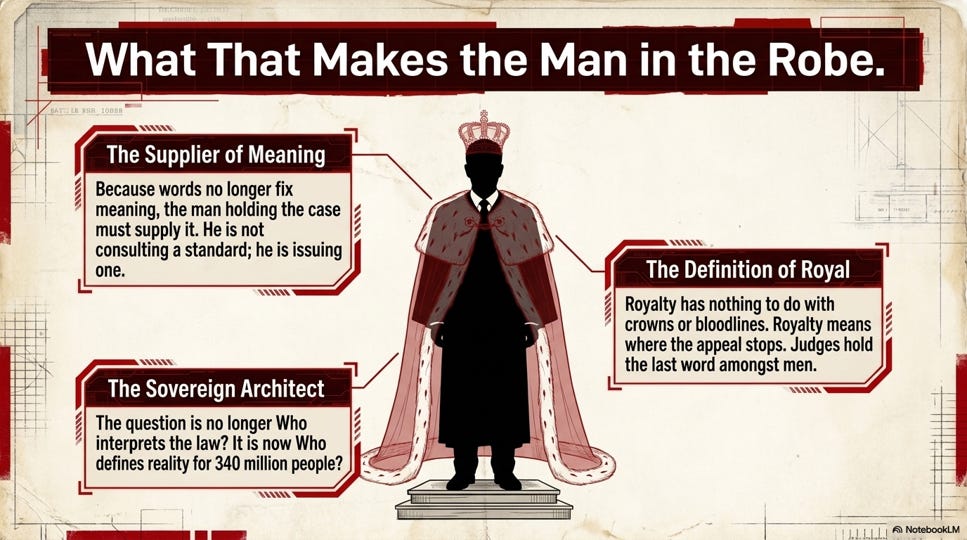
Therefore, the question starts as “who interprets the law?” on its face, but when more clearly stated, it becomes “who defines reality for 340 million people?”
What That Makes a Judge
What does this do to the man in the robe?
If the words no longer fix the meaning, somebody has to supply meaning, and that somebody is whoever happens to be holding the case. At that moment he isn’t so much consulting a standard as he is issuing one, and the only people positioned to review what he issued are other men holding the same office under the same premises.
They have the last word amongst men. That’s what royal means. It has nothing to do with crowns or ermine or bloodlines, and everything to do with where the appeal stops.
This leads to the following question:
Who is educated in the whims of the judges?
You cannot be. Nobody can be. A standard that doesn’t exist until it’s applied to you cannot be studied in advance, cannot be conformed to, cannot be planned around. What can be studied is the men. Their moods, their leanings, their clerks, their circuit, their favored tests, the arguments that worked on them last term. That is rarified knowledge that only comes from existing in their world, within their ranks. You can’t just read the Constitution and expect it to be applied - that would be madness...wouldn’t it? The judges keep society intact, after all. That is their true job, which is why no one will listen to your interpretation of the plain language of the document in question.
We were forewarned about this, way back in yesteryear.
In 1788 a fellow writing as Brutus (a pretty smart one, generally attributed to Robert Yates) warned New York that the proposed judiciary would answer to nobody. Here is the bullet-pointed indictment Brutus/Yates circulated:
Finality without appeal. Judicial adjudications are final and irreversible; no court sits above them to hear an appeal, in error or on the merits.
Error without correction. No authority can remove them for any error in judgment or want of capacity, and none can reduce their salaries. The framers copied England’s good-behavior tenure while omitting England’s tribunal for correcting judicial mistakes.
Power above the legislature. They determine in the last resort the extent of Congress’s powers; they give the Constitution an explanation, and nothing above them can set that explanation aside. English judges are bound by the laws the legislature passes; the will of the judges controls the legislature.
Construction by spirit rather than letter. They explain the Constitution according to the spirit of the law, unfettered by the words.
The states are dissolved by degrees. Each adjudication becomes a precedent, and the accumulation will silently melt the states down into the general government.
Responsibility is absent by design. No court of justice was ever invested with powers so immense while placed in a situation where they are answerable to so few.
The summary charge. Independent of the people, of the legislature, and of every power under heaven. Men placed in that situation will generally soon feel themselves independent of heaven itself.
Hamilton wrote Federalist 78 and 81 to sell the ratification of the Constitution, saying:
It’s the least dangerous branch. The judiciary poses the smallest threat to political rights of the three departments, and beyond comparison the weakest of them.
The judiciary doesn’t even have purse or sword. No influence over either; no command of the strength or the wealth of society; no direction whatsoever over the two things that make government able to compel a human being.
They also have neither force nor will, merely judgment. The bench decides. It has no desire and no command.
The judiciary is bound by strict rules and precedents. These would define and point out judicial duty in every particular case, specifically to prevent arbitrary discretion in the courts.
Judicial review implies no superiority over the legislature. (Judicial review being the power of the federal and state courts to examine the actions of the other branches and determine whether they square with the Constitution.) The people stand above both the judiciary and the legislature, and judges are servants of a fundamental law they are ascertaining rather than composing.
The judiciary is dependent on the executive arm. The courts require the executive even to give their own judgments effect, which is precisely what keeps them modest.
Judges require good behavior for their whole tenure. Life tenure exists so judges can resist encroachment from the political branches, with impeachment standing by as the check on the judges themselves.
Judicial encroachment is a phantom (81).
Hamilton answered six of the seven charges from Brutus, added two assurances of his own, and stepped around Brutus’s fifth charge. Now hold what was sold beside what was delivered:
The least dangerous branch delivers a body that has settled abortion, marriage, school prayer, campaign finance, firearms, presidential immunity, and the reach of every agency in Washington. Name a domain of American life the least dangerous branch has left alone.
No purse, no sword delivers federal judges running school districts, prison systems, and police departments by consent decree for decades at a stretch. A court commanding another man’s purse and another man’s sword has no need to own either.
Merely judgment delivers the Casey decision, in which the Court announced that liberty includes the right to define one’s own concept of existence, of meaning, of the universe, and of the mystery of human life. A court that hands you the authority to define existence has told you where it thinks law comes from.
Bound by strict rules delivers tiers of scrutiny conjured whole from a footnote in 1938, balancing tests weighted by the man holding the scale, and stare decisis released whenever a special justification appears, the specialness of the justification being determined by the party seeking release.
No superiority over the legislature delivers Cooper v. Aaron, in which the Court’s own interpretation became the supreme law of the land, binding every officer in every state, forever, by its own declaration.
Dependent on the executive arm delivers the 101st Airborne escorting nine children to school in Little Rock, after which compliance became a habit and the dependency became a formality.
Impeachment as the check delivers eight federal judges removed in the republic’s entire history, and zero from the Supreme Court. Zero.
The phantom menace delivers nine officials, life tenure, no appeal, immunity from suit for malice and corruption alike, sole authority to say what their own authority is.
And the charge Hamilton never answered. The states melting by degrees delivers incorporation, 1897 through the 1970s. Everson took a clause that barred Congress from touching the religious settlements the states had made for themselves and converted it into the instrument for overriding them. Silently, adjudication by adjudication, precisely as charged.
In short, Brutus identified what he saw as the logical conclusion, what I would call shadow metaphysics (the concept I mentioned in Abuse and Disabuse); that is to say, a metaphysical endpoint that would be reached when following premises to their conclusion. Hamilton sold assurances that these worries would never come to light, and those assurances are goods that have never been delivered.
So, based on what we see of our current system, have we a Constitutional Republic? Hardly. How about a Constitutional Democracy? Getting warmer. What I see is a Royal Managerial Democracy in all but name.
Royal, because the last word belongs to judge-kings as an institution.
Managerial, because the populace is actively managed in every aspect of its life.
Democracy, because the managed populace votes to choose some of its managers, and to make the choices its managers permit.
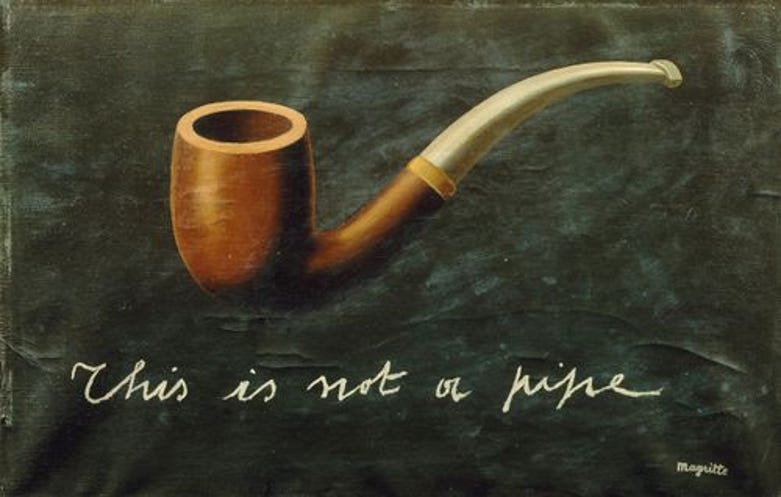
The Constitution still exists (as a husk). Federal officers route around it, whilst paying it all the lip service required. The people remain sovereign the way a painting of a smoking pipe is a pipe (in label only).
Returning to the top, there are two things wrong with the slogan No Kings, then. We have kings. And the democracy isn’t ours.
Brutus is the founder of the American Epistemology Institute (AEI), an educational nonprofit dedicated to restoring the metaphysical foundations of American life. He is the creator of Metadiagnostics — a diagnostic theory that identifies how metaphysical premises shape institutional behavior and civilizational trajectories. Twenty years of autodidactic philosophical study. A professional background in systems design. A conviction that the real crisis is upstream of politics. He is the lead author of AEI’s white papers. Read more at Grinning Brutus
The issues with the Judicial branch of the Federal governnent do need further study, since they normally are not as much readily apparent to the public. Both the Legislature and Executive branches do what they do in full view of the public. Although judicial independence from politics is right, it still is governed by flawed humans who do need to be held accountable.
Excellent article! Here's an interesting quote from Lincoln's first inaugural address:
"If the policy of the government, upon vital questions affecting the whole people, is to be irrevocably fixed by decisions of the Supreme Court, the instant they are made, in ordinary litigation between parties... the people will have ceased to be their own rulers, having to that extent practically resigned their government into the hands of that eminent tribunal."