


The author has recorded an audio version for those who prefer.
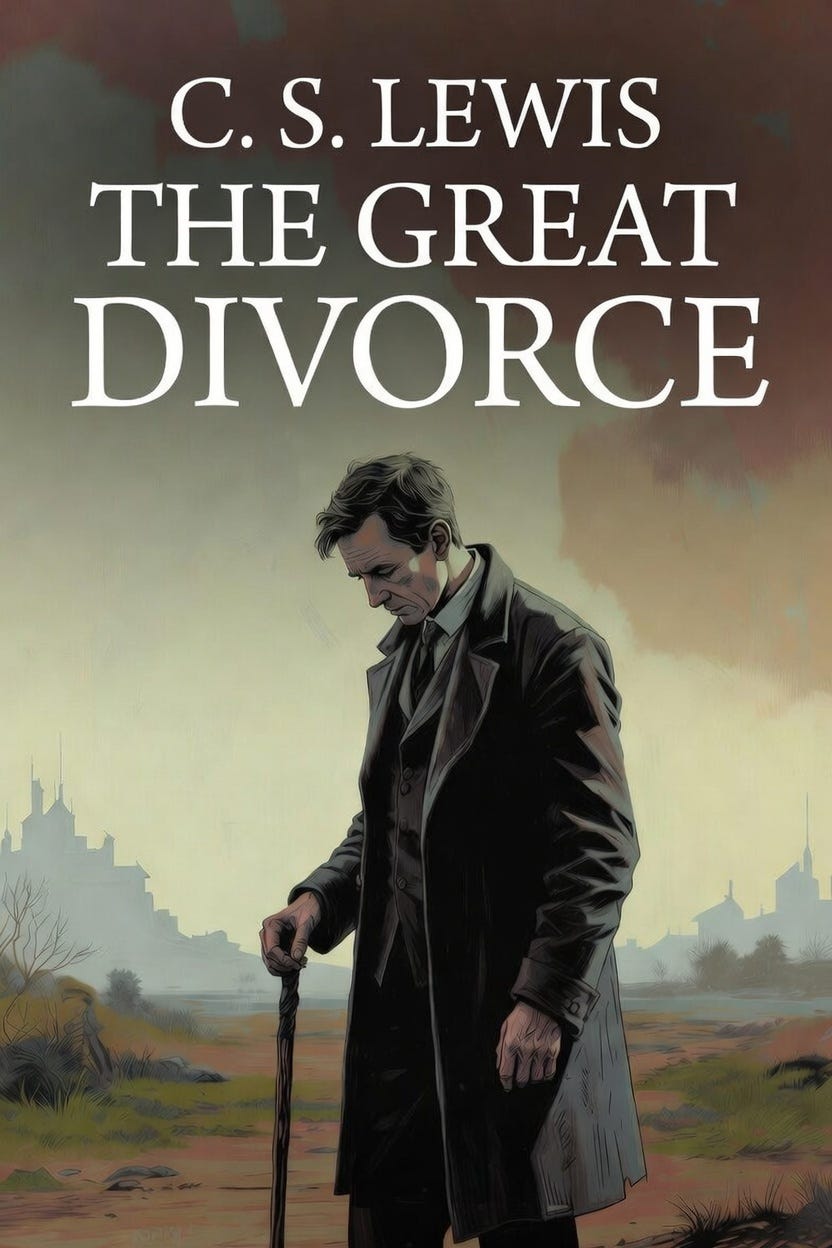
If you want to learn something new, read an old book; you’ll learn things about matters older than yourself. “The Great Divorce” By C.S Lewis is one of those books. It is for humanity. He delves into human character flaws and their ability to hold people back if not eradicated. His setting is purgatory. One last chance for the sinner to repent. In the opening lines of the book, Lewis compels the reader forward with the following preface:
“Blake wrote the marriage of Heaven and Hell. If I have written of their divorce, this is not because I think myself a fit antagonist for so great a genius, nor even because I feel at all sure that I know what he meant. But in some sense or other, the attempt to make that marriage is perennial.”
Perennial is a great word choice. Defined in philosophy and literature as: something eternal or constantly occurring. The Great Divorce is philosophical fiction. The book deals with human flaws and the building of character through struggle. These are eternal and constantly occurring. Lewis reminds the reader that not everyone is ready and willing to let go of such flaws. In many cases, people simply refuse to change. Often, grave consequences are the result of our choices and Lewis is serving up a warning.
The story begins with a narrator standing close to a bus stop where people have formed a line. The sky is grey and it’s raining. The weather here is always this way. The narrator has been wandering this land for some time and has come to learn a good many things about the place and its residents. This is a world where the people have whatever they want simply by wishing it to be. There is no struggle required for any material item desired. They’ve grown cranky and pessimistic as a result. They are lazy. They are bored from never having to work for anything.
Displeased and unsatisfied with everything around them, they have bickered and fought with neighbours to the point many want as much distance from others as possible. People are disconnected from one another. They don’t have any significant problems yet, complain about everything. It’s a bleak world of materialism and selfishness. A place where deeper meaning and enlightenment are not on the menu. The following observations made by the narrator sum up the state of this grey world:
“The appalling lack of any intellectual life doesn’t worry them.”
“There is no proper economic basis for any community life.”
The Great Divorce has a dream-like quality to it. The bus arrives and the people all climb aboard. It then takes off vertically, travelling through the dreary grey into a sky of, “a bright blueness that stung the eyes.” On the bus, the narrator has a series of interesting interactions with the travellers who are nervously anticipating the arrival at their destination.
The depictions of humanity and how people react to life’s unpredictability and chaos in the stories of the travellers is fascinating. These are useful snippets of human flaws on full display. Lewis brilliantly spotlights his motivations for writing this book in the telling of these individual accounts. When the bus finally comes to a stop, the passengers disembark into a place of stunning beauty. Everywhere they look there are images that out-do the previous one in terms of splendor.
However wonderous the visual beauty of the place, it soon becomes apparent that all of the objects of this place are brutal in their physicality. Fallen leaves and other small objects are too heavy to lift. The narrator tries to pluck a petal off of a flower and finds, “The little flower was hard, not like wood or even like iron, but like diamond.” Objects that are normally malleable or easily manipulated in the grey world are unforgiving and unmoveable here. The grass is described as being, “hard as diamonds to my unsubstantial feet, made me feel as though I were walking on wrinkled rock.” Nothing is usable here without an enormous amount of effort. Lewis further describes this world then informs us who these travellers really are:
“The light, the grass, the trees that were different, made of some different substance, so much solider than things from our country that men were ghosts by comparison.”
The bus travellers, as well as the narrator, are deceased. They are ghosts who have not properly repented for their sins. This place is only accessible to those who are willing to repent by working to expel their flaws. The unyielding difficulty of this place forced many to retreat back to the bus. They are not accustomed to any kind of struggle so they quit at the first signs of anything challenging. They would rather go back to the grey world they complain so much about. They prefer their miserable lives. They refuse to change.
The instant gratification from readily available goods and services in the hellish grey world is inextricably linked to the INABILITY to access these same things in the heavenly world. The beast of their selfish materialism cannot be fed in this place. Heaven’s bounty is off limits to the ghosts. They have not endured the trials required to “walk on the grass” in Heaven. They are unwilling to let go of the traits and behaviours that keep them out. They cherish their poor qualities. Lewis attributes this to a spiritual illness. A Nietzschean “Death of God” vibe, where their selfish desires have become the driver.
In this Heavenly world, the ghosts encounter ‘Spirits’. These nearly transparent beings act as guides. They are working to convince the ghosts to shed their earthly ways and enter heaven proper. One such encounter sees the “Episcopal Ghost” interact with a “Bright Spirit” who were once friends when they were living. The ghost, a former theologian, attempted to re-imagine the meaning in certain Christian doctrine. He did this not because he questioned the original stories himself, but rather for the notoriety and fame he knew it would bring. His dishonesty to himself is his greatest wrong. His Spirit guide attempts to help him admit his pride and selfishness. The ‘Episcopal Ghost’ refuses. He is too enamoured by the dark fruits of his sins. The “Bright Spirit” tries in vain to effect change in his former friend with a final plea:
“When, in our whole lives, did we honestly face, in solitude, the one question on which all turned: whether after all the Supernatural might not in fact occur? When did we put up one moment’s real resistance to the loss of our faith?”
Most of the ghosts from the bus avoid personal responsibility as though it were a plague. The attitude is, nothing can be their fault if they don’t take responsibility for anything. However, they do expect every desire they have to be fulfilled on their terms without question or qualm. How characteristically human. Unfortunately many of the ghosts remain stubborn and narrow-minded. Even after plenty of encouragement from the Spirit guides, many ghosts refuse to change. They prefer their own self-indulgent vices. The Spirits grow more concerned for their ghostly charges,
“Friend, said the Spirit, could you only for a moment, fix your mind on something other than yourself?”
Lewis is cautioning the reader here. One cannot enter Heaven when fixated on selfish pursuits. Heaven is not available to the unworthy. Lewis kills any ambiguity between Heaven and Hell he may have been maintaining by stating, “The choice of every lost soul can be expressed in the words: Better to reign in Hell than serve in Heaven.” The ghosts are in love with their grievances about the ‘grey’ world so much they want to bring them into Heaven with them. This is precisely why Lewis is calling for the ‘divorce’.
The writing of characters is a philosophical endeavor. For what is philosophy if not the study of characters? There is a deeper exploration of humanity in The Great Divorce. Lewis outlines the human desire to “extend hell, to bring it bodily, if they could, into Heaven.” Lewis writes of a particular breed of ghost that, “all seemed incurious about the country in which they had arrived.” These same ghosts “repelled any effort to teach them, and when they found that nobody listened to them, they went back, one by one, to the bus.”
People become addicted to their suffering. Some feel they have earned the right to carry it with them and wield it as a weapon when needed. This weapon presents itself when the person is called upon to do anything helpful for anyone, or for the overall good of the community. Some play the ‘struggle card’ to remain a perpetual victim. Lewis’s ability to evoke the absurd when illuminating some of these human traits is on full display in the tale of The Dwarf and the Tragedian. He serves up a brilliant lesson in the destructive nature of vulnerable narcissism in this scene:
“The demand of the loveless and the self-imprisoned, that they should be allowed to blackmail the universe, that till they consent to be happy (on their own terms) no one else should taste joy; that theirs should be the final power, that hell should be able to veto heaven.”
Lewis wraps up his story with a moment of clarity. It’s appropriate here to use perennial again. In terms of humans imprisoning themselves, their own bad habits and the resulting self-loathing and resentment, the word is perfect. Eternal realities, constantly occurring. The Great Divorce reminds us we always have a choice between Heaven and Hell and that these two ought to be “divorced” from one another and remain that way. There should be no letting into Heaven the qualities that belong in Hell. C.S. Lewis was warning humanity to change while we still can:
“Because all answers deceive. If ye put the question from within time and are asking about possibilities the answer is certain. The choice of ways is before you. Any man can choose eternal death. Those who choose it shall have it.”
Choose wisely.
Mike Lyons is a Carpenter who posts about humanity, horses and classic books. He is a Correspondence Theory team member. You can follow him on X at https://x.com/MikeLyonsofHere
Great piece Mike; you captured the essence of The Great Divorce. Thank you for writing this!