


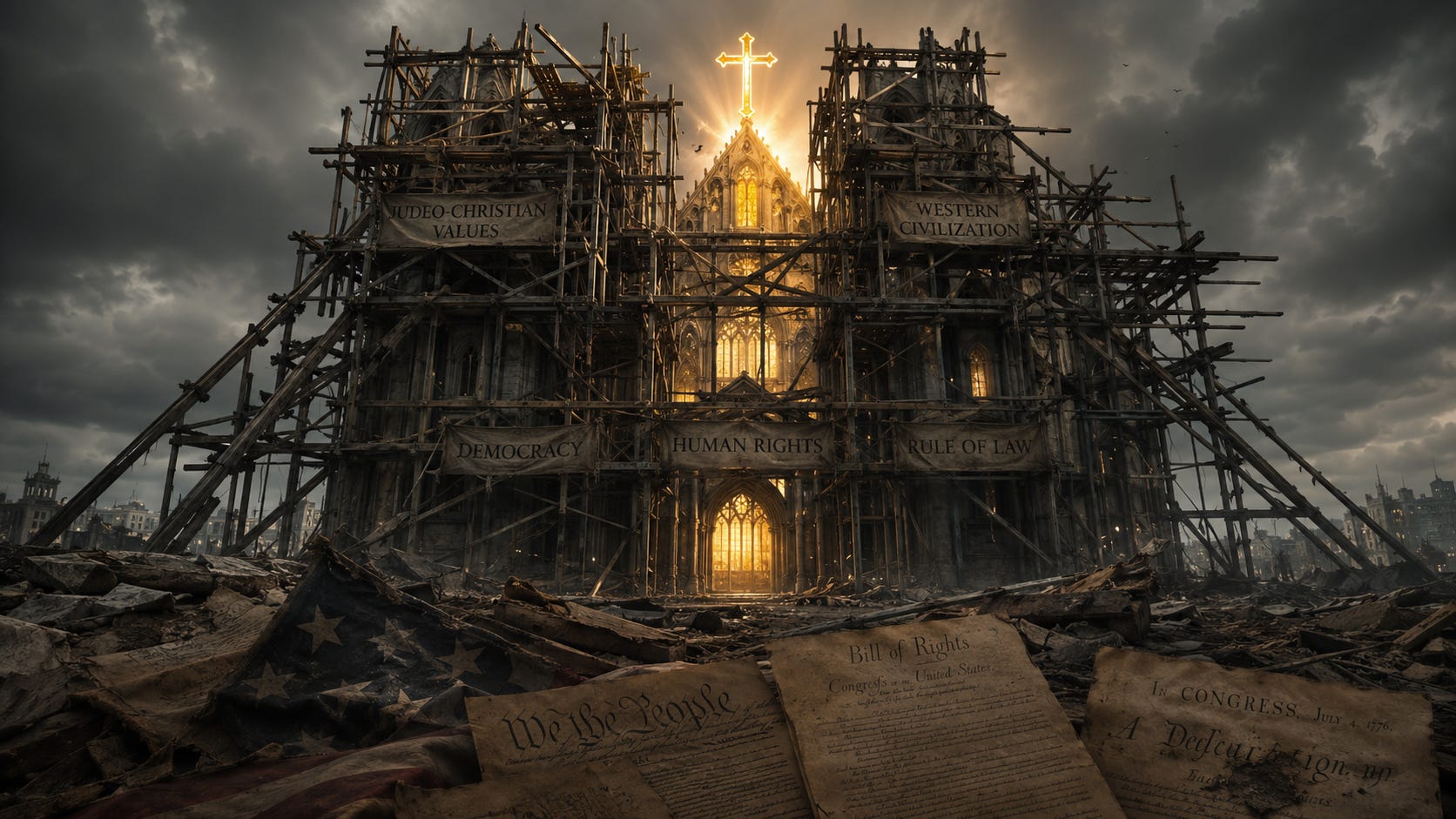
The modern “Judeo-Christian” formula is frequently treated as the timeless foundation of Western liberty. This essay argues, however, that it is a twentieth-century civic synthesis which extracts a shared political vocabulary from distinct and frequently incompatible theological traditions. Its utility as an emergency framework does not render it a sufficient metaphysical foundation for the public order. By examining James Lindsay’s defense of the formula, this essay asks whether a neutral procedural square can preserve human liberty after the transcendent authority that originally limited political power has been excluded from it.
I. The Synthetic Scaffold: The ‘Judeo-Christian-American’ Framework
In the contemporary conservative imagination, the “Judeo-Christian” synthesis has attained the status of a foundational myth, often depicted as a three-legged stool supporting Western civilization: a tripod of Hebrew covenant, Christian grace, and American proceduralism. For secular conservative thinkers—most notably James Lindsay—this framework serves as a vital firewall against the corrosive impulses of the modern Left. In his reflections on America’s 250th anniversary, Lindsay frames the American Experiment as a moment of integration, arguing that the Calvinist Pilgrims and the Founders revived the Covenant of Sinai in a “Christian-Gentile” key. By blending Jewish notions of responsibility, Christian mercy, and Enlightenment common sense, he proposes a uniquely “Judeo-Christian-American” philosophy that represents the essence of the West.
The attempt to anchor this synthesis in the Puritan founding, however, reveals a fundamental detachment from history. Advocates like Lindsay point to the Puritans as the architects of this covenantal integration, yet this ignores the reality of the Puritan world. Far from seeking a “Judeo-Christian” partnership, the Puritans were strict supersessionists who viewed their commonwealth as a New Israel under the exclusive lordship of Christ. To the Puritan mind, the “hyphen” would not have been a source of strength, but a dilution of the very truth that defined their community. By rebranding these rigorous, vertical believers as proponents of a modern, proceduralist synthesis, contemporary conservatives do not recover the American past; they project a secularized, administrative sensibility onto a seventeenth-century faith that would have found such an identity alien.
The appeal of Lindsay’s position is not merely rhetorical convenience; it reflects a genuine intellectual response to the vacuum of modern conservatism. In a landscape defined by the deconstruction of Western heritage, his framework offers a “usable past” that feels both grounded and distinctively American. By framing the American experiment as a deliberate integration of Western and Hebraic roots, he rescues the conservative tradition from the charge of being a collection of reactive prejudices. Furthermore, by identifying a high-stakes enemy—the “managerial progressive” machine—he allows his audience to view their advocacy as the defense of civilization itself. His focus on “values” rather than “dogma” bypasses divisive theological debates, offering a streamlined identity that can be shared by secularists, Christians, and Jews alike. For those exhausted by the perceived moral drift of modern life, this framework promises a restoration of order that is intellectually rigorous and immediately deployable in the public square.
Yet, when subjected to historical inquiry, this “three-legged stool” reveals itself as a late-modern civic coalition rather than an ancient inheritance. The model promises a public order robust enough to sustain a shared moral vocabulary while remaining sufficiently “neutral” to accommodate secularization. In practice, however, it functions as a structural artifice, reframing Hebrew tradition as “covenant-as-contract,” Christianity as “grace-as-sentiment,” and the American founding as a triumph of “procedural neutrality.”
The addition of “American” to this hyphenated synthesis is the final move toward procedural neutrality. By defining the West as “Judeo-Christian-American,” the framework shifts the source of liberty from the transcendent Logos to the procedural genius of the American Founding. Here, the “American” term acts as a stabilizer—a secular container that allows “Judeo-Christian” values to be utilized without the “danger” of their original, non-negotiable theological claims. The American hyphen does not merely describe our tradition; it redefines it as a manageable set of administrative values capable of sustaining a neutral public square.
This transition from a participatory to a procedural order is rooted in the late-medieval “nominalist turn.” As John Milbank argues in Theology and Social Theory, this shift dissolved the classical understanding of participatio—the belief that created realities possess their meaning, goodness, and intelligibility by sharing analogically in the divine order rather than existing as autonomous, self-contained entities—and replaced it with a world of discrete, unrelated objects governed by the arbitrary will of God or the mechanics of power. If justice is no longer a reality in which one participates through the Logos, it must be constructed through social contract. Consequently, we moved from an order limited by a transcendent horizon to a system where order is generated exclusively through the negotiation of individual wills. As Charles Taylor observes, this ushered in the “buffered self,” the modern individual who views the world as an impersonal, disenchanted space. The “neutral” square is thus not a discovery of inherent balance, but the political architecture of a disenchanted reality that, having lost the capacity to recognize a shared divine order, is left only with the administrative management of competing desires.
This formulation achieves stability through systematic omission: it brackets the sovereign authority of the living Logos. By defining the West through functionalist values rather than a shared metaphysical reality, the framework inadvertently adopts the very nominalism it purports to oppose. By stripping the world of its inherent, divinely ordered meaning, it renders the state unable to govern by recognizing a pre-existing justice, forcing it instead to become a mechanism that merely adjudicates between conflicting wills. Rights are no longer participations in a divine order, but self-evident political fictions negotiated within a hollowed-out public square. The danger is not merely that this framework is secular, but that it is epistemologically hollow: by positioning the “Judeo-Christian-American” synthesis as the timeless ground of the West, the modern conservative movement defends a construct that cannot generate its own soil, having excluded the only authority—the sovereign Logos—capable of limiting political power to something other than the administrative management of a disenchanted reality.
II. The Modern Invention of the Hyphen
In this climate, the “Judeo-Christian” label was an act of political triage. President Dwight D. Eisenhower gave the term civic permanence, famously declaring that American democracy rested upon a “Judeo-Christian concept”—before adding, with telling indifference, “I don’t care what it is.” That blunt admission captures the essence of the project: the term functioned not as a serious theological claim, but as a generic placeholder for a unified civic identity.
By emphasizing a shared moral inheritance, the architects of this coalition carved out a defensive perimeter against existential threats. Yet, this success rested upon a fundamental misreading of theology. To make the “hyphen” functional, the irreducible tensions regarding the Messiah, the nature of the Covenant, and the requirements of salvation were relegated to private “belief,” while a flattened, generic version of “moral law” was promoted to the level of public “foundation.”
Ironically, the same postwar consensus that embedded this synthesis into the American lexicon coincided with the entrenchment of the military-industrial complex that Eisenhower himself would later warn posed the gravest threat to the American way of life. Far from a neutral philological descriptor—as biblical scholar Wes Huff asserted in a recent post, claiming the term “has nothing to do with geo-politics or a one world order”—the “Judeo-Christian” formula has demonstrably functioned as a durable geopolitical and institutional scaffold. Its history reveals a striking convergence with expansive state architectures and the progressive blurring of jurisdictional lines between spiritual authority and temporal power.
This transformation stripped the Covenant of its supernatural character, reducing a historical relationship with the Living God to a set of contractual rights. Similarly, it reduced the radicality of grace to a sentiment of universal brotherhood. The irony is twofold: the term was deployed to preserve the religious character of the West, yet it functioned as a “legitimacy trap” that rendered religion irrelevant to the state. By providing a “value-neutral” basis for legitimacy that did not require acknowledging Christ’s sovereignty, the framework incentivized religious institutions to operate as mere “value-suppliers” for a state that manages the procedural “sandbox,” trading their jurisdictional independence for a seat at the table of American civil religion.
Resistance from within the Jewish tradition was both early and persistent, serving as a vital corrective to the homogenizing impulse of the hyphen. Arthur A. Cohen’s The Myth of the Judeo-Christian Tradition remains the definitive rebuttal, laying bare the theological dishonesty of the synthesis. Cohen argued that the label was an American political invention designed to foster a comfortable civic consensus at the expense of theological truth. He demonstrated that the synthesis required Judaism to shed its particularity and Christianity to abandon its unique messianic claims. Scholars like Jacob Neusner and Eliezer Berkovits similarly argued that Judaism is defined by its distinctness from Christianity; for them, any synthetic blurring was not a source of strength, but a threat to Jewish integrity.
Viewing the “Judeo-Christian” synthesis as a timeless foundation is a profound historical error. It mistakes a wartime defensive measure for the structural steel of the building itself. We have inherited a tactic designed for the 1940s and elevated it to a metaphysical necessity. The result is a conservative movement that fights for its existence on the terms of a temporary coalition, unaware that the coalition’s foundational premise—that a pluralistic nation can be sustained by a de-dogmatized “value set”—is the very mechanism that has left our culture spiritually defenseless. This civic de-dogmatization paralleled deeper shifts in the scriptural foundations themselves.
III. The Ancient Christian–Rabbinic Fork: Two Worlds, Two Texts
The “Judeo-Christian” hyphen rests on the popular assumption of a continuous, harmonious scriptural tradition. In reality, the history of the biblical text is one of profound divergence. Following the destruction of the Second Temple in 70 AD, the scriptural inheritance of Israel was curated, contested, and bifurcated. These were not peripheral variants; they were intentional divergences that crystallized as the Apostolic proclamation of the Incarnate Logos intersected with rabbinic efforts to delineate communal boundaries.
Christ and the Apostles were not bridging two co-equal religions; they were announcing the eschatological fulfillment of Israel’s Scriptures in the person of the Messiah within the living tradition that became the Church—long before the post-70 AD rabbinic reconfiguration crystallized distinct trajectories.
The Apostolic Textual World
For the early Church, the Septuagint (LXX) was not merely a translation but the inspired delivery system of the Logos. New Testament authors operated within this Greek textual world, citing it authoritatively as gegraptai (“it is written”). As Eugene Ulrich demonstrates, the “original” biblical text of the Second Temple period was a fluid, developing collection of manuscripts. The Church received and interpreted the Greek Old Testament within the living tradition of the altar and priesthood, seeing these texts not as static documents, but as illuminated by the Incarnate Word.
A vital clarification is necessary: the Great Isaiah Scroll at Qumran (1QIsaᵃ) presents a text with a proto-Masoretic character, confirming that the Masoretic tradition did not emerge ex nihilo after 70 AD. It drew upon an older, established stream of Hebrew transmission. However, this only deepens the theological stakes. As Karen Jobes and Moises Silva observe, the diversity of Second Temple texts was eventually pruned by a “standardization of tradition” that reflected the competing needs of distinct communities. The rabbinic project of standardization was a hermeneutic decision to prioritize a textual stream that resisted the Church’s claims. The Qumran scrolls do not prove the Masoretic text is “wrong,” but they confirm that its canonization was a deliberate act of identity formation in direct opposition to the Church’s Christology. By the second century, the Masoretic Text (MT) became the bedrock of an emerging Rabbinic Judaism that defined itself in critical, non-negotiable contrast to the early Church.
The Chronological Schism
Beyond textual variance, the post-70 AD rabbinic movement produced a distinctive chronology of sacred history. The Seder Olam Rabbah (c. 160 AD), the foundational rabbinic chronicle, compresses the Persian period by approximately 160 years compared to the timelines reflected in Ptolemy’s Canon and other external sources. This is more than a historiographical curiosity; it alters the arithmetic of Daniel’s prophecy of the “seventy weeks” (Daniel 9:24–27). Under the Seder Olam’s reckoning, the prophetic timetable no longer converges upon the lifetime of Jesus. Whether this was an internal methodological choice or, as scholars like Mitchell First suggest, an act of “theological engineering,” the result is clear: by the second century, Christian and rabbinic traditions operated within chronologies that no longer mapped the same historical landscape.
The Testimony of the Early Church
The Church Fathers were acutely aware of this schism. In Dialogue with Trypho (c. 150 AD), Justin Martyr explicitly addressed the divergence: “They [the Jews] have altogether taken away many Scriptures from the [Septuagint] translation... your teachers [the rabbis] have caused you to believe that the Scriptures are not as they are, but have interpreted them differently.” While modern scholarship cautions against overstating “deliberate alteration”—noting that some LXX variants reflect broader Second Temple pluriformity—Justin’s diagnosis captures a genuine historical reality: this was not a philological dispute, but a battle over the identity of the Messiah.
Pressure Points of Proclamation
These divergences cluster precisely where Apostolic proclamation confronted post-70 AD rabbinic boundary-setting:
The Sign of the Virgin (Isaiah 7:14): The LXX renders the Hebrew ‘almâ as parthenos (“virgin”), the prophetic signal of the Virgin Birth. Rabbinic readings later pivoted to alternatives that obscured this Christological application.
The Pattern of Sacrifice (Psalm 40:6 / Hebrews 10:5): The Apostolic reading—“a body you prepared for me”—reveals the Old Covenant’s localized sacrifices as fulfilled in the Incarnate Logos. The Masoretic tradition reads “ears you have dug for me,” steering the text toward ritualized obedience rather than the body as the site of definitive atonement.
The Divinity of the Messiah (Deuteronomy 32:43 / Hebrews 1:6): The LXX includes the exhortation, “Let all the angels of God worship him,” affirming Christ’s sonship. The Masoretic tradition omits this, reflecting a boundary-setting impulse that the Apostolic mission dismantled.
The Wounds of the Messiah (Psalm 22:16): The LXX reads ōryxan cheiras mou kai podas (“they pierced my hands and my feet”). The Masoretic tradition reads ka’ari (“like a lion”), a reading many textual critics regard as syntactically incomplete, which obscures the verse’s crucifixion resonance.
The Inclusion of the Nations: The LXX epilogue to Job and its reading of Amos 9:11–12 (“that the rest of mankind may seek the Lord”) provided the scriptural mandate for the Church’s universal mission. The Masoretic tradition narrows these texts, reinforcing the particular boundaries the Apostolic Church sought to transcend.
These are not mere artifacts of translation; they are tectonic plates of tradition. The modern “Judeo-Christian” synthesis treats these Scriptures as interchangeable reservoirs of “ethical values” to be harmonized through a proceduralist lens. But for the Apostles and Fathers, they were the historical unfolding of the Logos into time. By forcing these two divergent worlds into a singular, hyphenated box, the current consensus does not preserve tradition; it hollows it out, minimizing the scandal of the Cross and the necessity of the Incarnation.
IV. The Displacement: How the Hebrew Text Entered the Christian West
The “Judeo-Christian” synthesis assumes a stable, monolithic textual foundation. In reality, the history of the Western canon is defined by a slow-motion displacement of the Church’s original blueprint. The bridge between the Apostolic Church and the modern hyphenated consensus was not one of natural continuity, but a series of deliberate shifts in textual authority that systematically favored the post-70 AD rabbinic stream over the Apostolic Greek inheritance.
The Quest for Hebraica Veritas
For the early Church, the Septuagint (LXX) was not merely a translation but the inspired delivery system of the Logos. The rabbinic movement, however, viewed these Greek Scriptures as a distortion. Around 240 AD, Origen’s Hexapla established the Hebrew text as a “master” standard, implicitly positioning the Church’s Greek text as derivative. This trend accelerated with St. Jerome and his pursuit of Hebraica veritas (“the Hebrew truth”). Jerome famously relied on clandestine rabbinic instruction, a move that prompted Augustine’s sharp protest in De Civitate Dei (18.43). Augustine argued that the Septuagint’s authority was providential and that undermining it risked severing the Church’s continuity with the Apostles.
Despite Augustine’s warnings, the trajectory of Western philology—driven by humanist and scientific concerns—gradually sidelined the Septuagint in favor of the Masoretic Text (MT). The Reformation’s ad fontes principle completed this displacement. By treating the post-70 AD Masoretic text as the “neutral” original, Reformers bypassed institutional Church authority. Once the Church accepted a Hebrew canon defined outside its own tradition as the “real” Old Testament, the semantic and theological bridge for later syntheses was fully constructed. This pursuit of historical precision, while valuable, marginalized the Apostolic hermeneutic that read the Old Testament as an organic, Christological fulfillment, eventually sacrificing the Church’s interpretive sovereignty on the altar of historical-critical detachment.
The Semantic Deformation of Justice
This philological displacement had profound political consequences. The shift in the Western understanding of justice was not the product of a single translation, but Jerome’s preference for Roman legal terminology in the Vulgate acted as a critical conduit for a broader intellectual reorientation. By translating the Apostolic dikaiosynē—a term evoking the holistic, participatory harmony of the soul under the Logos—as the Latin iustitia (frequently inflected by the Roman concept of aequitas), the translation facilitated a move toward an administrative, procedural understanding of right relationship.
As Gerhard Kittel notes, dikaiosynē is fundamentally relational and participatory; it describes a person’s standing before God. When flattened into iustitia, it began to carry the weight of Roman legalism—a concern for the balanced ledger of rights and duties. This coincided with the “nominalist turn” that replaced a cosmos of objective participation with one of discrete objects and legal contracts. Where dikaiosynē denoted harmony under the Logos, aequitas shifted the emphasis toward balancing competing individual claims through external rules.
Over centuries, this semantic pivot helped detach justice from its vertical, transcendent horizon, increasingly framing it as a horizontal negotiation between rights-bearing agents. This provided the late-medieval and Enlightenment legal orders with a new, less theological vocabulary for governance. By the time this reached the modern era, “justice” had been successfully abstracted from the life of the Church and tethered to the procedural management of the State.
Some argue that because the Septuagint originated as a Greek translation for the Jewish diaspora, the Church’s reliance upon it was merely the adoption of a Jewish document, thereby vindicating the “Judeo-Christian” synthesis from the start. This observation is philologically accurate, yet it is ecclesially insufficient. It confuses provenance with participation. The Church did not receive the text as a static artifact of ancient Judaism, but as the transfigured language of the Incarnate Word. By the time the Apostles cited the Septuagint, it had been fundamentally remade by the life, death, and resurrection of Christ; it had become the Church’s unique textual life-blood. When the West abandoned this participatory framework in favor of a neutral, philological “original,” it did not merely switch translations; it dismantled the mechanism of Christological participation, facilitating the modern, administrative neutralization of the public square.
V. The Actual Architecture of Western Liberty: Jurisdictional Sovereignty
The “Judeo-Christian” hyphen is an intellectual artifice that obscures the genuine historical development of Western civilization. The architecture of the West was not assembled by a generic coalition of “values”; it was forged through the integration of Roman procedural jurisprudence, Greek metaphysics, and—most crucially—the revolutionary jurisdictional claims of the Church as the living Body of the Logos. This synthesis did not arise from neutral negotiation; it was born because the Church possessed the authority to baptize, discipline, and reorient the civil sphere. Liberty was not an abstract gift of the state, but a boundary line drawn by the Church against the totalizing reach of temporal power.
The Jurisprudence of the Logos
The trajectory of Western law—from the Roman tradition to the emergence of constitutionalism—is fundamentally a story of Christianized synthesis. The defining moment was the “Papal Revolution” of the 11th century, which, as Harold J. Berman documents, systematically established the independence of ecclesiastical law from secular rule. While Justinian’s Corpus Juris Civilis provided the procedural toolkit, articulating that imperial majesty must be “armed with laws” for the common good, it was the Church that provided the limiting principle. Medieval canonists looked not to a secular contract, but to the vertical gaze of the Incarnate Logos. They understood law as an objective, participatory reality to be discovered rather than invented—an extension of divine order that provided a horizon no ruler could transgress without forfeiting legitimacy.
St. Thomas Aquinas crystallized this in the Summa Theologiae. In I-II, Q. 95, Art. 2, he grounds the claim in Augustine’s dictum that “that which is not just seems to be no law at all,” concluding that a law which deflects from the law of nature “is no longer a law but a perversion of law.” He restates the principle even more sharply in I-II, Q. 93, Art. 3: “Human law has the nature of law in so far as it partakes of right reason; and it is clear that, in this respect, it is derived from the eternal law. But in so far as it deviates from reason, it is called an unjust law, and has the nature, not of law, but of violence.” This principle, coupled with the doctrine of the Two Swords articulated by Pope Gelasius I, established dual jurisdictions as a structural check against totalization. The Magna Carta (1215), forged in a climate of ecclesiastical assertion regarding the limits of royal prerogative, embodied this tension in practice, demonstrating that limited government was a direct consequence of the Church’s insistence that it held a jurisdiction distinct from the State.
The Ontology of Dignity
The concept of “human dignity” derives its operative weight in the Western legal tradition not merely from its scriptural mention in Genesis—an inheritance shared with ancient Israel—but from its Christological fulfillment and elaboration. As Larry Siedentop argues in Inventing the Individual, the doctrine of the Incarnation fundamentally reoriented the status of the human being by identifying the person as a soul capable of a direct, vertical relationship with God, thereby breaking the ancient monopoly of the city-state (and, by extension, any immanent collective) over identity. Aquinas grounded human reason in this same vertical relationship, describing it as an imprint of the Divine light on the soul.
The Imago Dei thus became the ontological sanctuary: creatio continua—the doctrine that God sustains the person and the universe in every moment—and the Pauline understanding of conscience as an internal witness created a sphere of dignity that the state cannot penetrate. This specific theological labor, rooted in the hypostatic union and the realism of the Logos, birthed the concept of limited government. The “individual” was not a product of secular philosophy or generic biblical theism, but an ontological category carved out by the Church’s insistence that the human person possessed an inherent, participatory value that the magistrate was bound to respect.
The Destruction of the Metaphysical Architecture
The “realism” of the West relied on the recognition that human nature is an objective, ontological reality rather than a legal fiction. In English Common Law and clerical equity, law functioned as a check on power because it recognized a source of justice antecedent to the state. Rights were inherent attributes of a creature sustained by God, not merely the claims of “rights-bearing agents” negotiating a hollow secular contract.
We must reject the notion that Western liberty is merely the product of a “Judeo-Christian” synthesis. Such a framing is historical revisionism, stripping away the high-stakes theological labor that forged our freedom. The West was built by those living under the immediate sovereignty of the Living Logos—not in a neutral square where theological claims were bracketed for the sake of consensus. By reducing this legacy to a hyphenated value set, we preserve the procedural machinery of law while dismantling the metaphysical architecture that once rendered that law binding upon the conscience of both ruler and ruled. In the absence of the Logos, that machinery inevitably decays into an administrative engine of control; when the state no longer acknowledges the ontological sanctuary that the Church once defended, it assumes the authority to define the human person by its own administrative metrics.
VI. The Neutral Square Contradiction
The fundamental incoherence of the secular-conservative project lies in its desire to retain the fruits of Western liberty while discarding the roots that nourished them. James Lindsay’s demand that we “slough off most of the religiosity” in our values—while defending the cultural inheritance of the Bible and “Judeo-Christian” ethics—is a profound nominalist error. In his framework, “Nature’s God” and “natural law” function as sufficient substitutes for the Triune God and a thick theological order. He views the history of the West as a civilization that only achieved its potential once Enlightenment thinkers “put faith in the flames.” This celebrates the very process of desacralization that dismantled the ontological framework necessary to sustain the civilization he seeks to protect.
By demanding a public square cleansed of “religiosity,” Lindsay and like-minded thinkers are not defending Western liberty; they are ensuring its erosion. If human rights are not rooted in the objective sovereignty of the Logos—if they are merely “values” reached through procedural consensus—they become entirely dependent on the administrative apparatus to define their meaning and scope. As Alasdair MacIntyre demonstrates in After Virtue, once the teleological framework of human life is discarded, we are left with “emotivism”—a state where moral language is drained of objective content and reduced to the expression of preference. In such a vacuum, “procedural neutrality” is not a protective shield; it is the final arbiter of human nature. Once the transcendent authority standing above the state is removed, one does not create a neutral space; one creates a power vacuum that the state, by necessity, must fill.
The failure of the “Judeo-Christian” synthesis is a structural necessity of the modern managerial state. As Walter C. Opello and Stephen J. Rosow argue, the liberal state emerged by subordinating individual subjectivity to the “rules of reason” that maximize social productivity, effectively trading the thick, participatory moral orders of the past for a utilitarian calculus. By positioning “neutral” values as the basis of the public square, the state creates an environment where citizens are no longer bearers of inherent, pre-political rights, but efficient contributors to the administrative order. In this system, “neutrality” acts as a mechanism to neutralize all non-instrumental human motivations—such as love, loyalty, or obedience to a transcendent order—that might disrupt the bureaucratic machine. By de-dogmatizing our tradition, we have not created a space for pluralistic freedom; we have surrendered the only vocabulary capable of challenging the administrative state’s claim to be the final arbiter of human life.
This dynamic echoes Eric Voegelin’s critique of Gnostic tendencies in modernity: the immanentization of transcendent symbols into political ideologies that promise intramundane salvation. Lindsay deploys a similar diagnosis against “woke” Marxism, yet the caution remains: without vertical anchorage, proceduralism invites the very Gnostic-like totalism it opposes. As Patrick Deneen suggests in Why Liberalism Failed, liberalism’s success in liberating the individual from traditional bonds undermines the cultural preconditions necessary for self-government, leading to a “soft despotism” of administrative oversight. Without the vertical reality of the Church bearing witness to the dignity of the person as imago Dei, the administrator becomes the final interpreter of existence.
Against this, some advocates argue that the “Judeo-Christian” synthesis need not be secularized, but can serve as an ecumenical defense of natural law. They maintain that Western liberty is rooted in moral truths that remain accessible to human reason across sectarian divides. However, this “thicker” defense ultimately founders on the jurisdictional shoals identified by Oliver O’Donovan in The Desire of the Nations. By divorcing natural law from the vertical, Christological reality of the Church, this framework implicitly concedes that the public square can be ordered by a “general” morality, while the “specific” truth of the Gospel remains a private, ecclesiastical matter. This forces a bifurcated existence: we are granted the right to hold our faith privately, but we are denied the right to challenge the state’s administrative logic with the fullness of that faith. Consequently, this synthesis remains tethered to a neutral proceduralism, lacking the jurisdictional authority to assert that the state itself is subject to the sovereignty of the Logos.
Lindsay attempts to combat the “managerial progressivism” of the Left, yet he fights it on its own terrain. By utilizing a secularized, “hyphenated” baseline, he advances a program of immanent repair encoded in the Enlightenment project. He seeks to combat the totalitarian machine while insisting on operating within the same pristine, neutral construct designed to function as its staging ground. He fails to acknowledge that if the public square is truly “neutral,” it possesses no immune system against a totalizing state. The “neutral square” is not a fortress of liberty; it is a temporary waiting room for the next administrative override. Proceduralism, detached from participation in the eternal Logos, lacks the moral density to sustain the very civilization it claims to protect.
VII. The Hyphen as Transitional Triage, Not Foundation
It is necessary to concede that the “Judeo-Christian” hyphen was not born of malice. Under the existential pressures of the 1930s and 1940s, it served as a functional act of civilizational triage. Confronted by the nihilistic threats of Fascism and Soviet atheism, defense intellectuals and religious leaders identified the need for a unified civic front. In that specific geopolitical crisis, the hyphen functioned as a pragmatic barrier designed to hold back a totalitarian flood that threatened both the synagogue and the altar.
The “Judeo-Christian” synthesis involves a degree of immanentization for civic utility—a strategy that buys time but inevitably erodes without replenishment from deeper sources. While it successfully avoids the worst modern Gnostic eruptions, it cannot generate the cultural density required for the long term. The tragedy of the contemporary Right is its inability to distinguish between a temporary tactical arrangement and a permanent foundation. By treating a wartime measure as an ontological baseline, secular conservatism has mistaken the tourniquet for the limb itself.
The erosion of the jurisdictional barrier between the state and the religious institution is no longer a theoretical concern; it is a feature of administrative governance. The conventional understanding of the “separation of church and state” is frequently invoked as a wall to keep the Church from infringing upon the state’s neutrality. In practice, however, the state has established its own secular religion—the religion of Procedural Neutrality—and is using its coercive power to force all other institutions to conform to its dogmas. The state is no longer an external referee; it is acting as an ecclesia, an authoritative body that determines which “values” are permissible and which are illicit.
This “reverse breach” is evident in the systematic encroachment upon institutional autonomy:
Institutional Autonomy: Mandates regarding health coverage force religious organizations to facilitate practices they define as inherently immoral, overriding their internal moral order.
The Ministerial Exception: Efforts to apply secular employment non-discrimination statutes to the hiring of ministers treat the Church as a mere employer subject to the “neutral” labor calculus of the managerial state.
The “Neutral” Orthodoxy: Administrative efforts to judge which activities are “religious” enough for exemption effectively place the state in the role of a theologian, stripping faith-based organizations of their jurisdictional autonomy and reclassifying them as secular agents of the state’s own moral framework.
These are not isolated instances of bureaucratic overreach; they are the natural fruits of a “neutral” system that lacks a transcendent recognition of a power higher than itself. If the state is the sole author of the values that govern the public square, it will invariably ensure that all other moral authorities remain subservient to its administrative ends.
We must distinguish between tactical alliance and metaphysical foundation. Legitimate civic cooperation between Christians and Jews is both possible and necessary; we can stand together against tyranny and protect the conditions of a peaceful public order without dissolving our distinct theological realities into a hyphenated abstraction. The danger lies in the claim that this cooperation supplies the foundation for the law, human rights, or the nature of liberty itself. A temporary coalition can preserve civic peace, but it cannot ground the objective moral order of the universe.
To hold on to the hyphen as our primary foundation is to admit that we no longer believe in the veracity of our own civilizational source code. It is an act of intellectual surrender, suggesting that we are too secularized to stand on the ground we actually occupy, preferring the “neutral” middle ground of a defensive construct. The mid-century emergency has long since passed; persistence in this framework breeds stagnation, leaving conservatism reactive—defending outcomes without replenishing the theological soil that produced them. By allowing the hyphenated synthesis to frame our political existence, we have allowed the state to become the Summus Pontifex of our age, defining the boundary between the permissible and the prohibited. Escaping this trap requires a restoration of the jurisdictional reality that actually birthed Western freedom. The doctrine of the Two Swords is not a nostalgic relic, but the only mechanism capable of breaking the state’s monopoly on the definition of the human person.
VIII. The Alternative: The Two Swords
The path out of the managerial trap is not found by digging deeper into localized archetypes or retreating into the “neutral” sandbox of the Enlightenment. If we are to reclaim Western liberty, we must recover the only framework capable of resisting the corrosive engine of the administrative state: the classical doctrine of the Two Swords.
The Jurisdictional Split
As Pope Gelasius I formulated in 494 AD: “Two there are, august Emperor, by which this world is chiefly ruled: the sacred authority of the priesthood and the royal power.” This is not a relic of a theocratic past but the foundational architecture of limited government. As Harold J. Berman documents, it was this jurisdictional conflict—the creative tension between these two authorities—that birthed the Western legal tradition by establishing that the state is not the ultimate source of law. This jurisdictional split is the only structural check against a totalizing project. The temporal sword holds the mandate for the physical maintenance of peace and procedural justice, while the spiritual sword holds the authority to interpret metaphysical reality, define the human person, and anchor dignity beyond the reach of the state.
The “hyphenated” consensus attempts to merge these spheres into a single, manageable civic unit, creating a secular integralism that forces the state to become a surrogate for the Church. By failing to distinguish between the two, we have allowed the cultural apparatus to become the final arbiter of human nature, replacing the imago Dei with “values” subject to administrative revision by fiat. Concepts such as Abraham Kuyper’s “sphere sovereignty” extend this insight: distinct spheres—family, church, state, academy, economy—each possess derived authority under the cosmic lordship of Christ, preventing any one from becoming totalitarian.
The Recovery of Sovereignty
Authentic Christian realism recognizes that the public square is a procedural necessity, but it insists that this square is not the source of our meaning. When the Two Swords are properly ordered, tyranny is structurally constrained because the state lacks the authority to define the human person. Spiritual authority acts as a constant, vertical check on temporal power, reminding the magistrate that his authority is delegated, limited, and subject to a higher Law. The Logos does not abolish jurisdictions; it orders and sustains them.
We are left with a choice that no typographical dash can obscure. We can continue to rely on the collapsing three-legged stool of modern proceduralism, waiting for the administrative state to finalize its reach, or we can return to the vertical reality of the Logos. Western liberty was not built by synthesis, nor by “neutral” contracts; it was built by the shattering of immanent idols and the assertion of Christ’s cosmic lordship over both realms. Any system that attempts to bypass the altar—whether it flees into the neutral rooms of the Enlightenment or the mythic forests of the digital fringe—will find its structures compromised by the same metaphysical law: if one does not gather with the Logos, one will inevitably scatter into the vacuum.
The Jurisdictional Buffer
The doctrine of the Two Swords is the original blueprint for jurisdictional pluralism. Its recovery requires us to cultivate and defend “intermediate institutions”—the family, the parish, and the local association—as active jurisdictional buffers. The modern individual stands naked before the state precisely because the “little platoons” that once mediated between the person and the sovereign have been hollowed out by administrative centralization. By recovering a robust sense of subsidiarity, we move beyond the “hyphenated” consensus that treats the public square as a sterile, neutral void.
In this model, the state ceases to manage the person and instead protects the spaces where the person is defined by higher loyalties. When these institutions operate under the lordship of the Logos rather than the administrative guidelines of the state, they become the primary mechanism for breaking the state’s monopoly on the human person. We do not need a new secular “values” coalition to save the West; we need to re-empower these autonomous spheres to perform their role as an immune system against the hubris of the managerial machine.
The hyphen was an emergency scaffold. Scaffolds stabilize patients in crisis; they must eventually yield to foundations. The alternative to the “Judeo-Christian” hyphen is the unapologetic assertion of two jurisdictions under the living Logos—a framework that protects the temporal order from the hubris of the state and the spiritual order from the corruption of the square. It is time to move past the hyphen, discard the mask of the utility machine, and return to the demanding reality of the faith that actually built the West. “He is before all things, and in him all things hold together” (Colossians 1:17). We must stand on the only Pillar that sustains the world.
Selected Bibliography
Primary Sources & Historical Texts
Aquinas, Thomas. Summa Theologiae. Translated by the Fathers of the English Dominican Province. Christian Classics, 1981.
Augustine. De Civitate Dei (The City of God). Translated by Marcus Dods. Modern Library, 1950.
Gelasius I. Duo Sunt (Letter to Emperor Anastasius). In Patrologia Latina, edited by J.-P. Migne.
Jerome. Select Letters. Translated by F. A. Wright. Loeb Classical Library, Harvard University Press, 1933.
Justin Martyr. Dialogue with Trypho. In Ante-Nicene Fathers, vol. 1, edited by Alexander Roberts and James Donaldson. Hendrickson, 1994.
Justinian. Institutes. Translated by Thomas Cooper. Various editions.
Secondary Scholarship & Modern Works
Avineri, Shlomo. Moses Hess: Prophet of Communism and Zionism. New York University Press, 1985.
Berman, Harold J. Law and Revolution: The Formation of the Western Legal Tradition. Harvard University Press, 1983.
Cohen, Arthur A. The Myth of the Judeo-Christian Tradition. Harper & Row, 1970.
De Lubac, Henri. Exegesis of Medieval History, vol. 1. Translated by Mark Sebanc. Eerdmans, 1998.
Deneen, Patrick J. Why Liberalism Failed. Yale University Press, 2018.
First, Mitchell. Jewish History in Conflict: A Study of the Major Discrepancy between Rabbinic and Conventional Chronology. Jason Aronson, 1997.
Gregory, Brad S. The Unintended Reformation: How a Religious Revolution Secularized Society. Belknap Press, 2012.
Hamburger, Philip. Separation of Church and State. Harvard University Press, 2002.
Hayes, Christine. The Emergence of Judaism: Jewish Religion in Response to the Critical Age of Antiquity. Cambridge University Press, 2021.
Herberg, Will. Protestant-Catholic-Jew: An Essay in American Religious Sociology. Doubleday, 1955.
Jobes, Karen H., and Moises Silva. Invitation to the Septuagint. 2nd ed. Baker Academic, 2015.
Kittel, Gerhard, and Gerhard Friedrich, eds. Theological Dictionary of the New Testament. Translated by Geoffrey W. Bromiley. Eerdmans, 1964.
Kuyper, Abraham. “Sphere Sovereignty.” In Abraham Kuyper: A Centennial Reader, edited by James D. Pratt. Eerdmans, 1998.
Legutko, Ryszard. The Demon in Democracy: Totalitarian Temptations in Free Societies. Encounter Books, 2016.
MacIntyre, Alasdair. After Virtue: A Study in Moral Theory. 3rd ed. University of Notre Dame Press, 2007.
Milbank, John. Theology and Social Theory: Beyond Secular Reason. 2nd ed. Blackwell, 2006.
Nirenberg, David. Anti-Judaism: The Western Tradition. W.W. Norton & Company, 2013.
Nisbet, Robert A. The Quest for Community: A Study in the Ethics of Order and Freedom. Oxford University Press, 1953.
Oakley, Francis. The Watershed of Modern Politics: Law, Virtue, Kingship, and Consent (1300–1650). Yale University Press, 2015.
O’Donovan, Oliver. The Desire of the Nations: Rediscovering the Roots of Political Theology. Cambridge University Press, 1996.
Opello, Walter C., and Stephen J. Rosow. The Nation-State and Global Order: A Historical Introduction to Contemporary Politics. 2nd ed. Lynne Rienner Publishers, 2004.
Siedentop, Larry. Inventing the Individual: The Origins of Western Liberalism. Belknap Press, 2014.
Silk, Mark. “Notes on the Judeo-Christian Tradition in America.” American Quarterly 36, no. 1 (1984): 65–85.
Taylor, Charles. A Secular Age. Harvard University Press, 2007.
Tierney, Brian. The Idea of Natural Rights: Studies on Natural Rights, Natural Law, and Church Law 1150–1625. Emory University Studies in Law and Religion, 1997.
Tov, Emanuel. Textual Criticism of the Hebrew Bible. 3rd ed. Fortress Press, 2012.
Ulrich, Eugene. The Dead Sea Scrolls and the Origins of the Bible. Eerdmans, 1999.
Voegelin, Eric. The New Science of Politics: An Introduction. University of Chicago Press, 1952.
Zimmerman, August. Subsidiarity: A Study of the Social Philosophy of the Catholic Church. Radio Replies Press, 1957.
Additional References
Huff, Wes (@WesleyLHuff). “So much noise online regarding the term Judeo-Christian…” X post, July 13, 2026.

Lindsay, James (@ConceptualJames). “For America’s 250th...” X post, July 4, 2026.


Various patristic and biblical references (Septuagint, Masoretic Text variants, Colossians 1, Romans 2) drawn from standard critical editions (Nestle-Aland, Biblia Hebraica Stuttgartensia, Rahlfs-Hanhart LXX).

Dark Jordan is a Juilliard trained musician with a deep interest in Philosophy, Politics, Esotericism, and Orthodoxy. You find him on X at https://x.com/TheDarkJordan and follow his writing Dark Jordan .

Addendum: To call for the necessary addition of an institution to mediate the defining of dignity and justice does not prevent government—or human power—from defining those things. It simply relocates the defining authority into another institution of men. Man is still left to define the standard. The problem of interpretive sovereignty is not solved by multiplying human mediators; it is only moved. Its location remains removed from the source.
I can admit that “Judeo-Christian” is fairly recent label. However I don't believe that it negates the American Founding by introducing a foreign concept...
Given that the founders were mostly supersessionist, believing that they (the Protestant church) were the true continuation of Israel, and that the nation they made was the New Israel. Because of that, they treated the Old Testament as living authority for their own political life, not as something distant or secondary. Their supersessionism made the Hebrew (Judeo) roots more applicable, not less.
"Judeo-Christian" however, is a softening of the Founders claim on the Hebrew inheritance for shared set of values of governance that can be held while setting that claim of supersessionism aside. (There is a whole debate to the veracity of supersessionism, but even among the direct theological desendents of the Founders it has been found to be a theology that has major flaws.)
The claim that the "Judeo-Christian" framework being recent invention, and therefore incompatabel with the Founding, does not follow when one takes the the Founders’ own understanding as a New Israel already placed the Judeo roots at the center of their project. The discontinuity comes from the lack of supersessionism, not framework or grounding.
Further, Jordan's argument from the Orthodox position about the Scriptures being “polluted” by the shift from the Septuagint to the Masoretic (Hebrew) texts rests on a church tradition that was never the tradition nor understandings of the Founders. To make a critique from this position is to make the same fallacy that the article itself attempts to push onto the Judeo-Christian framework.
The Founders worked from English Bibles—chiefly the Geneva and the King James—whose Old Testament was translated from the Hebrew Masoretic tradition, not from the Greek Septuagint. They stood inside the Reformation’s preference for the Hebrew text. To treat the later use of that Hebrew tradition as a corruption or displacement is to measure the Founding by a standard that was not its own. The preference for the Septuagint as the pure Apostolic text is far more characteristic of Eastern Orthodoxy and certain patristic retrievals than of the English Protestant world that formed the American founding.