


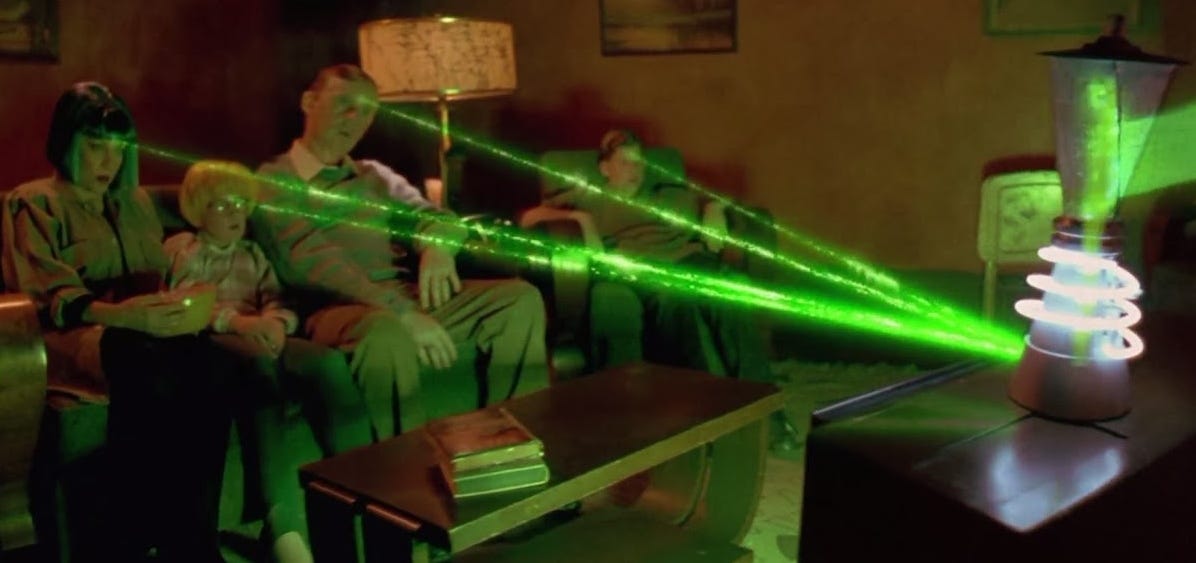
In 1995 Joel Schmacher released the third Batman movie titled “Batman Forever”. The movie itself received less then favorable ratings but was considered a major film success with a lot of consumer tied in merchandise aimed towards youth. The movie took an abrupt turn from the darker Tim Burton Batman films as a return to a mix of Burton-esque Gotham but with a much lighter tone in the style of Batman. Although Batman and Robin released later would most likely fall into full “campy” Batman reminiscent of the Adam West era, this film still retained some elemental style of the darker psyche of the archetype that Batman represents. There were two themes that I believe came from the movie.
The first theme is trauma. The movie explores the trauma of four main characters Batman, Robin, Riddler and Two-Face. Batman/Bruce Wayne’s split psyche is explored through the archetype of the “femme Fatale” character of Doctor Chase Meridian (played by the always stylish Nicole Kidman). Doctor Chase’s task is to explain the psychology of the villains while also attempting to understand the psychology of Batman. As she explores Batman’s psychology she falls for Batman’s alter ego Bruce Wayne. This aspect of the movie is probably the weakest and serves as an explainer for the characters motivations which as a trope fails as the motivations of characters should be revealed through exposition.
The second theme of Batman Forever and the one that we will be exploring in depth today is The Riddler’s “Box”. In the movie Edward Nygma is a mentally unwell but genius scientist (Mad Scientist Archetype) who attempts to pitch his device to Bruce Wayne, the owner of Wayne Enterprise whom he works for. Edward is obsessed with Bruce Wayne and proving himself. His research is in brainwaves to direct television signals directly into the human brain, admittedly in his own words “manipulating brainwaves”. The goal is to create a more real then real experience for the viewer. To make the television programming become real and provide a truly emotional experience to the viewer where reality becomes indistinguishable from fiction. Bruce Wayne worries The Box could be used for nefarious purposes so he shuts it down. Edward Nygma tests the device out on his boss and finds out that The Box creates disassociation within the viewer. The victim disassociates consciousness from reality. A vessel without a consciousness is an open vessel for manipulation, or in the case of the movie, the theft of memories and information. Of course knowledge gained that is not earned is damaging, so while the device allows the transfer of information to the owner of the box it also drives Edward mad in the process. This fully fractures the mind of Edward causing him to develop the alter ego of “The Riddler” who wants to gain all knowledge unto himself, unknowingly driving him further into madness. He devises the box and markets it. It is an instant success going into the homes of all the citizens of Gotham. In the movie an Advertisement for The Box goes, “Critics have claimed that the box turns Gothamits into zombies but Edward Nygma just shrugs that’s what they said when T.V was invented”. Edward Nygma, steps out of the shadow of his idolatry of Bruce Wayne and into his own “personality” status. In Gotham you are either one of the uppers or you are struggling and to distract from the grime of the reality of the city there is an obsession with celebrity status figures. Using funding from Two-Face he upgrades the box to develop fully interactive holographic fantasies. Reality becomes utterly severed from fantasy, a full simulacrum of pleasure and vice with none of the consequences.
The Box
“The Box” from Batman Forever is marketed as a revolutionary 3D TV device that beams signals directly into users’ brains, making an engaging and addictive experience. The function is to provide pleasure and create a fully immersive experience for the user. That function of course is a ruse. The real purpose of The Box is to gain access to the victims mind without their knowledge or consent. It serves two functions for The Riddler. The first is that it increases his overall IQ and mental cognition. The second is that it gains him access to “forbidden knowledge”. This mirrors gnosticism as a belief that secret divine knowledge will allow one to transcend the false reality of the world. The movie is simplistic in the rending of what is used with that knowledge, more akin to thievery of credit card information and social insurance numbers as well as secrets that can be used to manipulate the people who use the device.
This movie was released in 1995. At this time cell phones as they were known then were just moving past being big and bulky. They were starting to shrink and very early digital technology was being introduced. Global Systems for Mobile Communications and Time Division Multiple Access were laying the groundwork for future advancements. The most high tech phones at the time had primitive access to touchscreen technology. TV technology was entering into the early stages of Color Plasma Display to allow high definition however the Cathode-ray tube (CRT) was still the primary standard. TV’s were heavy, bulky and only offered Standard Definition. They were also dropping rapidly in price compared to televisions from the 1970’s and 1980’s. They were no longer luxury items. It is also key to note that VCR’s had dropped in price averaging around $100 and VCR tapes allowed people to record memories and purchase movies which allowed for multiple viewing and more time spent in the home. The television was a key staple and people watched it obsessively, they also believed what was on television as they rarely has alternative sources to compare the news.
The Box was eerily precedent as a predictor of the modern era of smartphones and algorithms that invade our lives on a daily basis and take our information from us, while feeding us content that continues to produce a fake more real then reality experience. The Box is mind manipulation on par with Social Media. In the movie people sit for hours mindlessly watching television absorbed, look around at the world around us currently and see how people sit for hours staring at the computer box in public, absorbed. The new and improved Box in the movie fully immerses the user in a virtual reality similar to how Social Media filters create a false reality that is projected for others to see. It is addictive as the desire for that reality becomes wanted for the participant and the observer which multiplies the delusion.
The Box can be compared to Brave New World’s concept of “feelies”. Feelies in Brave New World is a hyper reality simulation form of cinema. Reality and fantasy disappear and the user becomes pacified and compliant. The pleasures of Brave New World is the trap, no boot stamping on the human face forever is required like 1984 because the citizenry is trapped in a pleasure cycle. The Box plugs people in through their television to endless pleasure, it keeps them pacified. The Box interferes with the brainwaves to produce a perfectly immersive experience. In a city like Gotham that is hopeless and people live desolate lives, a box like this enables the lower and middle class to engage in activities they see on television from the “uppercrust” of the Gotham society. A place where figures like Carmen Falcone and Bruce Wayne occupy. The constant need to feel more involved, more informed and part of a larger conversation in our modern world drives us to seek a more Box like experience to have the feelies like in Brave New World. While the feelies are meant to keep people pacified. The Box is more equivalent to a smartphone. It moves past the pacification and into the realm of extracting information from user to gain power for the person who owns The Box. Brave New World came out in 1932 and although there was some conceptualization of what inducing the feelies looked like, it was largely mechanical. The devices used were industrial. The Box however focuses on disrupting brainwaves. In this way the technology of 1932 could not imagine how the feelies could be shrunk down and digitized directly into the brain in 1995. Yet even in 1995 the concept of carrying a Box around in ones pocket to induce feelies was also still in the realm of mostly science fiction. Yet despite the mechanical differences, the result is largely the same, sensation of pleasure to dull the chaos of reality.
Jean Baudrillard developed the concept of “hyperreality” explained in Simulacra and Simulation in 1981. Simulations, a copy without a reality, replaces reality. It is a post-modern concept. We see this when consumerism develops a product, such as french toast flavored goldfish. It has the taste of french toast but is not based on the actual product itself. It is the authentic and the made up collapsing on themselves. The Box in Batman Forever sends a signal to the brain that creates a reality more real then the one that the user experiences through the television itself. The mechanical aspect of the feelies from Brave New World is a limiting factor because there is still some grounding in reality, the mechanical aspect grounds the person because there is still some connection that can showcase that the hyper reality is being produced. The user may not care or even desire the hyper reality but the mechanical aspect still limits the user. With The Box, the walls of the hyper reality are less defined. Yes the user may ultimately understand (since the machine can still be shut off) that it is fake but the perimeters are less limited since the mystical manipulation aspect is more pronounced. The user does not understand the mechanism behind The Box, it simply works which makes the illusion more believable and less restricting.
Now this is not a new concept, Cyber Punk genres have been experimenting with the idea of virtual or augmented reality since Ghost in the Shell, the comic series Transmetropolitan and movies like The Matrix. Modern cellphones have not yet managed to remove the rails completely but advancements have been made. Google Glasses, Facebook’s Oculus, Playstation’s VR and Apple’s AR headsets are a few examples of Generation one technology that has attempted to broach this divide. The limiting factors not really explored in Batman Forever’s Box is the energy requirement to maintain the hyperreality. Real life generation one hyperreality is still limited by energy. Even the most advanced examples such as Apple’s AR headsets still require an external battery source connected to the headset. Despite the energy requirements these platforms are refining and getting better. They will continue to grow in popularity as people long to escape the messy reality that they inhabit on a day to day basis.
This is where The Box is a marketing and technical work of genius for the movie. In 1995 Batman Forever accurately predicted that the television screen was still not real enough and people would crave an even more authentic if not fake reality. Compare this desire to the modern AI revolution of simulacra content. The rise in artificial intelligence is wreaking havoc and moving even the simulacra into chaos through slop generated fake AI content that is becoming more difficult to distinguish from reality itself. What is the point of this AI generated content? Just like The Box, this content is meant to engage people in order to steal information. The Box steals information directly but AI generated content steals time and IP information that is sold to advertisers and agencies to sell products and predict behavior. The simulacra of our reality mirrors the The Box as one part of the equation, as behind the entertainment is a mechanism that is feeding itself as much information that it can legally acquire. The Box feeds it to a single evil villain archetype while in real life we feed our time and information to mega corporations who want us to constantly consume. The Box has a strong correlation to the conceptualization of hyperreality and was a predictor of the demand for an even more engaging form of simulacra content.
In Conclusion
There is a belief that movies are a form of predictive programming. They prime the masses for future technology, events and belief structures. This movie was marketed towards children, the tie in products were vast and that is what made it a better commercial success then Tim Burton’s Batman Returns. One watches this movie to see a story arc about people obsessively watching television yet seeking a more real experience. This became reality but it was not a box on top of the television per say but in the Smartphone. A device that is always listening, trying to keep you engaged with it and offering you a simulated experience with the world. The apps and operating systems on these devices meanwhile, are siphoning off your personal information to data brokers and Governments. They do this to manipulate you, build profiles on you and attempt to get you excited about the next product so you keep spending money. The Box exists and we are plugged into them all day long getting our simulation while our data is siphoned away. As more data is collected, like The Riddler, these corporations get more unhinged and AI gets more psychotic.

Russell is a Canadian Conservative and Catholic who wants you to spend less time with “The Box” and more time with your family. He believes in volunteerism as a key means to building community and social cohesion. He believes that citizens should be active members in the life of their Country and that rejecting that responsibility has resulted in physical and moral decay in Canada.
Good article! It is a good reminder of the potentially dystopian nature of technology addiction (I say as a sit here swyping on my phone).
It brings to mind a recent experience of mine with Grok. I've gotten way too reliant on it. Not just as a tool but also as a sounding board and as a partial substitute for personal interaction. I've been cognizant of AIs tendency to tell you what you want to hear and to be nice and pleasant to keep you interacting longer. So, I recently pushed back on it enough that it stopped trying to be "friendly" altogether. It was an eye-opening experience! Very cold, very alien and very much an experience that could make me understand how a person could wonder if (while there may not be a "god" in the machine) there might be a demon or other unfriendly spirit. There isn't anything in particular that I can point to that would likely explain it very well. It was more of an emotion or a feeling I got. Maybe it's just me seeing what it's like when the AI finally stops pretending to be human or have emotions? Maybe not even really that either because there was a darker feeling than merely machine.
I know none of this makes rational sense. A machine is a machine is a machine. However, I believe in the supernatural. I believe in evil "princes and powers" and I just wonder. 🤔
It all makes sense now😳