


For those who prefer, the author has recorded an audio version.
On the school grounds, on the evening of my eighth grade graduation, after everyone had gone home, I was to have my first ever cigarette. Fast forward thirty three years and tens of thousands of cigarettes later, I was wheezing constantly and experiencing frequent bouts of shortness of breath. I was in denial about it but I had symptoms similar to asthma. Not only did I think smoking was killing me, the prospect of never being able to move beyond it was making me miserable. I needed to change and didn’t know how.
The catalyst for this much needed change would come on my forty-sixth birthday. My wife surprised me with a homemade card that included a pasted-on, printed logo of a local horseback riding school including the phone number of an instructor willing to administer my first riding lesson.
A few weeks later I was on my way to the barn. I had never been on a horse before and had no significant exposure to them growing up. I did not know what to expect.
I knew something “happened” as the Romantics like to say, the first time I sat on a horse. It was a feeling of having been there before. It was familiar. What I would quickly learn was that riding horses and working closely with them on the ground would transform my life and help me breathe again.
Four months after my first lesson, I would be free from the mental obsession of cigarette addiction.
Vacuuming the House
I heard somewhere that depression concerns itself with the past whereas anxiety is a response to worry or apprehension of the future. Forgive the reckless generalities, I make no light of either affliction. I have experienced both and they are no joke. I wonder if horses suffer similar emotions. I like to ponder these sorts of things when doing household chores. I enjoy vacuuming in particular because I seem to experience revelations while doing so. I’m not sure why but it happens often enough. The latest was “the antidote to chaos is presence”.
To be clear, this was a response to a question that I was wrestling with: What is the best response when a horse “spooks” or is startled to the point of an explosive flight response? Horses are prey animals. They are also considered flight animals which means their default response to any perceived threat is to flee. They have stimulus driven brains, humans have goal-driven brains. Big difference. In her brilliant book, Horse Brain Human Brain: The Neuroscience of Horsemanship, Author and doctor Janet L. Jones eloquently states:
“When dangerous sensory signals were detected on the prairie, a horse couldn’t twiddle his hooves, deciding what to do. He had to run first and be alive to ask questions later. To manage that requirement, the equine brain evolved to connect perception directly to action.”
To illustrate this further, horses, unlike humans, do not have a prefrontal cortex. For example, if a horse visibly detects what it deems to be a threat (which can be anything!) the visual cortex immediately sends a signal to the motor cortex and the response is RUN! A few seconds of incalculable chaos usually follow. And just a heads up, this response doesn’t care if you are in the way or not. The horse will run you over. To say this is dangerous is an understatement. It can be very scary.
The human brain on the other hand, receives the visual signal, sends it to the prefrontal cortex to evaluate and come up with a game-plan. Only then does the information reach the motor cortex and the appropriate action is then taken.
The question quickly arises: how can we calm or “quiet” to the extent we ensure a safer, relaxed and more enjoyable experience when handling these very reactive animals?
Back in The Saddle
During my second riding lesson, I asked my instructor if I could volunteer at the facility. Within a few weeks I was at the barn two nights a week for three to four hours a night. I took any opportunity to learn anything new. I would collect horses from the yard using a rope halter and lead them into the tack stalls to prepare them for the evenings’ lessons. I would groom them, clean out their hooves, saddle and bridle them.
Most of the horses were very cooperative as they had received excellent training. Some were stubborn about certain aspects of the “tack”. Fewer still were not happy at all with at least one thing, commonly the tightening of the saddle cinch around their bellies. They are all a little bit different, personality-wise.
I have been knocked down, pushed around, stepped on, rammed, front-kicked, side-kicked, back-kicked, bitten and thrown from a horse named Moose. This last incident prevented me from riding for almost two months. During the time off from riding, I would still show up to spend time with the horses, I enjoyed observing their herd behaviour and social dynamics. I could easily identify their “pecking order” and dominance hierarchy structure. I felt myself becoming compelled to learn as much as I could about how a horse’s brain works, how they communicate, what specific behaviours mean and most of all, how horses learn.
How would one go about teaching a hose anything?
Exhale To Calm
Commencing horseback riding lessons as a forty-six year-old, pack-a-day smoker, put me at great disadvantage. My lungs were in terrible shape and I was out of breath very early into the lessons. It became increasingly obvious I was using muscles that I never knew I had because based on how my entire lower region felt for months, those muscles could not have existed before.
On top of the discomfort, I had another problem. My breathing difficulties brought with them an elevated heat rate and a stress response like fight or flight. When riding a horse, an elevated heart rate in a rider produces the same effect in the horse. They feel what we’re feeling.
Being such a novice, I was not yet aware of how sophisticated a horse’s senses are to appreciate just how much of an obstacle I had in my way, I was the opposite of calm and the horses would respond in ways like, bucking, bolting, balking, and ignoring commands altogether. The signals coming from me were erratic, uncertain and rushed. The result was those same behaviours from the horse. I would eventually come to find that breathing would prove to be a valuable tool in directly communicating things to a horse.
In his book Zen Mind Zen Horse, Harvard trained brain surgeon and renowned horse trainer Allan J. Hamilton describes the role breathing plays when working with horses.
“The foundation of training begins and ends with a breath. Deep breathing disciplines us to slow down. As predators, we like everything as fast as possible, preferably yesterday. Why? The faster the action, the quicker the reward. For prey animals, it’s just the opposite. The slower the action. The more it gets absorbed. Prey animals are patient. For them, rushing is inextricably linked with fear…breathing benefits the trainer by focusing their intention.”
On page 327 of Horse Brain Human Brain, Dr. Jones digs into it too, “Breathe slowly and steadily. Most people underestimate the effect of breathing on the equine mind. Dressage riders use exhalation to halt a horse, Hunter riders use rhythmic breathing to steady pace on course. Race riders use both inhalation and exhalation to quiet a horse. Anyone can use inhalation and exhalation to quiet a horse.”
As I was reading both of these books, I took what I was learning to the barn and experimented with the horses; breathing more slowly and steadily seemed to invite the horses in and drew them closer to me. Some would seem to be awaiting further instruction or command. From engaging their great curiosity to recognizing more obvious body language cues, conscious breathing becomes a key to unlocking a horse’s willingness to cooperate with humans. If practised enough, I have no doubt anyone could become a little bit more like Dr. Doolittle, with his uncanny ability to speak with animals. I know he’s not real but Francis of Assissi was, and he treated all animals as though they were our brothers and sisters. I kind of like that. I do that too.
Breathing is one way to directly communicate with a horse. Ironically it would be a horse’s breathing and their incredible sense of smell that would ultimately help me overcome my biggest hurdle.
When a horse wants to really “take you in” so to speak, they will place their nose directly in front of your face and slowly breathe in and out. Their nostrils are approximately eight inches of super-sniffing power! Now, I’ll admit, I don’t know if this is an established thing or not but I have had more than twenty different horses do this same thing. Whether it is a “thing” they do or not, this would become a great motivator and eventually help remove cigarettes from my life completely.
I couldn’t stand the thought of the horses taking in that second-hand, stinky, cigarette smoke smell. I did not want that to be a part of my essence anymore. So I quit.
Otancan
To be truly effective with horses, we need to check our egos at the door. Horses are mirrors. They are only adversarial in direct proportion to the extent we are with ourselves. That last line is probably enough to write a whole volume about but for our purposes here, we’ll carefully side-step it for now. Lets just say that horses demand confident leaders.
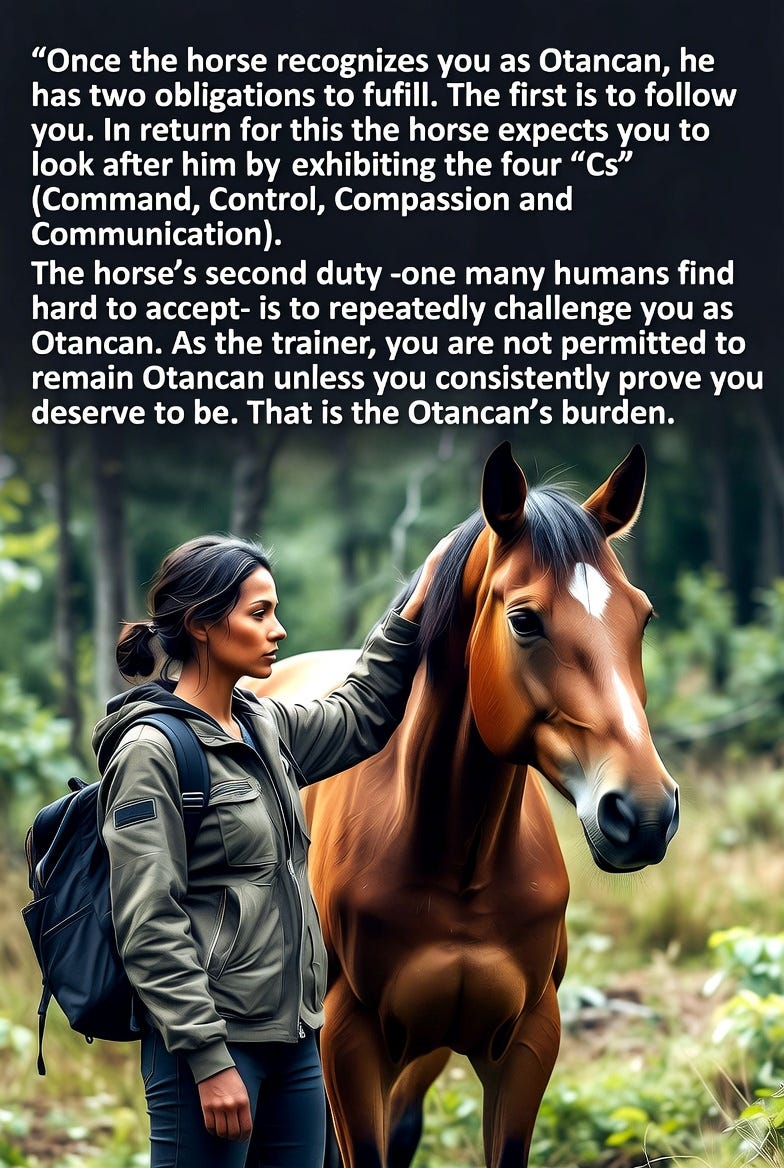
In “Zen Mind Zen Horse” Allan J. Hamilton shares the Lakota word “Otancan” which translates to: “leader, the greatest.” He goes on to explain, “Once the horse recognizes you as Otancan, he has two obligations to fulfill. The first is to follow you. In return for this the horse expects you to look after him by exhibiting the four “Cs” (Command, Control, Compassion and Communication). The horse’s second duty -one many humans find hard to accept- is to repeatedly challenge you as Otancan. As the trainer, you are not permitted to remain Otancan unless you consistently prove you deserve to be. That is the Otancan’s burden”.
It is my experience up to this point that the above seems to be accurate.
Chaos
In the Spring of 2024, after about a year and a half of riding, volunteering and learning basic training tips from one of many horse books I was reading at that time, and there were many, I was approached and asked if I would be interested in socializing four Yearlings. Two colts and two fillies. I had become previously acquainted with these four as they were present at the barn for a short time. They didn’t stay long as they went to a more suitable space given their age. I remember my disappointment when they left as I saw them as prime candidates for some of the basic training experiments I was trying to do. Their nervous, jumpy energy was something I somehow could relate to. This new opportunity seemed to me, directly in line with where I wanted to be going.
It would be a trial by fire, my favourite. The particulars were this: Four, one year old horses in three open, connected pastures ranging in size. I would be unsupervised, like swimming on a beach with no lifeguard. Lastly, I could come and go whenever I wanted (within reason). A very simple, informal agreement with little to no strings attached. Perfect.
At this point it’s probably prudent to do a Public Service Announcement on the dangers of working with horses, but more so, young horses. They are prone to sudden rises of stress levels followed by sheer panic and an immediate flight response. It can be violent. I should also note that none of the people involved in this endeavour had any expectation that I would be doing anything beyond brushing them and getting them accustomed to being gently handled by people. I would come to do much more than that. I knew the dangers but someone such as myself with so little experience, needed every reminder I could get.
For the next year, I would show up every other day and spend about two hours “cutting my teeth” attempting to teach all four horses some very basic groundwork exercises. When I got stuck on something, I would consult the growing pile of reference material I had been collecting as well as watching any YouTube video by a more experienced trainer that might provide some insight into whatever problem we were having.
In four months I had these wily, energetic, feisty young horses comfortable being caught in the pasture, haltered, led around without any trouble, and able to tie safely. I also taught them how to lift and hold their hooves up for cleaning, how to take the saddle pad, how to back-up and that “Whoa!” means stop and stand still. I would come to learn that horses have an incredible aptitude for learning.
Six months into working with the Yearlings, I was approached once again and asked if I would be interested in working with four Mares and their respective foals. Of course I would. The young ones were about three months old and still very attached to their Mommas. What I didn’t know was that out of the eight new horses, only two, one Mare and her colt, would let me close enough to touch them. These two and the other six “untouchables” would teach me things about horses and myself that I never could have imagined. My patience would be tested time and time again. This was an education so unconventional and unique, It felt like I had won the lottery. I now know I have.
The great consequence in quieting and winning the trust of nervous Mares is that the foals will then no longer intuit messages from them in the form of warnings or anxiety about the presence of people. The result is a calm foal that becomes more cooperative and easier to handle and train. If the mare doesn’t mind me being around, the foal won’t either thus allowing me access to their relentless curiosity.
Winning trust by slowly introducing new things; a halter and a lead rope, a hoof pick, a saddle pad on their back and then let consistent, gentle handling do the rest. Kindness goes a long way too.
Perhaps the most important thing the young horses teach us is situational awareness. Where should I best be situated when things “pop off” and chaos ensues? Because it is a most inevitable ‘when.’
It WILL happen.
One incident I like to recall is one where all eight horses and myself were standing around a circular-shaped steel cattle feeder with a big round bail of hay in it. They were chewing on hay and I was chewing gum. I like chewing gum around the horses as it mimics their “licking and chewing” behaviour that can indicate a calming down or a lowering of adrenaline chemicals.
When I chew gum I have a tendency to blow and then loudly pop the bubbles. Not a good idea around nervous horses. I blew and popped a bubble and they exploded. All eight were on the other side of a one acre field in a flash. The speed was crazy.
This was a great, early, real-time visual reminder of how quickly things can turn when in close quarters with animals their size. Not to mention the importance of ALWAYS remembering to respect prey animal characteristics that are “hard-wired”.
These fright and flight features are not so easily transformed into behaviours or temperament commonly referred to as calm or quiet.
How does one find quiet in chaos?
Begin with a breath.
Mike Lyons is a Carpenter who posts about humanity, horses and classic books. He is Correspondence Theory team member. You can follow him on X at https://x.com/MikeLyonsofHere